

Daily Dose Of Jazz…
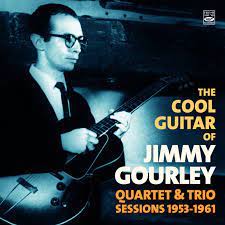
James Pasco Gourley, Jr. was born June 9, 1926 in St. Louis, Missouri. He met saxophonist Lee Konitz in Chicago when both were members of the same high school band and credits Konitz with encouraging him to become a serious musician.
His father started the Monarch Conservatory of Music in Hammond, Indiana, though he didn’t teach and bought his son his first guitar. Jimmy took his first guitar classes at the school and became interested in jazz while listening to the radio, enjoying in particular Nat King Cole. For his first professional experience as a performer, he dropped out of high school to play with a jazz band in Oklahoma City, Oklahoma.
From 1944 to 1946 Gourley served in the U.S. Navy. Upon his return to Chicago, Illinois he met guitarist Jimmy Raney and wanted to play like him. He worked in bars and clubs with Jackie Cain & Roy Kral, Anita O’Day, Sonny Stitt, and Gene Ammons. Through the G.I. Bill he received tuition for three years to any college in the world.
Beginning in 1951, Jimmy spent the rest of his life in France, working with Henri Renaud, Lou Bennett, Kenny Clarke, Richard Galliano, Stéphane Grappelli, Bobby Jaspar, Eddy Louiss, Martial Solal, and Barney Wilen. He played with American musicians who were passing through, including Bob Brookmeyer, Clifford Brown, Stan Getz, Gigi Gryce, Roy Haynes, Lee Konitz, Bud Powell, Zoot Sims, Lucky Thompson, and Lester Young.
Guitarist Jimmy Gourley, who spent the better part of his life in Paris, France transitioned at the age of 82 on December 7, 2008 in Villeneuve-Saint-Georges, France.

More Posts: bandleader,guitar,history,instrumental,jazz,music

Daily Dose Of Jazz…
Phillip Rista Nimmons was born on June 3, 1923 in Kamloops, British Columbia, Canada. He studied clarinet at the Juilliard School and composition at the Royal Conservatory of Music in Toronto, Canada. In 1953 Nimmons formed the ensemble Nimmons ‘N’ Nine, which later he led during his weekly radio show on CBC radio. This ensemble eventually grew to 16 musicians in 1965 and was active intil 1980.
He joined the University of Toronto in 1973 and as an educator, Nimmons has made substantial contributions to the study of jazz. In 1960, Along with Oscar Peterson, he founded the Advanced School of Contemporary Music in Toronto, Canada. He was involved in the development of the jazz performance program at the University of Toronto.
Nimmons received the first Juno Award given in the Juno Awards jazz category, for his album Atlantic Suite. His composition The Torch was commissioned for the 1988 Winter Olympics in Calgary, Alberta, Canada and was performed at the Olympics by a big band led by Rob McConnell.
In 1993, he was made an Officer of the Order of Canada, received the Order of Ontario, the Jazz Education Hall of Fame honor, the Lifetime Achievement Award by SOCAN and the Governor General’s Performing Arts Award, Canada’s highest honour in the performing arts, for his lifetime contribution to popular music.
Clarinetist, composer, bandleader, and educator Phil Nimmons, known for playing in the free jazz and mainstream styles, has recorded seventeen albums as a leader and at 98 is still involved in music.
More Posts: clarinet,composeer,educator,history,instrumental,jazz,music
Daily Dose Of Jazz…
Herbie Lovelle was born June 1, 1924 in Brooklyn, New York. His uncle was drummer Arthur Herbert. He began his career in the late 1940s with the trumpeter, singer and bandleader Hot Lips Page. By the 1950s he was playing with the saxophonist Hal Singer, Johnny Moore’s Three Blazers and the pianist Earl Hines.
Through working for both Lucky Thompson and Jimmy Rushing of Count Basie’s Orchestra, he became house drummer at the Savoy Ballroom in New York City for much of the 1950s. He toured with the tenor saxophonist Arnett Cobb and the pianist Teddy Wilson in 1954.
He contributed to the pianist Paul Curry’s album Paul Curry Presents the Friends of Fats in 1959. Then in the early years of television, Herbie performed with the King Guion Orchestra on the Jerry Lester Show and the Ed Sullivan Show. In 1966, he was the lead drummer for the Sammy Davis, Jr. TV show.
During the 1950s Lovelle began playing more R&B and worked as a studio musician recording behind Sam Taylor, Bob Dylan, Pearls Before Swine, Eric Andersen, David Blue, John Denver, Tom Rush, B. B. King, John Martyn, the Strangeloves, the McCoys, and the Monkees. He continued working as a studio musician well into the 1980s.
In 1976, he produced the first album by Stuff, which went platinum in Japan. He also played drums in the 1976 revival of Guys and Dolls. From the 1980s on he acted in film and television, on such shows as Law & Order and Third Watch. His film credits ~ A Man Called Adam, Bella, Mitchellville, The Rhythm of the Saints, Don’t Explain, The Curse of the Jade Scorpion, and Down to Earth among others.
His list of recordings as a studio musician extended across genres to some six dozen albums with jazz notables Candido Camero, Buck Clayton , Art Farmer, Herbie Mann, Sonny Stitt, Budd Johnson, Buddy Tate, Chico O’Farrill, Evie Sands, Johnny Hodges, Nat Adderley, Tony Bennett, Illinois Jacquet and numerous others. Drummer, producer and actor Herbie Lovelle transitioned on April 8, 2009 in New York City.

Daily Dose Of Jazz…
Armando Peraza was born May 30, 1924 in Lawton Batista, Havana, Cuba and was orphaned by age 7 and lived on the streets. By twelve he was supporting himself by selling vegetables, coaching boxing, playing semi-pro baseball, and becoming a loan shark. His music career began at seventeen when he heard at a baseball game that bandleader Alberto Ruiz was looking for a conga player and Ruiz’s brother was on the same baseball team as him. Despite the absence of experience in music, he practiced and won the audition.
He left Cuba for Mexico in 1948 to tend to his sick friend, conga drummer Mongo Santamaría. They arrived in New York City in 1949 and after playing in Machito’s big band, Peraza was invited by Charlie Parker to participate in a recording session that included Buddy Rich. He recorded with Slim Gaillard in New York Cuty in 1949 in a session that produced Bongo City and toured the U.S. with him band until they reached San Francisco, California. He spent time in Mexico recording with Perez Prado and did some soundtracks for the Mexican movie industry.
Returning to the U.S. he settled in San Francisco, worked with Dizzy Gillespie, toured extensively with Charles Mingus and Dexter Gordon, and played with Puerto Rican actor and musician Tony Martinez. Armando led an Afro-Cuban dance review at the Cable Car Village Club in San Francisco, attracting a clientele from Hollywood that included Errol Flynn, Marlon Brando, and Rita Hayworth.
By 1954, he was working with pianist Dave Brubeck, Peraza met Cal Tjader, and jazz critic Leonard Feather recommended Peraza to Fantasy Records to record an Afro-Cuban album with Tjader. The result was Ritmo Caliente, which combined Afro-Cuban rhythms with a jazz sensibility. Following this he met George Shearing through bassist Al McKibbon and he spent the next twelve years with the pianist, a collaboration that put Peraza at the forefront of Afro-Cuban music.
Armando emerged as a composer, writing and recording twenty-one songs for Shearing, such as Mambo in Chimes, Mambo in Miami, Ritmo Africano, Armando’s Hideaway, This is Africa, and Estampa Cubana. These recordings were during the mambo craze in the U.S. and the world. In 1959, he joined Mongo Santamaría for the Mongo album, then became a member of Cal Tjader’s band for six years, followed by a stint with drummer Shelly Manne.
He recorded one solo album, Wild Thing, was the first Afro-Cuban percussionist to add conga drums to a rock track, an in 1972, at the age of 47, Peraza joined the rock band Santana, influencing andtrmining for nearly twenty years and played to millions of people around the world, partnering with percussionists José Areas, Mingo Lewis, Raul Rekow, and Orestes Vilató. He wrote or co-wrote sixteen songs recorded by Santana.
Peraza retired from Santana in 1990 at the age of 66, played a Santiago de Chile concert with Santana in 1992, returned to Cuba after fifty year absence in 202, and recorded on the John Santos, 20th Anniversary in 2005, At 82 years of age, in 2006 he made a rare appearance with Santana for a three show performance at the Montreux Jazz Festival in Switzerland. In 2007, he received a Lifetime Achievement Award from the Voices of Latin Rock, who present the Armando Peraza Award for achievement in the San Francisco Bay Area every year.
On April 14, 2014 Latin jazz percussionist Armando Peraza who played congas, bongos, and timbales transitioned from complications of pneumonia. He was 89.

More Posts: bongo,conga,history,instrumental,jazz,music,timbales

Daily Dose Of Jazz…
David Kenneth Brooks, Jr. was born May 29, 1922 in Fayetteville, North Carolina, the older brother of Tina Brooks. His first professional gig was with the medicine show of Pepper McAllister.
He served in the Army during World War II where he played with James Moody. He moved to New York City after his discharge in 1944, where he played at Minton’s Playhouse and the Harlem Grill. He toured North Carolina in a band alongside Sonny Payne in 1947, then played with George Barkley at the Baby Grand in New York. He first recorded with Barkley around 1947 or 1948, then went on to play with Sonny Thompson from 1948 to 1957.
In 1958 he worked with Jimmy McCracklin and in 1961 with Phil Upchurch. While doing session work with pop musicians in the 1960s. From 1967 to 1973 he played at the Fantasy East in New York City with alto saxophonist Charles Williams and Don Pullen, recording three albums as a trio for Mainstream Records.
After a short run with Jimmy McGriff in 1974, Brooks became a member of Bill Doggett’s ensemble, where he remained for two decades from 1976 to 1996. He worked in the middle of the 1990s with Bross Townsend, Carrie Smith, and the Harlem Blues and Jazz Band, and toured France with Al Casey in 1999.
He recorded with Wynonie Harris, Phil Upchurch, Charles Williams, Bill Doggett, Bross Townsend, Michel Pastre, Joseph Carter, and Bobby Forrester. Tenor saxophonist David Kenneth Brooks, Jr., better known as Bubba Brooks or Bubber Brooks, transitioned on April 11, 2002.
More Posts: history,instrumental,jazz,music,saxophone