

Daily Dose Of Jazz…
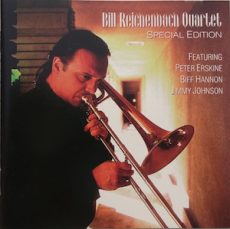
Bill Reichenbach was born William Frank Reichenbach Jr. on November 30, 1949 in Takoma Park, Maryland. He began playing in high school for bands in the Washington, D.C. area and also sat in with his father’s group, playing with Milt Jackson, Zoot Sims, and others.
He went to Rochester, New York to study at the Eastman School of Music with the legendary teacher Emory Remington and after graduating joined the Buddy Rich band. He would go on to work in the Toshiko Akiyoshi – Lew Tabackin Big Band in Los Angeles, California in the mid/late 1970s. After that move he became known for music for television and film.[2]
He played trombone on The Wiz and, with the Seawind Horns including Jerry Hey on Michael Jackson’s albums Off the Wall, Thriller, and HIStory. He was a composer for Cartoon All-Stars to the Rescue.
He recorded a solo album, Special Edition, where he is featured on bass trombone as well as tenor. Trombonist, euphoniumist, composer and session musician Bill Reichenbach, who has collaborated on eighty-six albums with artists from Al Jarreau and George Benson to Barbra Streisand, Patti Austin and Bette Midler to Christopher Cross and Selena, continues his career in television, films, cartoons, and commercials.

More Posts: bandleader,composer,euphonium,history,instrumental,jazz,music,trombone
Daily Dose Of Jazz…
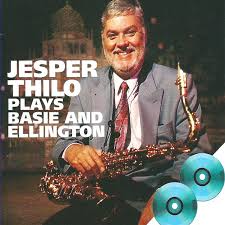
Jesper Thilo was born on November 28, 1941 in Copenhagen, Denmark to a pianist-actress mother and architect father. He started to play clarinet at age 11 and from 1955 to 1960 he played clarinet and trombone in various amateur Dixieland jazz bands with the occasional paid jobs as a musician. Early he knew that he wanted to become a professional jazz musician but to get an education he chose to study classical clarinet at the Royal Danish Academy of Music.
While at the Academy, Thilo joined Arnved Meyer’s orchestra from 1960 to 1964 and again from 1967 to 1974 and it was Meyer who convinced him to shift to saxophone. He would go on to play with Ben Webster, Benny Carter, Harry Edison, Roy Eldridge and Coleman Hawkins. During this part of his career his virile swing style was chiefly inspired by Webster and Hawkins and his own quintet which he put together in 1965 and co-lead with Torolf Mølgaard and Bjarne Rostvold.
From 1966 to 1989, he was a member of the DR Big Band under bandleaders Palle Mikkelborg and Thad Jones. He mainly played alto saxophone but occasionally also tenor saxophone, soprano saxophone, baritone saxophone, concert flute, clarinet or bass clarinet. Through the Eighties, Jesper played in Ernie Wilkins’ Almost Big Band. Other collaborators have included Wild Bill Davison and Niels Jørgen Steen.
By 1989, leaving the DR Big Band and Ernie Wilkins’s orchestra he led his own bands with Søren Kristiansen, Olivier Antunes, Hugo Rasmussen og Svend-Erik Nørregaard. He first recorded as a leader for Storyville Records in 1973 and in the 1980s on Storyville his sidemen at various times included Kenny Drew, Clark Terry and Harry “Sweets” Edison, and appeared on the Miles Davis album Aura.
Considered to be one of the top European straight-ahead jazz musicians of the post-1970 period, tenor saxophonist, alto saxophonist, clarinetist and flutist Jesper Thilo continues to perform and record.
More Posts: bandleader,clarinet,flute,history,instrumental,jazz,music,saxophone

Daily Dose Of Jazz…
Robert Conti was born November 21, 1945 in Philadelphia, Pennsylvania and was an autodidact, first performing locally at age fourteen and mentoring with Pat Martino. In 1966, after four years on the road touring North America, he settled in Jacksonville, Florida.
In 1970, he dropped out of the music business to work in the securities field. Six years later he picked up his guitar and by 1979, he signed with Discovery Records. Conti released Solo Guitar as his debut as a leader and his sophomore project Latin Love Affair. By 1982 he left music again for the business world but again in 1985 he released another album. The following year he headlined the Florida National Jazz Festival, with Jimmy McGriff and Nick Brignola as his sidemen.
In mid-1988 he was offered a position under filmmaker Dino De Laurentiis in Beverly Hills, California. After a lengthy recovery from a back injury in late 1988, he was offered a position as resident jazz guitarist at the Irvine Marriott, a job he held until 1998.
Since starting his website in 2000, he has released 30 educational DVDs on jazz guitar, including pro chord melody and improvisation using his No Modes No Scales approach to teaching jazz guitar. Guitarist and educator Robert Conti, who has his own line of solid spruce thinline archtop jazz guitars since 2009, continues to teach, and perform.
More Posts: bandleader,educator,guitar,history,instrumental,jazz,music

Requisites
Perdido ~ The JATP All-Stars | By Eddie Carter
This morning’s column features some of the best musicians in jazz. Jazz At The Philharmonic was a series of concerts organized by Norman Granz. From 1944 to 1949, this revolving ensemble of all-stars made one of the greatest impacts on the public since the heyday of Swing. Perdido (VSP-Verve VSP-16/VSPS-16) is a 1966 reissue highlighting two performances by The JATP All-Stars from September 27, 1947. The song debuted on Norman Granz’s Jazz At The Philharmonic, Volume Eight. The personnel is Howard McGhee on trumpet, Bill Harris on trombone, Illinois Jacquet, Flip Phillips on tenor sax, Hank Jones on piano, Ray Brown on bass, and Jo Jones on drums. My copy used in this report is the 1966 US Mono reissue.
Side One gets underway with Perdido, a jazz standard written by Juan Tizol in 1941. Ervin Drake and Hans Lengsfelder added lyrics three years later. In Spanish, Perdido means lost and the song refers to the street in New Orleans. The rhythm section introduces the tune, segueing into the ensemble’s mid-tempo melody. Flip opens the solos at a deceptively relaxed groove, before elevating to a joyous swing that captures the enthusiasm of the crowd. Howard adds drive and excitement to the second reading. Illinois energizes the third statement with an invigorating power supply. Next, Hank has a good deal to say, then Bill captivates the audience in the closing statement with a mix of poise and fire ahead of the ensemble’s finish.
Side Two opens with Mordido, a jaunty tune occupying the second side. The composer is listed as Norman Shrdlu but is Norman Granz. Everyone gets an opportunity to solo, and the song gets underway with the septet’s collective melody. Illinois is up first with jubilant shouts of joy in the opening statement. Howard takes over and romps through the second solo with great passion. Hank takes the reins next and cooks with conviction. Bill follows and has an exceptionally brisk conversation with the rhythm section. Ray takes his bass for a very spirited walk, then Flip provides a scintillating statement of concentrated heat. Jo fuels the finale with energetic brushwork leading to the closing chorus and appreciative applause from the crowd.
Val Valentin engineered the concert’s original recording, and the remastering was done by Dave Greene. The sound quality of this reissue is a little bright with no distortion during the highs, midrange, and low end. However, there’s a little noise during the first few moments of the opening track. Norman Granz was one of the most successful jazz promoters and produced Jazz At The Philharmonic concerts in the US, Canada, Europe, and Japan from 1944 to 1983. He also founded five record labels, Clef, Down Home, Norgran, Pablo, and Verve. The roster of musicians and vocalists he toured with is the definitive Who’s Who in Jazz. Granz also fought for equal rights for the black musicians who worked for him, paying them the same wage as white musicians, and providing the same lodging as well.
I chose Perdido for this week’s discussion to honor one of my favorite tenor saxophonists, Illinois Jacquet whose birthday was recently observed on October 31. This album also suspends in time one of the best jazz concerts by The JATP All-Stars during the forties with an enthusiastic audience at one of the greatest concert venues in the world, Carnegie Hall. While it may not be considered an essential record for your library, I hope I’ve piqued your curiosity enough to check out Perdido by The JATP All-Stars on your next vinyl shopping trip. It’s a great introduction to the Jazz At The Philharmonic concerts, and you’ll be rewarded with some of the best live jazz albums you’ll hear that still swing today!
~ Postscript – The date of the recording on my reissue of Perdido is listed as November 1947. However, when checking further in the booklet of my Japanese box set, Norman Granz’ Jazz At The Philharmonic – 1940s (1981), Perdido was recorded on September 27, 1947. Likewise, Mordido and Endido were also recorded that night. – Source: jazzdisco.org ~ Norman Granz’ Jazz At The Philharmonic, Volume Eight (Mercury Records 11000, 11001, 11002), Norman Granz’ Jazz At The Philharmonic – 1940s (Verve Records UMV 9070, 9071, 9072) – Source: Discogs.com ~ Perdido – Source: JazzStandards.com ~ Norman Granz – Wikipedia.org © 2022 by Edward Thomas Carter
More Posts: choice,classic,collectible,collector,history,instrumental,jazz,music,orchestra
Daily Dose Of Jazz…
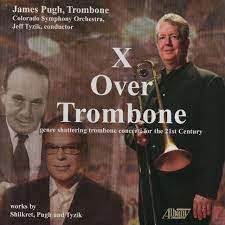
James Edward Pugh, born November 12, 1950 in Butler, Pennsylvania began playing the trombone around the age of ten. He attended the Eastman School of Music from 1968 to 1972, where he played in an ensemble under Chuck Mangione.
Pugh toured and recorded with the Woody Herman Band for four years from 1972 and briefly performed with Chick Corea in 1977. He then concentrated on studio session work for jazz and popular musicians. In 1984, he was co-leader for the album The Pugh–Taylor Project. He also composed for and played on the album X Over Trombone.
Trombonist and composer James Pugh continues to perform and record sessions for jazz, pop and Broadway soundtracks.
More Posts: bandleader,history,instrumental,jazz,music,trombone