


Daily Dose Of Jazz…
Alain Mion was born of French extraction on January 14, 1947 in Casablanca, Morocco but was raised in Paris, France.Influenced by Bobby Timmons, Ray Charles and Les McCann, his style varies between jazz, soul jazz and funky music. By the time he was 19 he formed his own trio and performed at the Blue Note. This subsequently led to him gigging at various festivals with Hank Mobley and Philly Joe Jones.
1974 Alain created the jazz funk group Cortex and recorded a dozen albums before embarking upon a career under his own name in 1982, recording to date eleven albums, such as Pheno-Men, Alain Mion in New York recorded with David Binney and Marc Johnson, and Some Soul Food recorded in Stockholm, Sweden with Patrik Boman and Ronnie Gardiner.
In 2008, he emerged with a new group, Alain Mion FunKey Combo with drums, bass and a saxophone section consisting of Italian and French musicians. He reinvented his new group Alain Mion & The New Cortex with the singer Adeline de Lépinay reprising the role originally performed by Mireille Dalbray on the Troupeau Bleu album.
In the United States, Alain Mion and Cortex’s songs have been sampled by several hip-hop artists including but not limited to Madlib, Fat Joe, DJ Day, MF DOOM, Wiz Khalifa, Curren$y, Mellowhype, Tyler The Creator, Rick Ross, and Lupe Fiasco.
Pianist, composer, arranger, and vocalist Alain Mion continues his exploration of the jazz idiom.
More Posts: arranger,bandleader,composer,history,instrumental,jazz,music,piano,vocal
Daily Dose Of Jazz…
Dannee Fullerton was born January 12, 1944 in Los Angeles, California and at the age of four, moved with his mother to Saudi Arabia, joining his father who worked for the Arabian American Oil Company. By 11, he was enrolled at the Institut Montana Zugerberg, an all boys international school in Switzerland. It was here that drums became a strong influence and his very first drum set was a pair of brushes and a set of bongo drums. Along with singing, Dannee played the guitar and the drums.
At 14, he started a band at the Institut and gave concerts 3 to 4 times a year, something that had never before been accomplished on that campus. By 15 Dannee attended a concert and on the bill was the Gerry Mulligan Quartet and the Benny Goodman Orchestra featuring Gene Krupa playing Sing,Sing,Sing. The effect upon hearing this music caused Fullerton to give away all his rock and roll albums and so he could seriously concentrate on jazz.
During these formative years, he taught himself and others to play Jazz and continued to hold jazz concerts at school. Creating the school’s first jazz club, convincing the Director to allow students to attend jazz concerts, he was able to see concerts by the Oscar Peterson Trio, Ella Fitzgerald, Duke Ellington, Count Basie, Louis Armstrong, J.J. Johnson, Stan Getz, The Modern Jazz Quartet, Ahmed Jamal, Cannonball Adderly, the John Coltrane Quartet and the Dave Brubeck Quartet… Dannee was now hooked on the jazz art form and was intent on learning it.
Graduating from high school, Fullerton attended Berklee College of Music and studied under Alan Dawson, Herb Pomeroy, John La Porta, and Jack Peterson. Later he studied privately with drummer Pete La Roca. He played sessions with Keith Jarrett, Mick Goodrick, Gene Perla, John Abercrombie, Sam Rivers, Sadao Watanabe, Byard Lancaster and other students at the time. He performed with the Keith Jarrett Trio for two years, in his Boston, Massachusetts trio.
Drafted into the US Army during the Vietnam era, he served in various Army bands over the next 24 years, serving in Europe, Korea, Okinawa and many locations within the United States. During his service Dannee performed with Maynard Ferguson, Herb Ellis, The Ink Spots, Bill Watrous, Bill Lohr, “Jazz Express” (Dannee’s own group) John Payne, Don Erdman, Kurt Black, Buddy Tate, Joe Newman, Mike Francis and Curt Warren to name a few.
Retiring from military service in 1989, he settled outside Tacoma, Washington. Drummer Dannee Fullerton, who never recorded professionally, continues to perform locally with Jack Percival, Sid Potter, Tim Eikholt, Tom Russell, Gary Black, Joe Bach, Roger Gard, Pete Lira, Bob McNamara, Ken Upton and Lance Buller, among others.
More Posts: bandleader,drums,history,instrumental,jazz,music
Daily Dose Of Jazz…
David Lee, Jr. born January 4, 1941 in New Orleans, Louisiana played professionally from his early teens. While serving in the U. S. Army, he was a member in several bands. In 1969, he co-founded the New Orleans Jazz Workshop.
In 1969 Dizzy Gillespie brought Lee into his band and soon after he was working with Roy Ayers in 1971 and Sonny Rollins for three years beginning in 1972. The Rollins recordings were hard swinging but included the plethora of tempos of the Seventies.
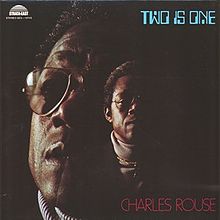
Forming a quartet but never recording as a leader, he continued to work as a sideman. On August 4, 2021, drummer and composer David Lee, who recorded Yoshiaki Masuo, Charlie Rouse, Lonnie Liston Smith and Richard Wyands among others, transitioned at 80 years of age.
More Posts: bandleader,composer,drums,history,instrumental,jazz,music
Daily Dose Of Jazz…
John Laird Abercrombie was born in Port Chester, New York on December 16, 1944. Growing up in the 1950s in Greenwich, Connecticut he was attracted to the rock and roll of Chuck Berry, Elvis Presley, Fats Domino, and Bill Haley and the Comets. He also liked the sound of jazz guitarist Mickey Baker of the vocal duo Mickey and Silvia. He had two friends who were musicians with a large jazz collection and they listened to albums by Dave Brubeck and Miles Davis.
The first jazz guitar album he heard was by Barney Kessel, and taking guitar lessons at the age of ten, asked his teacher to show him what Kessel was playing. After high school, John went to Berklee College of Music and while there he was drawn to the music of Jim Hall, Sonny Rollins, and Wes Montgomery. He cites George Benson and Pat Martino as inspirations. His playing around Boston, Massachusetts led to his meeting the Brecker Brothers and organist Johnny Hammond Smith, who invited him to go on tour.
From Berklee in 1967 to North Texas State University to a move to New York City in 1969 where he became a popular session musician. He joined the Brecker Brothers in the jazz-rock fusion band Dreams, followed by recordings with Gato Barbieri, Barry Miles, and Gil Evans. He continued to play fusion in Billy Cobham’s band until an invitation from drummer Jack DeJohnette led to the fulfillment of Abercrombie’s desire to play in a jazz-oriented ensemble.
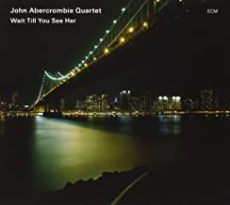
Around the same time, record producer Manfred Eicher, founder and president of ECM Records, invited him to record an album. He recorded his first solo album, Timeless, with DeJohnette and keyboardist Jan Hammer. who had been his roommate in the 1960s. In 1975 he formed the band Gateway with DeJohnette and bassist Dave Holland.
Between 1984 and 1990, Abercrombie experimented with a guitar synthesizer. Free jaz became a mainstay for him in the 1990s and 2000s as he formed many new associations. Drummer Adam Nussbaum, and Hammond organist Jeff Palmer became his trio and made a free-jazz album, then replaced Palmer with organist Dan Wall and released three albums between 1992 and 1997. Adding trumpeter Kenny Wheeler, violinist Mark Feldman and saxophonist Joe Lovano to the trio he recorded Open Land in 1999.).
He continued to tour and record until the end of his life. who recorded 59 as a leader, 4 with Gateway, 6 with Andy LaVerne and 93 as a sideman for the who’s who in jazz. Guitarist John Abercrombie, whose work explored jazz fusion, free jazz, and avant-garde jazz, passed away of heart failure in Cortlandt Manor, New York, at the age of 72 on August 22, 2017.

More Posts: bandleader,composer,guitar,history,instrumental,jazz,music

Daily Dose Of Jazz…
Anthony Tillmon Williams was born of African, Portuguese, and Chinese descent on December 12, 1945 in Chicago, Illinois and grew up in Boston, Massachusetts. He studied with drummer Alan Dawson at an early age, and began playing professionally at the age of 13 with saxophonist Sam Rivers. Saxophonist Jackie McLean hired Williams when he was 16.
At 17 Williams gained attention when he joined Miles Davis in what was later dubbed Davis’s Second Great Quintet. A vital element of the group, his playing helped redefine the role of the jazz rhythm section through the use of polyrhythms and metric modulation.
He recorded his first two albums as leader at nineteen for the Blue Note label, Life Time in 1964) and Spring in 1965.. He also recorded as a sideman for the label including, in 1964, Out to Lunch! with Eric Dolphy and Point of Departure with Andrew Hill.
By 1969, he had formed his trio, the Tony Williams Lifetime, with John McLaughlin on guitar and Larry Young on organ. Lifetime was a pioneering band of the fusion movement. Disbanding the group, in 1975 he put together a band he called The New Tony Williams Lifetime, featuring bassist Tony Newton, pianist Alan Pasqua, and English guitarist Allan Holdsworth, which recorded two albums for Columbia Records..
In mid-1976, Tony reunited with Herbie Hancock, Ron Carter, and Wayne Shorter. Freddie Hubbard replaced Miles Davis who was in the midst of a six-year hiatus. The resulting record was later released as V.S.O.P. and the group toured for several years and produced a series of live albums released under the name V.S.O.P. or V.S.O.P.: The Quintet.
1979 saw Williams, McLaughlin and bassist Jaco Pastorius united for a one-time performance at the Havana Jazz Festival. This trio came to be known as the Trio of Doom. In 1985, returning to Blue Note he released six albums through 1993, playing his compositions almost exclusively ubtil he left Blue Note for the final time.
He lived and taught in the San Francisco Bay Area, was one of the pioneers of jazz fusion, and was inducted into the Modern Drummer Hall of Fame in 1986. On February 20, 1997 he checked into Seton Medical Center in Daly City, California, suffering from stomach pain. Three days later, while recuperating from gallbladder surgery, drummer Tony Williams passed away of a heart attack at 51 on February 23, 1997.
More Posts: bandleader,drums,history,instrumental,jazz,music