

The Quarantined Jazz Voyager
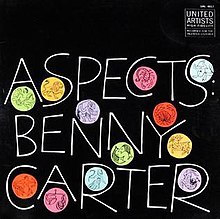
Reveling in my space during this time of temporary seclusion, I am with my music and having lit a few candles, a couple of sticks of incense burning I prepare myself for the talented alto saxophonist and composer Benny Carter. As I drop the needle on his self-produced Aspects album, I kick back, stretch out and enjoy. Recorded in late summer of 1958 in Los Angeles, California it was released the following year on United Artists.
Track List | 46:42Except where noted, all compositions by Benny Carter
- June in January (Ralph Rainger, Leo Robin) ~ 3:12
- February Fiesta (Hal Schaefer) ~ 1:54
- March Wind ~ 3:16
- I’ll Remember April (Gene de Paul, Patricia Johnston, Don Raye) ~ 3:21
- One Morning in May (Hoagy Carmichael, Mitchell Parish) ~ 2:49
- June Is Bustin’ Out All Over (Richard Rodgers, Oscar Hammerstein II) – 2:59
- Sleigh Ride in July (Jimmy Van Heusen, Johnny Burke) ~ 2:50
- August Moon ~ 3:39
- September Song (Kurt Weill, Maxwell Anderson) ~ 2:39
- Something for October ~ 2:52
- Swingin’ in November ~ 3:02
- Roses in December (Ben Oakland, Herb Magidson, George Jessel) ~ 2:36
- Benny Carter – alto saxophone, arranger
- Pete Candoli, Conrad Gozzo, Uan Rasey, Shorty Sherock – trumpet
- Herbie Harper, Tommy Pederson, George Roberts – trombone
- Buddy Collette, Chuck Gentry, Justin Gordon, Bill Green – saxophone
- Arnold Ross – piano
- Larry Bunker – vibraphone
- Bobby Gibbons – guitar
- Joe Comfort – bass
- Shelly Manne – drums
- Joe Gordon, Al Porcino, Ray Triscari, Stu Williamson – trumpet
- Russ Brown, Tommy Pederson, Frank Rosolino – trombone
- Buddy Collette, Jewell Grant, Bill Green, Plas Johnson – saxophone
- Gerald Wiggins – piano
- Barney Kessel – guitar
- Joe Comfort – bass
- Shelly Manne – drums

More Posts: adventure,album,club,genius,jazz,museum,music,preserving,restaurant,saxophone,travel
The Quarantined Jazz Voyager
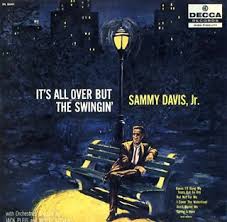
It’s All Over But The Swingin’ is a studio album by Sammy Davis, Jr. that was recorded on July1~2 and 9~10, 1957 and released the same year on the Decca Record label. The music was arranged by Jack Pleis and Morty Stevens and the session was produced by Lee Gillette.
Track List | 43:13- Guess I’ll Hang My Tears Out To Dry (Sammy Cahn, Jule Styne) ~ 4:43
- But Not for Me (George Gershwin, Ira Gershwin) ~ 3:24
- Where’s That Rainbow? (Lorenz Hart, Richard Rodgers) ~ 3:27
- I Cover the Waterfront (Johnny Green, Edward Heyman) ~ 3:19
- Don’t Blame Me (Dorothy Fields, Jimmy McHugh) ~ 2:52
- Better Luck Next Time (Irving Berlin) ~ 2:43
- Can’t Help Lovin’ Dat Gal (Oscar Hammerstein II, Jerome Kern) ~ 4:53
- It Never Entered My Mind (Hart, Rodgers) ~ 4:05
- Someone to Watch over Me (G. Gershwin, I. Gershwin) ~ 3:23
- I’ve Grown Accustomed to Her Face (Alan Jay Lerner, Frederick Loewe) ~ 2:47
- Spring Is Here” (Hart, Rodgers) ~ 4:03
- I Can’t Get Started” (Vernon Duke, I. Gershwin) ~ 3:29
- Sammy Davis, Jr. – vocal
- Dan Lube, M. Sosson – violin
- Al Dinkin, Paul Robyn – viola
- Eleanor Slatkin – cello
- Harry Klee – flute
- Harry Edison, Conrad Gozzo, Virgil Evans, Mannie Klein – trumpet
- Milt Bernhart, Frank Howard, George Roberts – trombone
- Harry Klein, Ronnie Lang – alto saxophone
- Babe Russin, Don Raffell – tenor saxophone
- Bob Lawson – baritone saxophone
- Roger Renner – piano
- Tony Rizzi, Bob Bain – guitar
- Mort Cobb, Joe Comfort – double bass
- Irving Cottler, Alvin Stoller – drums
More Posts: adventure,album,club,genius,jazz,museum,music,preserving,restaurant,travel,vocal
Requisites
For Those In Love ~ Dinah Washington | By Eddie Carter
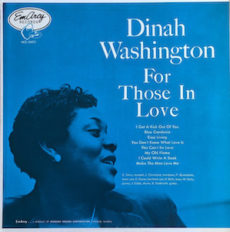
To the singer of jazz ballads, standards, or contemporary hits, a song is comprised of three essential parts, melody, harmony, and rhythm. When all three elements are mixed, and enhanced by great arrangements and musicians, the result is an enriching music experience. This morning’s choice from the library is by Dinah Washington, a vocalist who sang the blues, jazz, pop, and R&B proficiently. The album is For Those In Love (EmArcy MG 36011), recorded and released in 1955. She’s joined on this date by Clark Terry on trumpet, Jimmy Cleveland on trombone, Paul Quinichette on tenor sax, Cecil Payne on baritone sax, Wynton Kelly on piano, Barry Galbraith on guitar, Keter Betts on bass, and Jimmy Cobb on drums. The arrangements are by Quincy Jones and my copy used in this report is the second 1955 US Mono release featuring the silver Mercury Records oval at the noon position of the label with EmArcy Jazz appearing in the bottom of the oval.
The opener is I Get a Kick Out of You, written by Cole Porter for the 1934 Broadway musical, Anything Goes, and the octet gets right to work on this swinger. Dinah has the spotlight first and gives a splendidly entertaining improvisation. Jimmy follows, having a ball on a spirited statement, then Kelly displays impeccable chops on a relaxed reading. Clark comes in for some savory swinging with a mute on the closing solo, and Dinah handles the finale with great effectiveness leading the group into a slow fade. Blue Gardenia by Lester Lee and Bob Russell was composed for the 1953 crime drama, The Blue Gardenia. It became a signature song for Dinah and the octet offers a supporting role behind her delicately subtle narrative. Quinichette gives a brief statement of tenderness, then Galbraith offers a solo of soft tranquility. Payne has a moment in the spotlight adding a dreamlike softness to the closing solo. Dinah wraps up the song with emotional sensitivity on the climax.
Easy Living by Ralph Rainger and Leo Robin was the main theme of the 1937 comedy of the same name. The group provides a perfect complement to Dinah’s luxurious vocals on the opening chorus, and the solo order is Paul, Clark, and Jimmy. The first two readings are like delicate porcelain figurines, perfectly proportioned and translucent. The pace picks up slightly for the trombonist who plays the next interpretation with sensual beauty. Ms. Washington is especially attractive on the reprise with a velvety, smooth timbre in her voice that’s gorgeous. You Don’t Know What Love Is by Gene de Paul and Don Raye is a perfect song for film-noir. The haunting lyrics describe the hurt and sadness at the end of a love affair. It opens with a solemn introduction by Dinah and Galbraith. She captures the subtle pathos of the song with the octet’s soft supplement. Cleveland provides the song’s only solo with a graceful and elegant interpretation before Dinah returns to the melancholy mood of the beginning.
This Can’t Be Love by Richard Rodgers and Lorenz Hart was written in 1938 and featured in the Broadway musical, The Boys From Syracuse. The mood is jubilant, and Dinah rises to the occasion with a vivacious vocal treatment. Clark’s muted trumpet sets a lively mood on the first solo. Cecil is up next with an energetic performance of his own. Jimmy mines a vein of unsuspected riches on the third statement, then Paul delivers a delightful interpretation. Kelly cooks up a mesmerizing musical brew before Dinah sings the closing chorus. My Old Flame by Arthur Johnston and Sam Coslow made its debut in the 1934 film, Belle of The Nineties. Dinah begins this tune as a duet with Galbraith preceding the rhythm section’s slow-tempo theme. She’s the dominant presence here and presides with authority, as she recounts her lost love some time ago in a reflective flashback. The horns make their presence known for the closing chorus with Dinah giving it the recognition it deserves.
The 1940 show tune by Rodgers and Hart, I Could Write A Book gets taken for a mid~tempo spin by Ms. Washington and the ensemble. The octet starts the song in unison for the introduction, then Dinah treats the listener to an effervescent vocal performance on the melody. Paul starts with a passionately playful lead solo. Terry adds some fire on the muted trumpet, then Cleveland ends the solos on an upbeat note. The album’s finale, Make The Man Love Me is by Arthur Schwartz and Dorothy Fields. Quinichette opens with a seductive introduction, then Dinah makes a passionate romantic plea with the lyrics. Paul takes the lead with a remarkably graceful solo, then Terry turns in a beguilingly beautiful statement. Kelly approaches the next performance with affective empathy and Cleveland soothes the soul on the closer. Dinah sings two verses of the Duke Ellington–Paul Francis Webster classic, I Got It Bad (and That Ain’t Good) before returning to the original lyrics for the coda.
It’s a solid summation to an album sparkling with marvelous music, exciting, evocative solos, excellent arrangements, and the extraordinary vocals by Dinah Washington that are exceptionally presented. She brought the lyrics she sang to life in each song. The Queen of The Blues, a title she gave herself, recorded a total of thirty-three LP’s for EmArcy, Mercury, and Roulette during her short recording career that began in 1952 and lasted only eleven years. Though her greatest hit, What a Difference a Day Makes came four years later in 1959, For Those In Love would become one of the strongest albums of her career. Dinah passed away from a drug overdose on February 14, 1963, at the age of thirty-nine. This is a gorgeous recording with a splendid soundstage that’ll take your breath away each time you listen. I found For Those In Love to be thoroughly enjoyable and recommend it as a wonderful starting point for any fan interested in exploring the music of Dinah Washington. After one audition, I’m sure you will too! ~ What a Difference a Day Makes (Mercury MG 20479/SR-60158) – Source: Discogs.com
~ I Get a Kick Out of You, Easy Living, My Old Flame, I Could Write a Book, I Got It Bad (and That Ain’t Good) – Source: JazzStandards.com ~ Blue Gardenia, Dinah Washington, Make The Man Love Me – Source: Wikipedia.org © 2021 by Edward Thomas

More Posts: choice,classic,collectible,collector,history,instrumental,jazz,music,vocal

Daily Dose Of Jazz…
Shinobu Ito was born in Oiso, Kanagawa, Japan on January 28, 1951. While a young boy, his interest was in American pop songs, so his father bought him a guitar and gave him lessons. Devoting great efforts to his study of the guitar, in junior high school he organized his own pop music group and performed at various musical events. He became interested in jazz guitar during his high school days when he listened to Wes Montgomery. While attending Tokai University, he studied guitar with Ikuo Shiosaki, and became a member of the university’s Jazz Workshop.
He began his professional career at this time, performing at clubs and on recordings. In 1975, during a 6-month stay in Los Angeles, California he met Toshiko Akiyoshi, who introduced him to many musicians and strongly suggested to him that he go to New York to learn and play jazz on his next visit to the States.
When he returned to Japan in 1975, Shinobu joined vocalist Yoshiko Kimura’s group, and also resumed activities with top Japanese musicians such as Kohsuke Mine, Seiichi Nakamura, Shigeharu Mukai, Hidefumi Toki and Takao Uematsu. He also performed with Tete Montliu, Bill Reichenbach, Ronnie Foster, Stanley Banks in this era.
Back in New York City again in 1977 he became a member of a 10-piece band directed by Reggie Workman, joined Teruo Nakamura & his Rising Sun Band and Shinobu appeared on pianist Tsuyoshi Yamamoto’s album in 1981. Once settled he performed and recorded with Joe Jones Jr., Sadik Hakim, John Orr, Tommy Turrentine, Bob Mintzer, Rickey Ford and Kenny Kirkland, Valery Ponomarev, Lonnie Plaxico, Eddie Henderson, Lonnie Smith, Jesse Davis, Kenny Davis and Jeff Williams, Mike Formanek, Vincent Herring and Judy Niemack among others.
Shinobu released his first CD in 1991 with Tom Harrell, Danny Gottlieb, Gary King, Mark Soskin and Dick Oates. While Shinobu is known as a jazz guitarist who plays with a pick, he also plays only with his fingers, and his improvisations effectively fuse classical guitar and jazz.
As an educator he has worked as an instructor in the Jazz Division of the Senzoku College of Music in Tokyo, Japan. Returning to New York City in 2009 guitarist Shinobu Ito resumed performing and recording and continues to explore new directions.

More Posts: bandleader,history,instrumental,jazz,music,saxophone
Daily Dose Of Jazz…
Igor Grigoriev was born on January 24, 1955 in Moscow, Russia and taught himself to play the guitar as a young child, and later obtained his master’s degree from a music institution in Russia. As a young boy in the late sixties, he was interested in the latest music of the time, rock and started his career, gaining fame by playing and touring around the world.
Becoming a band leader of the trio, Roof, with trumpeter Andrew Solovyov, and percussionist Michael Zhukov they recorded on Melodia Records and Leo Records. His group, Asphalt also gained tremendous popularity despite its short life span.
As he developed musically, Grigoriev became interested in Charlie Parker’s work, but in later years the influence of classical composers became evident in his music. Permanently migrating to the United States in 1989 he continued his career, as a classical and jazz musician, but later he became more and more interested in Avant-garde music.
Better known for his 1990s work, he rapidly assimilated the American avant-garde and forged his own, instantly identifiable style. His music of the 1970s and 1980s saw transition from rock to classical to jazz and to avant-garde music. Igor developed methods of simultaneously improvising bass lines, harmony and melodic lines. In his later years, his playing became less predictable and formulaic.
He has recorded a number of solo albums, as well as recording or performing with Stan Getz, Red Callender, Larry Gales, Milcho Leviev, Ira Schulman, Rod Oakes, and many others. Igor and Rod founded OGOGO in 1996, which is one of the most important organizations to perform improvised music. His central focus was free improvisation, though he occasionally appeared in more conventional jazz and classical contexts, such as big band, various ensembles, and string orchestra.
He composed and arranged for a wide range of music genres, did orchestra work for a Russian circus, and arranged music for theatrical plays. As an educator he taught guitar, music history, jazz history, ensembles, and improvisation at Los Angeles Harbor College and Cerritos College in Los Angeles, California. Guitarist, composer, arranger, band leader and educator Igor Grigoriev passed away on September 25, 2010.
More Posts: arranger,composer,guitar,history,instrumental,jazz,music