

Requisites
Sassy Swings The Tivoli ~ Sarah Vaughan | By Eddie Carter
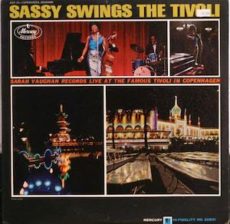
On the stage stands a beautiful woman who’s about to give a memorable performance before a capacity crowd in The Tivoli Theatre. The concert will be praised by the Danish press as one of the highlights of her career. Behind her sit three elegantly dressed gentlemen who’ll match her improvisational techniques, incredible range, and sophisticated style with their musical artistry. Together, they are a perfectly melded ensemble who are up to the task of enchanting the audience. Her name is Sarah Vaughan, and the gentlemen are Kirk Stuart on piano, Charles Williams on bass, and George Hughes on drums who collectively make up The Kirk Stuart Trio. This morning’s choice from the library is Sassy Swings The Tivoli (Mercury Records MG-20831/SR-60831). Quincy Jones was the musical director during the group’s four-day engagement at the Copenhagen hall. He supervised each recording and worked with Sarah on the song selections. My copy used in this report is the 1963 Mono deep groove album.
Side One starts with Won’t You Come Home Bill Bailey? It was written by Hughie Cannon and originally titled Bill Bailey, Won’t You Please Come Home? Cannon wrote the song after his friend Willard “Bill” Bailey discussed his marriage to his wife Sarah during an evening out together. Sassy serves up two exhilarating vocals that swing on the opening and closing melodies. Kirk comes in next for an energetic interpretation illustrating the trio’s remarkable interplay. The quartet slows the pace to a ballad tempo for Misty by Erroll Garner who wrote it with Johnny Burke adding the lyrics a year later. Sarah opens with a seductively stunning showpiece that spills out her emotions with sincere feeling. Stuart shares the spotlight adding a humorous note when he takes over on the bridge with a light touch during his vocal statement. Sarah, Kirk, Charles, and George have a little fun on the finale and these musical pranksters will bring a smile to your face and may even make you laugh a little by the song’s end.
Sassy and the trio offer an uptempo version of the Cole Porter classic, What Is This Thing Called Love? It was first heard in the musical, Wake Up and Dream (1929). Here she makes the lyrics come alive with a jubilant performance including a short, scintillating scat that’s mesmerizing. Amidst a thunderous ovation from the audience, Stuart begins a brief solo introduction developing into an elegantly beautiful rendition of Lover Man by Jimmy Davis, Roger Ramirez, and Jimmy Sherman. The dreamlike softness that Sarah brings to this standard is incredibly tender, soft, and delicately supplemented by the trio’s soothing support. Sometimes I’m Happy by Vincent Youmans and Irving Caesar is a perfect song for jazz vocal improvisation. Sassy and the trio grandly illustrate this at a rapidly brisk tempo. The quartet invites the audience to sit back and enjoy an uptempo free-wheeling scat performance of aggressive rhythmic heat with an agile ending.
Side Two starts with I Feel Pretty by Leonard Bernstein and Stephen Sondheim. This song premiered in the Broadway musical, West Side Story (1957) and was later reprised in the 1961 film. The melody receives a delightfully spring-like interpretation by Sassy who sings the first chorus at midtempo, then picks up the pace for the second verse with a rocking groove and the rhythm section providing the sprightly support behind her. She returns to the original tempo taking the trio through the reprise into a sudden stop followed by the audience’s ovation. Up next is the jazz standard Tenderly by Walter Gross and Jack Lawrence. This ageless classic is presented at a slow tempo with Sassy displaying a deep and strong romantic affection for the lyrics through her voluptuously gorgeous vocals. She even interjects her sense of humor on the word “breeze”. Her three bandmates return the favor by matching the simplicity and exquisite softness with an intimate finesse preceding a lush climax.
Sassy’s Blues is a midtempo original by Sarah and Quincy Jones that the quartet has some fun with beginning with a cheerful introduction that’ll have the listener tapping their feet along to the contagious beat. She takes over for the opening chorus and song’s only statement utilizing her skills to maximum effect with a series of scat verses including maintaining a single note for twenty seconds. She ultimately achieves an easy-going, happy sound on both that’s performed impressively before the ensemble wraps it up. Polka Dots and Moonbeams by Jimmy Van Heusen and Johnny Burke is one of jazz’s most recorded standards. Sassy first recorded this tune on her album Swingin’ Easy (1957). The quartet begins at a very slow tempo, but her delivery is strikingly beautiful with each verse a remarkable commentary of warmth, intimacy, and elegance sustained by the delicate understructure of the rhythm section’s foundation.
The quartet closes with a speedy version of I Cried For You by Gus Arnheim, Abe Lyman, and Arthur Freed. This standard has been a favorite for jazz vocalists for years and is perfect for Sarah to sing one final outstanding number. Sassy lets loose every bit of her energy with a rendition I’m sure brought down the house judging by the audience’s reaction at the song’s finale. The Danish recording engineer and producer, Birger Svan was behind the dials with Quincy supervising the recording of each show. The sound quality of my copy is excellent revealing a smooth soundstage with sparkling highs, crisp midrange, and deep, tight bass. Sassy Swings The Tivoli is a marvelous live album showing Sarah in her prime with The Kirk Stuart Trio backing her beautifully. If you’re a fan of jazz vocals, I happily submit for your consideration, Sassy Swings The Tivoli by Sarah Vaughan. It’s a classic that’ll always be in style, and a must have for your library!
~ Birger Svan, Swingin’ Easy (EmArcy Jazz–Mercury MG-36109) – Source: Discogs.com ~ I Cried For You, Lover Man, Misty, Polka Dots, and Moonbeams, Sometimes I’m Happy, Tenderly, What Is This Thing Called Love? – Source: JazzStandards.com ~ I Feel Pretty, Won’t You Come Home Bill Bailey? – Source: Wikipedia.org © 2021 by Edward Thomas Carter

More Posts: choice,classic,collectible,collector,history,instrumental,jazz,music
Requisites
My Funny Valentine ~ Miles Davis In Concert | By Eddie Carter
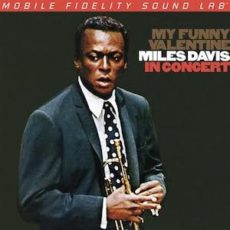
Miles Davis opens this morning’s discussion with a concert promoting a worthy cause. On February 12, 1964, his quintet of George Coleman on tenor sax, Herbie Hancock on piano, Ron Carter on bass, and Tony Williams on drums played a benefit performance for the registration of black voters at Lincoln Center’s Philharmonic Hall. The concert was sponsored by the NAACP Defense Fund, the Congress for Racial Equality, and the Student Nonviolent Coordinating Committee, resulting in two albums, ‘Four’ & More (1966) and My Funny Valentine (Columbia CL 2306/CS 9106), released in 1965. Their performance broke several records for a benefit concert with ticket prices reaching $25 and $50, resulting in Standing Room Only. It also emphasized Miles’ solidarity with these organizations and the people fighting racism in the south. My copy used in this report is the 2016 Mobile Fidelity Sound Lab Stereo audiophile reissue (MFSL 1-431).
My Funny Valentine by Richard Rodgers and Lorenz Hart opens Side One with a gentle introduction by Herbie. Davis states a delicate melody and paints an unforgettable haunting portrait on the lead solo. Miles later attributed his sound during their performance to reflecting his deeply personal reaction to President Kennedy’s death the previous November. George gives a nostalgic, reflective reading next. Herbie turns in an alluringly gentle statement. Ron and Tony provide an exquisite foundation into Miles’ profoundly moving ending. The quintet moves to mid-tempo for All of You by Cole Porter. Davis opens the melody and first solo with a deliciously inventive performance. Coleman sails into a blissfully, soulful groove. Hancock gets a momentary spotlight, and Miles concludes with a few final verses preceding a subtle finale receiving appreciative applause from the audience.
Side Two starts with Stella By Starlight by Victor Young and Ned Washington, one of the most beautiful standards in jazz. Herbie opens with a lovingly picturesque introduction. Miles, Ron, and the ensemble soar briefly on the melody, then the leader goes first, showing expressive beauty. George executes the next reading thoughtfully and Herbie follows with a touching performance. Miles ends with a tender display of romantic lyricism into a lovely climax. The lone up-tempo tune is Miles’ All Blues from Kind of Blue (1959). With a rapid snap of the leader’s fingers, Carter and Hancock start a scintillating introduction. Then comes Coleman, Williams, and Davis who starts the muted melody calmly then attacks ferociously on the opening statement with the mute off. Hancock builds the next reading into an energetic climax. Coleman takes the last solo for a brisk workout before the front line’s vigorous reprise and exit.
Miles and the trio open I Thought About You by Jimmy Van Heusen and Johnny Mercer with a graceful theme. The leader then moves to mid-tempo for a gorgeous opening statement. George responds with a stunning solo, then Herbie performs with heartfelt sincerity. Ron comes in next with a wealth of ideas, and Miles returns with warm sweet sounds on the closing chorus, ending one of his most outstanding performances. The sound quality of this MOFI reissue is superb with an extraordinary soundstage and incredible definition. If you’re a fan of jazz trumpet or only know of the fusion or contemporary albums by Miles Davis, I offer for your consideration, My Funny Valentine. It’s an hour of absolute perfection that belongs in every library and transports you back in time to enjoy a definitive performance with each listen!
~ ‘Four’ & More (Columbia CL 2453/CS 9253), Kind of Blue (Columbia CL 1355/CS 8163) – Source: Discogs.com
~ My Funny Valentine, All of You, Stella By Starlight, All Blues, I Thought About You – Source: JazzStandards.com © 2021 by Edward Thomas Carter
More Posts: choice,classic,collectible,collector,history,instrumental,jazz,music
Daily Dose Of Jazz…
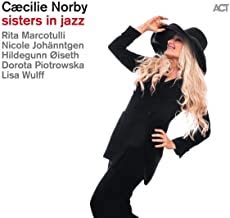
Cæcilie Norby was born on September 9, 1964 in Frederiksberg, Denmark, into a musical family, her father a classical composer and her mother an opera singer. She was a founding member of the band Street Beat in 1982 then for two years, she was a member of the jazz-rock band Frontline. From 1985 to 1993, she worked with singer Nina Forsberg in the rock band One~Two. During the 1990s, she turned to jazz and released her first solo album for Blue Note.
Her self~titled debut recording co~produced by Niels Lan Doky featured Scott Robinson, Randy Brecker and Michael Brecker each played on one track. Doky produced her following album My Corner Of The Sky in 1996, which prominently featured pianists David Kikoski, Joey Calderazzo and Terri Lyne Carrington on drums. The repertoire for both recordings included only a few jazz standards like Summertime or Just One of Those Things, instead she and Lan Doky arranged classic popular songs for a jazz line-up, like Wild Is the Wind, By the Time I Get to Phoenix and a track by Curtis Mayfield on the first album. The Look of Love, Life on Mars, Spinning Wheel and Set Them Free by Sting she recorded on the second.
For both albums Norby wrote lyrics to compositions by Randy Brecker, Chick Corea, Don Grolnick and Wayne Shorter. Both albums gained wide attention and five-digit sales, especially in Denmark and also in Japan.
Her third album Queen of Bad Excuses, released in 1999, was a collaboration with bassist Lars Danielsson, who already played bass on her sophomore release. This time she brought into the studio pianists Ben Besiakov and Lars Jansson, drummers Anders Kjellberg, Per Lindvall, Billy Hart, guitarist John Scofield, saxophonist Hans Ulrik and percussionist Xavier Desandre Navarre. Vocalist Cæcilie Norby continues to advance the music.

More Posts: arranger,composer,history,instrumental,jazz,lyricist,music,vocal
The Quarantined Jazz Voyager
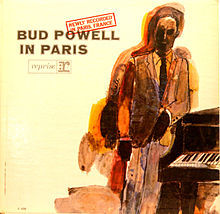
As the Delta variant continues to ravage the country in another wave of rising illness and once again full hospitals, for those of us remaining vigilant I offer you listeners a classic album Bud Powell in Paris. This studio album was produced by Duke Ellington and released in 1964 for Reprise Records.
On this album recorded in Paris, France in February 1963, Leonard Feather wrote the liner notes, the cover painting was done by Donald Leake and digital mastering was performed by Lee Herschberg.
Track List | 49:21- How High the Moon (Morgan Lewis, Nancy Hamilton) ~ 3:54
- Dear Old Stockholm (Traditional) ~ 3:53
- Body and Soul (Johnny Green, Edward Heyman, Robert Sour, Frank Eyton) ~ 6:05
- Jor-Du” (Duke Jordan) ~ 4:18
- Reets and I (Benny Harris) ~ 3:43
- Satin Doll (Duke Ellington, Billy Strayhorn, Johnny Mercer) ~ 4:45
- Parisian Thoroughfare (Bud Powell) ~ 1:56
- I Can’t Get Started (Vernon Duke, Ira Gershwin) ~ 5:40
- Little Benny (aka Bud’s Bubble) (Harris) ~ 3:31
Personnel
- Bud Powell ~ piano
- Gilbert Rovere ~ bass
- Kansas Fields ~ drums

More Posts: adventure,album,club,genius,jazz,museum,music,piano,preserving,restaurant,travel
The Quarantined Jazz Voyager
Remaining vigilant, being healthy, social distancing as those in our nation who continue to navigate positively and negatively through this pandemic.
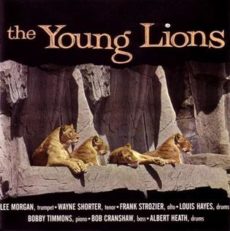
This week the album I’m recommending for listening is The Young Lions by Lee Morgan leading an ad hoc group of musicians who made up the septet for this recording. It was recorded on April 25, 1960 at the Bell Sound Studios in New York City and was produced by Sid McCoy. The album was released in 1961 on Vee~Jay Records.
The album title echoes that of a popular 1948 novel by Irwin Shaw which had been made into a feature film shortly before the album was recorded. The young lions who made the music on this album have varied musical philosophies and sundry jazz backgrounds.
The young lions phrase was revived in jazz in the 1980s when, as in 1960, there was a tension between the modern jazz traditionalists and the avant-garde.
Track Listing | 35:14- Seeds of Sin (Shorter) ~ 5:44
- Scourn’ (Shorter) ~ 5:58
- Fat Lady (Shorter) ~ 5:03
- Peaches and Cream (Shorter) ~ 6:52
- That’s Right (Morgan) ~ 11:37
- Lee Morgan – trumpet
- Wayne Shorter – tenor sax
- Frank Strozier – alto sax
- Bobby Timmons – piano
- Bob Cranshaw – bass
- Albert “Tootie” Heath (3-5, 8) drums
- Louis Hayes (1, 2, 6, 7) – drums
More Posts: adventure,album,club,genius,jazz,museum,music,preserving,restaurant,travel,trumpet