

Daily Dose Of Jazz…
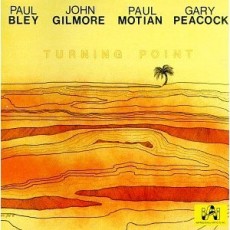
John Gilmore was born on September 28, 1931 and grew up in Chicago, Illinois but didn’t start playing the clarinet until age 14. While in the Air Force in the late Forties he took up the saxophone, then pursued a musical career, playing briefly with pianist Earl Hines before encountering Sun Ra in 1953.
For the next four decades, Gilmore recorded and performed almost exclusively with Sun Ra. Thought to have the makings of stardom like John Coltrane or Sonny Rollins, the latter taking informal lessons from Gilmore in the late 50s and partially inspired by his sound on “Chasin’ The Trane”.
By 1957 he was co-leading a Blue Note date with Clifford Jordan titled Blowing In From Chicago, that is regarded as a hard bop classic with Horace Silver, Curly Russell, and Art Blakey. In the mid-1960s John toured with the Jazz Messengers, participated in recording sessions with Paul Bley, Andrew Hill, Pete La Roca, McCoy Tyner, Melba Liston, and a handful of others. In 1970 he co-led a recording with Jamaican trumpeter Dizzy Reece, however his main focus throughout remained with the Sun Ra Arkestra.
Gilmore was devoted to Sun Ra’s use of harmony, which he considered both unique and a logical extension of bebop. He was the Arkestra’s leading sideman and soloist, performing with fluency and tone on straight-ahead post bop sessions and abstractly capable of long passages based exclusively on high-register squeals. Though his fame was shrouded in the relative anonymity as a member of Sun Ra’s Arkestra, he led the band after Ra’s death up until his own passing of emphysema in 1995.
Requisites
Mercy, Mercy, Mercy! ~ The Cannonball Adderley Quintet | By Eddie Carter
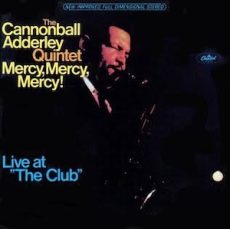
Have you ever heard a record so good it literally got into your head and stayed there forever? This morning’s album is one of those for me. Mercy, Mercy, Mercy! (Capitol Records T 2663/ST 2663) is a live album by the Cannonball Adderley Quintet. It was initially said to have been recorded in 1966 at The Club in Chicago. But it was actually recorded at the Capitol Records Tower with an invited audience and an open bar. The discrepancy arose because Adderley and the clUB’s new manager were friends, and the saxophonist offered the club free publicity. That aside, it’s a terrific album that’s worth the money if you enjoy live jazz.
The quintet consists of Nat Adderley on cornet, Cannonball Adderley on alto saxophone, Joe Zawinul on piano (tracks: A2, A3, B1 to B3) and electric piano (A4), Vic Gatsky on bass, and Roy McCurdy on drums. I own the 1967 U.S. Mono release. The announcer’s introduction sets the stage for Fun, the first of two tunes by Nat Adderley that immediately energizes the audience with the quintet’s lively melody. Cannonball’s brisk lines soar effortlessly in the opening statement, Nat’s spirited response adds warmth, and Joe’s vigorous interpretation ties it all together, showcasing their tight musical chemistry and improvisational skill that truly captures the audience’s excitement.
Cannonball announces the song title to the audience, then notes that their next tune is titled Games, which kicks off with the quintet’s upbeat introduction and theme. Cannonball opens with one of his most inventive solos, then Nat settles into an effervescent groove perfect for finger-popping and toe-tapping. Joe responds with a marvelous interpretation that builds to a satisfying finale. Joe switches to the electric piano as the rhythm section provides a warm backdrop for Cannonball’s intro to the album’s defining moment, Joe Zawinul’s Mercy, Mercy, Mercy. The quintet’s memorable theme and Joe’s soulful solo make this track a highlight, inviting listeners to experience the album’s emotional depth firsthand.
Sticks by Julian Adderley shifts the album into a finger-snapping tempo, opening the second side with the quintet’s danceable melody. Nat takes the lead with an energetic reading, leaving room for his brother to soar next. Joe comes in last and adds an indelible contribution before the ensemble’s theme restates and ends firmly. Hipadelphia by JosefZawinul begins with the ensemble’s relaxed melody. Cannonball has the first say and moves comfortably through the rhythm section with an easy-flowing stream of ideas. Nat rocks the second reading with a light, airy sound. Joe wraps up everything smoothly in the closer before the horns return to take the song out.
The set wraps up with Cannonball’s warm introduction to his tune, Sack O’ Woe. The rhythm section softly sets the mood for the quintet’s lively melody, a heartfelt blend of blues and church influences. Cannonball takes the spotlight first with a soulful sermon. Nat brings everyone to their feet with his finger-snapping, toe-tapping performance. Joe adds emotional intensity in his turn, and Vic finishes off ahead of the ensemble, bringing it all together in the closing chorus. David Alexrod produced Mercy, Mercy, Mercy, while the recording engineer remains a mystery. The album’s sound quality is excellent, making you feel like you're right there in the studio audience, sharing in the joy of the music as it happens.
Mercy, Mercy, Mercy truly shines as a jazz album that is both beautifully crafted and immediately captivating. The quintet’s arrangements and performances flow together smoothly, letting each musician shine and filling the album with warmth and vibrant energy. The title track really highlights what makes this album so special, while the other songs show that Cannonball Adderley and his band could groove in many different ways. I’m sure those in attendance walked away feeling like they had experienced something truly memorable. If you’re already a fan of the Cannonball Adderley Quintet or discovering their music for the first time, I encourage you to pick up Mercy, Mercy, Mercy on your next record shopping trip. It’s a lively and cohesive album that’s perfect for focused listening and relaxing enjoyment!
© 2026 by Edward Thomas Carter

More Posts: choice,classic,collectible,collector,history,instrumental,jazz,music,saxophone
Daily Dose Of Jazz…
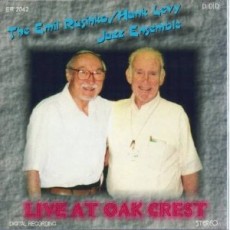
Hank Levy was born Henry Jacob Levy on September 27, 1927 in Baltimore, Maryland. He learned to play the saxophone and matriculated through Catholic University studying composition with George Thaddeus Jones. It was here that he became interested in odd meters through their use by such composers as Paul Hindemith, Maurice Ravel, and Igor Stravinsky. An adept composer of counterpoint, his talent can be heard in such compositions as Passacaglia and Fugue and Quintessence among others for both the Don Ellis Orchestra and Stan Kenton.
Levy was also prolific as an arranger of jazz standards, though few of them were published during his lifetime. He was especially fond of the music of the stage as it came through bebop: Cole Porter, George Gershwin, Jerome Kern. In his last years, he more frequently turned to bebop originals by Charlie Parker, Dizzy Gillespie, Tadd Dameron.
As an educator Hank was a full-time professor at Towson State University in 1967. He founded and directed for nearly a quarter of a century the Jazz Program and created the “Towson State Jazz Ensemble”. By 1970 he had brought the band to national prominence winning the outstanding band honors at the prestigious Notre Dame Jazz Festival, with and additional honor of “Best Lead Trumpet”.
Levy recorded an album in 1975 with the ensemble titled “2 + 2 = 5” comprised of six of his compositions. The “Hank Levy Legacy Band” currently performs his music, they have recorded two live CDs to date, and several of his works are still in print through various distributors. Saxophonist, composer and arranger Hank Levy passed away on September 18, 2001 in Parkville, Maryland.
Daily Dose Of Jazz…
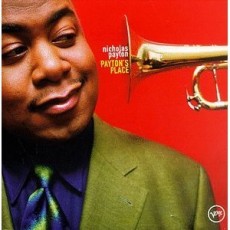
Nicholas Payton was born on September 26, 1973 in New Orleans, Louisiana, the son of bassist and sousaphonist Walter Payton. He took up the trumpet at age four and by nine was playing in the Young Tuxedo Brass Band. Upon leaving school, he enrolled first at the New Orleans Center for Creative Arts and then at the University of New Orleans under the tutelage of Ellis Marsalis.
Payton toured with Marcus Roberts and Elvin Jones in the early 90s, signed a recording contract with Verve Records, and released his first album, From This Moment in 1994. In 1996 he performed on the soundtrack of the movie Kansas City.
After seven albums on Verve, Nicholas signed with Warner Bros. and would perform and record with Wynton Marsalis, Dr. Michael White, Nancy Wilson, Christian McBride, Joshua Redman, Roy Hargrove Clark Terry, Allen Toussaint, and Joe Henderson among others. He is a founding member of the SFJAZZ Collective and in 2008, he joined The Blue Note 7 in 2008, releasing an album the following year that produced a U.S. promotional tour.
Trumpeter Nicholas Payton also plays piano and is a prolific blogger and has written a notable blog titled “On the Difference Between Prejudice and Racism…” in which Payton theorizes that blacks cannot be racist because a prerequisite to racism is power.
He has recorded more than a dozen albums as a leader and sideman, received a Grammy Award for Best Instrumental Solo for his playing on the album Doc Cheatham & Nicholas Payton and continues to compose, record and perform.
Daily Dose Of Jazz…
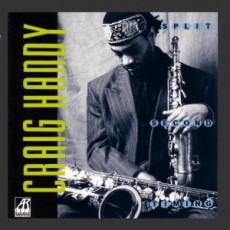
Craig Handy was born Craig Mitchell Handy on September 25, 1962 in Oakland, California and played guitar, trombone and piano before falling in love with the tenor saxophone. He was a part of the Berkeley High School Jazz Program, earned a Charlie Parker Scholarship award and attended North Texas State University from 1981 to 1984, where he was a member of their prestigious One O’Clock Lab Band.
By 1986 at age 23 he moved to New York City and once there he built up a cache of credits performing and recording with Herbie Hancock, Head Hunters, Art Blakey, Wynton Marsalis, Roy Haynes, Abdullah Ibrahim, Elvin Jones, Joe Henderson, Betty Carter, John Hicks, George Adams, Ray Drummond, Conrad Herwig, Dee Dee Bridgewater, Charles Tolliver, The Cookers, and David Weiss among many others.
He was a member and Musical Director of the Mingus Big Band, Mingus Dynasty, and Mingus Orchestra, post-bop tenor saxophonist Craig Handy has recorded as a leader, as a member of the group Chartbusters, portrayed the role of Coleman Hawkins in the 1996 film Kansas City and is credited for performing the Season Six theme of the Cosby Show. He continues to compose, perform, record and tour.
More Posts: saxophone