

Daily Dose Of Jazz…
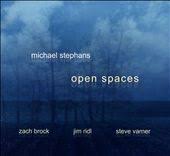
Michael Stephans was born in Miami, Florida on June 9, 1945. He has performed and recorded with artists including Dave Liebman, Bennie Maupin, Joe Lovano, Bob Brookmeyer, Don Menza, and Alan Broadbent.
Stephans’ first solo recording, Om ShalOM, was critically lauded in 2007 by UK critic Tom Barlow as an album of the year in the December 2007 – January 2008 issue of Jazzwise.
He has received multiple composition grants from the National Endowment for the Arts. In 1974, this association afforded him the opportunity to write the large ensemble composition Shapes and Visions for vibraphonist Karl Berger, which was performed at the Smithsonian Museum of Natural History in Washington, D.C.
In his role as a poet Michael has been published in The Note and Inscape, and received the Rachael Sherwood Poetry Prize by the English department at Cal State Northridge. He is the author of Experiencing Jazz: A Listener’s Companion, and Experiencing Ornette Coleman: A Listener’s Companion.
He is a professor who has taught at Pasadena City College, the University of Miami, and Bloomsburg University of Pennsylvania. Drummer Michael Stephans continues to pursue his career in jazz.

More Posts: bandleader,drums,educator,history,instrumental,jazz,music,poet,writer
Daily Dose Of Jazz…
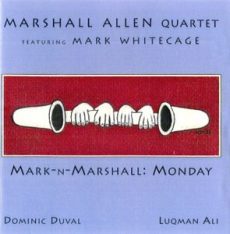
Marshall Belford Allen was born in Louisville, Kentucky on May 25, 1924. During World War II he enlisted in the 92nd Infantry Division and was stationed in France. He studied alto saxophone in Paris, France and played in Europe with Art Simmons and James Moody.
Best known for his mastery of explosive, jarring, chaotic sound effects on the alto saxophone, the opportunity came to create a long association with Sun Ra, with whom he performed almost exclusively from 1958 to Ra’s death in 1993. Marshall recorded with Paul Bley in 1964 and Olatunji during the mid-1960s.
Since Sun Ra death Allen has led the Arkestra and has recorded two albums. Allen often appeared in New York-area collaborations with bassist Henry Grimes, and participated in the Innerzone Orchestra with Francisco Mora Catlett, Carl Craig and others in an appreciation of Sun Ra’s music.
In 2022, the building at 5626 Morton Street known as the Arkestral Institute of Sun Ra was listed as a historic landmark in the Philadelphia Register of Historic Places. Free and avant-garde jazz alto saxophonist Marshall Allen, who also plays flute, oboe, piccolo, and EWI, at the age of 99 continues to live at the Institute, which has been his home since 1968.

More Posts: bandleader,ewi,flute,history,instrumental,jazz,music,oboe,piccolo,saxophone
Daily Dose Of Jazz…
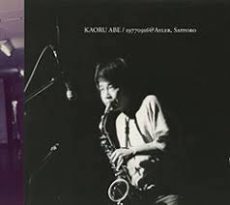
Kaoru Abe 阿部 薫 was born on May 5, 1949 in Kawasaki, Kanagawa, Japan. Self-taught at a young age, at 17 he dropped out of highschool in 1967 to focus on perfecting his playing. The following year he played his first performance at a jazz spot named Oreo.
He generally performed solo but played with notables Motoharu Yoshizawa, Takehisa Kosugi, Yosuke Yamashita, Derek Bailey, and Milford Graves. In 1970, Laoru met guitarist Masayuki Takayanagi and recorded with him.
Abe was prolific, appearing almost every day to jazz spots and concerts. His library consists almost entirely of archival and live recordings, however he has done studio recordings.
His later years saw Kaoru playing different instruments like the bass clarinet throughout his career. By 1976 for two years he was mostly explorative with the harmonica. He was portrayed in Kōji Wakamatsu’s film Endless Waltz by novelist and punk rock singer Kō Machida.
Avant-garde alto saxophonist Kaoru Abe transitioned on September 9, 1978 from Bromisoval overdose causing an acute gastric perforation.
More Posts: bandleader,history,instrumental,jazz,music,saxophone
Daily Dose Of Jazz…
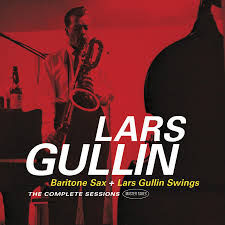
Lars Gunnar Victor Gullin was born May 4, 1928 in Visby, Sweden. A child prodigy on the accordion, by age thirteen, he played clarinet in a military band and later learned the alto saxophone. After moving to Stockholm, Sweden in 1947 he became a professional musician as a pianist. Planning on a classical career he studied privately with classical pianist Sven Brandel.
He filled the baritone chair in Seymour Österwall’s band in 1949 by chance, it was enough for him to decide that it was an instrument with possibilities. He was influenced by baritone saxophonist Gerry Mulligan for the first time on the Birth of the Cool recordings. He worked as a member of Arne Domnérus’s septet for two years from 1951.
Gullin began working with visiting American musicians, recording with James Moody, Zoot Sims and Clifford Brown. Most importantly, he first performed with Lee Konitz in 1951, an association which was to be repeated several times in future years.
In 1953 formed his own group, probably the only regular group he was to lead. It was short-lived, breaking up later that year after Lars was responsible for causing the group to be involved in an automobile accident, although no one was seriously hurt. The next year, 1954, he won the best newcomer award in the American DownBeat magazine. Later his albums were leased to Atlantic Records in the United States and toured several European countries with Chet Baker in 1955.
The remainder of his career was blighted by his own narcotics problems and sometimes he survived on artists’ grants from the Swedish government. During most of 1959 he was active in Italy, he played with Chet Baker again and with the jazz alto saxophonist Flavio Ambrosetti, making radio broadcasts with him in Lausanne, Switzerland.
He recorded with Archie Shepp in 1963. One of his last major statements was his Aeros aromatic atomica suite recorded in 1973. A recording jointly led by Lee Konitz and pianist Lars Sjösten, Dedicated to Lee … Play the Music of Lars Gullin was recorded in 1983 and issued by Dragon Records. Baritone saxophonist Lars Gullin transitioned from a heart attack on May 17, 1976, brought on by his long-term addiction to methadone.
More Posts: bandleader,clarinet,history,instrumental,jazz,music,piano,saxophone

Daily Dose Of Jazz…
Michael John David Westbrook was born March 21, 1936 in High Wycombe, Buckinghamshire, England and grew up in Torquay. After a spell in accountancy and his National Service he went to art school and studied painting and where he began his first bands in 1958, soon joined by such musicians as John Surman, Lou Gare and Keith Rowe.
Moving to London, England in 1962, Westbrook led numerous bands, large and small, and played regularly at the Old Place and the Little Theatre Club at Garrick Yard, St Martin’s Lane. Together with Chris McGregor’s Brotherhood of Breath, Westbrook shared the role of house-band at Ronnie Scott’s Jazz Club.
Becoming a key figure in the development of British jazz, Mike produced several big-band records for the Deram label, with the newly formed Mike Westbrook Concert Band, which varied in size from 10 to 26 musicians. His music was given exposure on BBC Radio. The British Arts Council awarded him a bursary to develop ‘Metropolis’ for an enlarged Concert Band, and the jazz suite was further broadcast on BBC Radio Three.
The 1970s saw a wide range of different projects beyond his orchestra work including but not limited to carnival processions, jazz-rock, avant-rock. At 80 years old, Westbrook, as part of the celebrations, recorded his first solo piano album for 40 years, titled PARIS.
Pianist, composer, and writer of orchestrated jazz pieces Mike Westbrook, who was awarded the OBE (Most Excellent Order of the British Empire), and recorded his latest album London Bridge Live in Zurich 1990 in 2022, continues to expand his musical horizons.

More Posts: bandleader,composer,history,instrumental,jazz,music,piano