

Daily Dose Of Jazz…
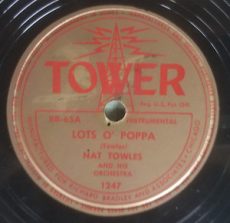
Nat Towles was born August 10, 1905 in New Orleans, Louisiana, the son of string bassist Phil “Charlie” Towles. He started his musical career as a guitarist and violinist at the age of eleven but switched to the bass at 13. Performing in his hometown through his teenage years with Gus Metcalf’s Melody Jazz Band, he eventually played with a number of bands, including Buddie Petit, Henry “Red” Allen, Jack Carey, and the Original Tuxedo Jazz Orchestra.
In 1923 he formed The Nat Towles’ Creole Harmony Kings. This jazz band became one of the prominent territory bands in Texas, Oklahoma, Kansas, and Nebraska. By 1925 he was playing bass for Fate Marable, and reformed his own band the next year. 1934 saw Towles organizing a band of young musicians studying music at Wiley College in Austin, Texas. He also worked the club circuit in Dallas, Texas during this period, when T-Bone Walker and Buddy Tate worked for him.
In the 1930s he transformed his band into The Nat Towles Dance Orchestra, signed with the National Orchestra Service, and focused on swing music through the 1930s and 1940s. In 1934 Towles took up residence in North Omaha, Nebraska, where his band was stationed for the next 25 years. With this outfit Towles dueled with Lloyd Hunter for dominance over the much-contested Near North Side in North Omaha, where he was held over at the Dreamland Ballroom for several weeks. In 1936 and 1937 Towles’ band held residence at Omaha’s Krug Park.
Over the course of his career Billy Mitchell, Buster Cooper, Red Holloway, Buster Bennett, Preston Love, Paul Quinichette, Neal Hefti, Jimmy Heath, Duke Groner, Buddy McLewis and Oliver Nelson were members of his band at one time or another. He continued leading bands throughout the 1950s until retiring to California in 1959 where he opened a bar.
Never finding true national recognition and fearing the limelight would then steal away his best players, there are very few recordings of Nat Towles’ Band. Bassist, big band leader and educator Nat Towles, whose band is considered one of the greatest territory bands of all time by musicians who played in it and by others who heard it, transitioned in Berkeley, California of a heart attack in January 1963.

More Posts: bandleader,bass,educator,history,instrumental,jazz,music
Daily Dose Of Jazz…
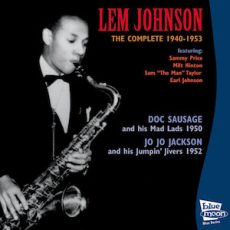
Lemuel Charles Johnson was born August 6, 1909 in Oklahoma City, Oklahoma. He played clarinet in local ensembles in the 1920s, however, he picked up saxophone in 1928, playing with Walter Page’s Blue Devils.
Early in the 1930s he played in the band of Grant Moore from 1931 to 1935 in the Milwaukee, Wisconsin area. Then he went to work with Eli Rice and Earl Hines. By 1937 he was moving to New York City where he played with Fess Williams, Luis Russell and Louis Jordan, before joining Skeets Tolbert’s band in 1939. In Tolbert’s group Johnson sang in addition to playing saxophone.
Lem recorded with Buster Harding, Eddie Durham, Edgar Hayes, Sidney Bechet, Claude Hopkins, St. Louis Jimmy, Sam “The Man” Taylor and Sammy Price. He also recorded with Johnny Long and his Orchestra on Coral Records. He cut several sessions as a leader, which have subsequently been released on compact disc.
After the 1940s he went into semi-retirement and occasionally played into the Sixties. Tenor and soprano saxophonist Lem Johnson transitioned in New York City on April 1, 1989.
More Posts: history,instrumental,jazz,music,saxophone
Daily Dose Of Jazz…
Charles “Chuck” Riggs was born on August 5, 1951 in Westerly, Rhode Island. Beginning in 1976 he played with Scott Hamilton and their association lasted well into the 1990s.
In the late 1970s and 1980s, he played with Bob Wilber, the World’s Greatest Jazz Band, Chris Flory, Benny Goodman, Kenny Davern, Dick Wellstood, Flip Phillips, Ruby Braff, and Jay McShann.
He was a member of the Concord Jazz All-Stars alongside Hamilton, Dave McKenna, and Gray Sargent in the early 1990s. Later in the decade he worked with Keith Ingham, Jon-Erik Kellso, and Ken Peplowski.
Riggs was featured on The Cotton Club, the soundtrack for the 1984 film of the same name.
Drummer Chuck Riggs continues to perform and record.
More Posts: drums,history,instrumental,jazz,music

Daily Dose Of Jazz…
Thomas Robert Talbert was born on August 4, 1924 in Crystal Bay, Minnesota and grew up listening to big band music on the radio. He learned to play piano before he became a composer. He got started as a band leader when he was drafted in the Army in 1943, becoming composer for a military band at Fort Ord, California, performing for War Bond drives throughout California.
In the late 1940s he led his own big band on the West Coast, much of his work foreshadowing what became known as West Coast jazz. During the decade in Los Angeles he worked with Johnny Richards, Lucky Thompson, Dodo Marmarosa, Hal McKusick, Al Killian, Art Pepper, Steve White and Claude Williamson…….
Moving to New York in the early 1950s after being denied a recording contract in Los Angeles, California he worked with Marian McPartland, Kai Winding, Don Elliott, Johnny Smith, Oscar Pettiford, Herb Geller, Joe Wilder, Eddie Bert, Barry Galbraith, Aaron Sachs and Claude Thornhill. In 1956, Talbert recorded two records that would become his best known works, Wednesday’s Child and Bix Duke Fats, which gained him fleeting fame.
When rock and roll eclipsed jazz in popularity, in 1960 he moved to his parents’ home in Minnesota. He tried his hand at cattle ranching in Wisconsin but eventually moved back to Los Angeles and a musical career in 1975. As a sideman he recorded with the Boyd Raeburn Orchestra, Johnny Richards, and Patty McGovern.
In addition to composing for TV and movie studios, he became involved in music education, and set up a foundation to help talented young musicians, with one of the first recipients in 1996 was Maria Schneider.
Pianist, composer and band leader Thomas Talbert, who recorded eighteen albums as a leader, transitioned on July 2, 2005 in Los Angeles.
More Posts: bandleader,composer,history,instrumental,jazz,music,piano
Daily Dose Of Jazz…
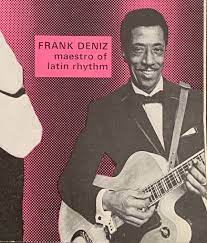
Frank Deniz was born Francisco Antonio Deniz on July 31, 1912 in Cardiff, Wales. His father, an African born in Cape Verde, was a seaman, and his mother was of English and African-American descent. They were amateur musicians, father playing violin and mother playing piano. From the age of 15 he joined his father on sea voyages. In 1931 his father was taken ill and the lad was forced to leave him in hospital in Odessa, Ukraine where he died. Between voyages he played music, inspired by jazz guitarists Teddy Bunn and Eddie Lang.
He married pianist Clara Wason in 1936 and they moved to London, England and found work as musicians in Soho. In 1937 they played for a time in the orchestra of Ken “Snakehips” Johnson. Deniz later played at Adelaide Hall’s Florida Club in Mayfair, where he played with pianist Fela Sowande.
Joining the Merchant Navy in 1940, he played music in between voyages with contemporaries Eric Winstone and Edmundo Ros, and formed his own band, the Spirits of Rhythm. In 1944 he was wounded when his ship was torpedoed on approaching Anzio.
Stanley Black, leader of the BBC Dance Orchestra employed him regularly and introduced him to others in the music business. Deniz joined Harry Parry’s Radio Rhythm Club Sextet, which had a regular radio series. In 1953 with his brothers, he formed the Hermanos Deniz Cuban Rhythm Band, which gave regular broadcasts in the 1950s regularly through to the 1970s.
Deniz composed music with his brother Laurence for the 1959 film Our Man in Havana. He accompanied Hoagy Carmichael on a tour of Britain. In his later years he played with the Hermanos Deniz band at the Talk of the Town. This continued for many years until his retirement in 1980, when they lived in Málaga Spain during the summer, until Clara contracted Parkinson’s disease in the 1990s. At this point Deniz became her caregiver until her death.
Guitarist Frank Deniz transitioned on July 17, 2005 at his home in Stanstead Abbotts, Hertfordshire, England.

More Posts: bandleader,guitar,history,instrumental,jazz,music