

Daily Dose Of Jazz…
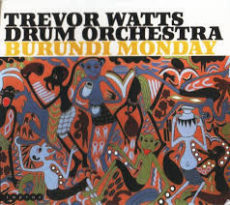
Trevor Charles Watts was born in York, England on February 26, 1939 and is largely self-taught, having taken up the cornet at age 12 then switched to saxophone at 18.
While stationed in Germany with the RAF from 1958 to 1963, he encountered the drummer John Stevens and trombonist Paul Rutherford. After his service he returned to London, England and in 1965, he and Stevens formed the Spontaneous Music Ensemble (SME), which became one of the crucibles of British free improvisation.
Leaving the band to form his own group Amalgam in 1967, Trevor returned to SME for another stretch that lasted until the mid-1970s. Collaborating with bassist Barry Guy and his London Jazz Composers’ Orchestra, they performed until their disbandment in the mid-1990s.
Though he was initially strongly identified with the avant-garde, Watts was versatile, working in everything from straight jazz contexts to rock and blues. His own projects blended jazz and African music, notably the Moiré Music ensemble which he led since 1982. He has collaborated with jazz musicians including Archie Shepp, Steve Lacy, Don Cherry, Jayne Cortez and Stephen Grew.
Free-improvising alto and soprano saxophonist Trevor Watts, who recorded 31 albums as a leader, and two as a sideman, continue to explore the music.

More Posts: bandleader,history,instrumental,jazz,music,saxophone
Daily Dose Of Jazz…
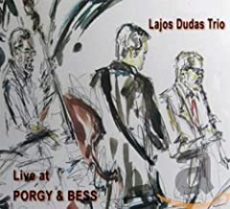
Lajos Dudas was born February 18, 1941 in Budapest, Hungary and studied at the Béla Bartók Conservatory and the Franz Liszt Academy of Music in his home city. He then appeared on concert tours throughout in Europe, not only as a jazz and rock musician but also as a soloist in works such as Carl Maria von Weber’s Clarinet Quintet, Igor Stravinsky’s Solo Pieces for Clarinet and Alexander Glazunov’s Concerto for Alto Saxophone. He won international recognition with his successful composition Urban Blues at the 11th International Jazz Competition in Monaco in 1982.
In the 1980s he was ranked high year after year in the Top People Poll of the International Jazz Forum. After his period as a freelance musician from 1963 to 1973, Dudas has been a lecturer at the School of Music in Neuss/GER and also taught from 1975 to 1985 at the Rheinland College of Education. In addition, since 1976, after a spell concentrating on classical music, he was recorded, worked radio productions and tours with Karl Berger, Gerd Dudek, Albert Mangelsdorff, Tom van der Geld, Charles Tolliver, Howard Johnson, Attila Zoller, Philipp van Endert, Leonard Jones, Theo Jörgensmann, Tommy Vig…
Over the course of his career Lajos has composed works commissioned by among several others, Frankfurt Radio Jazz Group, West German Radio & Television/Cologne, and Bavarian Radio Munich, and has performed at major European festivals.
Between 1996 and 2006 he was Artistic Director for the Concert Series in Neuss/GER. He also composed works for clarinet, woodwind chamber music and a Clarinet Method in 2 volumes. Clarinetist Lajos Dudas continues to explore jazz and other genres of music.
More Posts: bandleader,clarinet,composer,history,instrumental,jazz,music

The Quarantined Jazz Voyager
The masks the President promised are out however, he has given all the manufacturers an opportunity to participate. You only get two or three N95’s depending on where you get them. So if your Amazon order is slow to come stop by your local pharmacy and pick up yours. Continue social distancing and remain safe.
This week sliding off the shelves in alto saxophonist Jackie McLean and his 1963 album Destination… Out! The album was recorded on September 20, 1963, produced by Alfred Lion and released in November of the following year on the Blue Note label. It is the second McLean album to feature Bobby Hutcherson and Grachan Moncur III.
He’s 31 years of age and primed torecord an album for the ages. Hard bop aside he ventured into free jazz on this one to explore new sounds and improvisation never heard before. Four tunes make up this release, three by Moncur and one by the leader, who recognized the former’s penchant for composition.
Growth mandates that we expand our personal listening repertoire, that we stray from our comfort zone, and explore the options jazz offers. Needless to say McLean has put together a stellar band of musicians who engage us with the conversation they fluidly and freely have along its journey.
Track Listing | 34:57
- Love and Hate (Grachan Moncur III) ~ 8:25
- Esoteric (Moncur) ~ 9:02
- Kahlil the Prophet (Jackie McLean) ~ 10:23
- Riff Raff (Moncur) ~ 7:07
- Jackie McLean ~ alto saxophone
- Grachan Moncur III ~ trombone
- Bobby Hutcherson ~ vibes
- Larry Ridley ~ bass
- Roy Haynes ~ drums

More Posts: adventure,album,club,genius,jazz,museum,music,preserving,restaurant,saxophone,travel
Daily Dose Of Jazz…
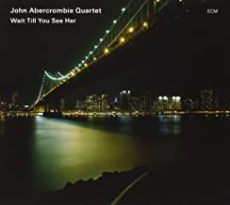
John Laird Abercrombie was born in Port Chester, New York on December 16, 1944. Growing up in the 1950s in Greenwich, Connecticut he was attracted to the rock and roll of Chuck Berry, Elvis Presley, Fats Domino, and Bill Haley and the Comets. He also liked the sound of jazz guitarist Mickey Baker of the vocal duo Mickey and Silvia. He had two friends who were musicians with a large jazz collection and they listened to albums by Dave Brubeck and Miles Davis.
The first jazz guitar album he heard was by Barney Kessel, and taking guitar lessons at the age of ten, asked his teacher to show him what Kessel was playing. After high school, John went to Berklee College of Music and while there he was drawn to the music of Jim Hall, Sonny Rollins, and Wes Montgomery. He cites George Benson and Pat Martino as inspirations. His playing around Boston, Massachusetts led to his meeting the Brecker Brothers and organist Johnny Hammond Smith, who invited him to go on tour.
From Berklee in 1967 to North Texas State University to a move to New York City in 1969 where he became a popular session musician. He joined the Brecker Brothers in the jazz-rock fusion band Dreams, followed by recordings with Gato Barbieri, Barry Miles, and Gil Evans. He continued to play fusion in Billy Cobham’s band until an invitation from drummer Jack DeJohnette led to the fulfillment of Abercrombie’s desire to play in a jazz-oriented ensemble.
Around the same time, record producer Manfred Eicher, founder and president of ECM Records, invited him to record an album. He recorded his first solo album, Timeless, with DeJohnette and keyboardist Jan Hammer. who had been his roommate in the 1960s. In 1975 he formed the band Gateway with DeJohnette and bassist Dave Holland.
Between 1984 and 1990, Abercrombie experimented with a guitar synthesizer. Free jaz became a mainstay for him in the 1990s and 2000s as he formed many new associations. Drummer Adam Nussbaum, and Hammond organist Jeff Palmer became his trio and made a free-jazz album, then replaced Palmer with organist Dan Wall and released three albums between 1992 and 1997. Adding trumpeter Kenny Wheeler, violinist Mark Feldman and saxophonist Joe Lovano to the trio he recorded Open Land in 1999.).
He continued to tour and record until the end of his life. who recorded 59 as a leader, 4 with Gateway, 6 with Andy LaVerne and 93 as a sideman for the who’s who in jazz. Guitarist John Abercrombie, whose work explored jazz fusion, free jazz, and avant-garde jazz, passed away of heart failure in Cortlandt Manor, New York, at the age of 72 on August 22, 2017.
More Posts: bandleader,composer,guitar,history,instrumental,jazz,music
Daily Dose Of Jazz…
George Coleridge Emerson Goode was born on November 29, 1914 in Kingston, Jamaica. His father was a choirmaster and organist and his mother sang in the choir. Moving to Britain in 1934, the 19-year-old student at the Royal Technical College in Glasgow, Scotland and then went on to read for a degree in engineering at Glasgow University. Already proficient as an amateur classical violinist he turned to jazz and took up the bass after hearing the music of Count Basie, Duke Ellington, Billie Holiday and Louis Jordan and decided to embark upon a musical career.
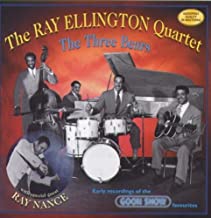
His primary early influences as a bassist were Walter Page, Slam Stewart and Jimmy Blanton. In London during World War II, Coleridge worked with Johnny Claes, Eric Winstone, Lauderic Caton, Dick Katz, became a founder member of the Ray Ellington Quartet and recorded with Django Reinhardt in 1946, alongside Stephane Grappelli. He went on to play with Tito Burns’ sextet and led his own group, before being invited to join Joe Harriott’s new band in 1958.
By 1967 he was recording with Chris McGregor, Dudu Pukwana, Ronnie Beer, and Laurie Allan on Gwigwi Mrwebi’s Mbaqanga Songs. Through the decade and into the 1970s, Goode worked extensively with pianist/composer Michael Garrick, while performing in the house band at Laurie Morgan’s Sunday jam session into his 90s.
In 2002, he published his autobiography Bass Lines: A Life in Jazz, which chronicled the birth of free form jazz in Britain. He was honoured with the Services to Jazz Award at the Parliamentary Jazz Awards, and at the age of 100, double bassist Coleridge Goode passed away on October 2, 2015.

More Posts: bass,history,instrumental,jazz,music