

Daily Dose Of Jazz…
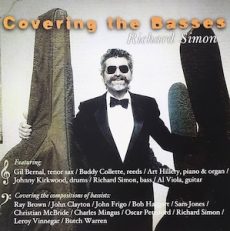
Richard Simon was born in Kansas City, Kansas on July 5, 1949 and left a comfortable position as a college English professor to take up the upright bass at age 30. He apprenticed with the elder elite of the Los Angeles, California jazz scene, including Red Callender and John Clayton, and soon began working with Buddy Collette, Teddy Edwards, Plas Johnson and Art Hillery, as well as LA Philharmonic’s Abe Luboff.
Richard has played traditional jazz with Pete Fountain, swing with Ken Peplowski, and be-bop with Richie Cole. He has recorded with Al Viola, Houston Person, Rebecca Kilgore, Gerald Wiggins and Chico Hamilton, toured Japan three times and performed twice with the King of Thailand. He worked frequently with vocalists Sue Raney, Maria Muldaur, Maxine Weldon, as well as the late vocalists Ernie Andrews, Lorez Alexandria and Keely Smith, and Rosemary Clooney.
Deeply involved in jazz education, Simonhe is the program director for JazzAmerica, a non-profit organization that provides tuition-free jazz instruction after school and in summer WorkChops.
Bassist Richard Simon continues to perform, record and educate.

More Posts: bandleader,bass,history,instrumental,jazz,music
Daily Dose Of Jazz…
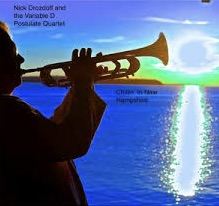
Nick Drozdoff was born on June 28, 1953 in Glencoe, Illinois. Holding degrees in music, engineering and physics, in 1978 he began his professional career in Maynard Ferguson’s band. Leaving the band in 1981 he ran his own contracting business and after completing his masters in classical trumpet, he began leading a double life in 1991 when he took on a day gig as a high school physics teacher at Winnetka’s New Trier High School.
After leading a double career existence and garnering awards as a high school science teacher, Nick developed endorsement deals as a jazz trumpeter at night. Retiring from teaching he pursued his musical passion. Now he spends time in Door County, Wisconsin and in the Northern Suburbs of Chicago where he regularly performs in both locations. He lives equal time in both places, depending on his performance and lecture/masterclass schedule.
His latest project centers on his new band, The Variable D Postulate Ensemble. This band is minimally a quartet of drums, guitar, keybaord and trumpet. It is primarily jazz driven but not exclusively. Drozdoff built a studio where he does his recording and has built connections as a trumpeter all over the world.
He has recorded with Grilly Brothers, Marshall Vente, Doug Lofstrom, Chuchito Valdes, and Guy Fricano. He is currently on call as solo trumpet with the Chicago Grandstand Big Band, The Jazz Consortium Big Band and the Starfall Big Band. Trumpeter Nick Drozdoff frequently appears as a classical soloist for churches, recitals andleads one of the Chicago area’s finest brass quintets.

More Posts: bandleader,history,instrumental,jazz,music,trumpet
Daily Dose Of Jazz…
Ronald “Ronnie” Hughes was born in Aberystwyth, Wales on June 27, 1925 and took up the trumpet at the age of eleven. The following year he was playing local semi-pro gigs. At nineteen he was in the RAF until 1947, spending part of his service in India. After returning to Wales to study photography, he then moved to London, England to join the Trinidadian clarinettist Carl Barriteau band. He worked for a year with the Teddy Foster Band from 1948 until 1949, and was a member of the Ted Heath band from 1949 until 1954.
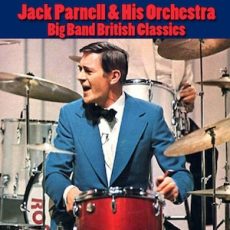
In the late fifties, Ronnie was in the bands of Geraldo and Jack Parnell, and after his marriage broke up had a spell working on ocean liners. A fluent jazz improviser and reliable and ubiquitous session player during the heyday of TV work, he was one of the original members of the BBC Big Band. He was a member of the Sinatra band and a long-term friend of fellow trumpeter Mannie Klein.
He would go on to appear in the film Quartet directed by Dustin Hoffman, who was captivated by his playing. Throughout his career he worked with Nat Allen, Lesle Holmes’ Londonairs, Harry Parry, Teddy Foster, Cyril Stapleton, Johnny Evans, BBC Radio Orchestra and led own quintet in 1958. He was a member of the Berlin Big Band, Eric Winston & His Orchestra, Johnny Keating and 27 Men, The Pride of London Big Band, and the Ray Davies Orchestra.
Trumpeter Ronnie Hughes died on April 1, 2020 in Banstead, Surrey at the age of 94.
More Posts: history,instrumental,jazz,music,trumpet
Daily Dose Of Jazz…
Jean Oh was born in Seoul, Korea on June 11, 1978 and began playing the guitar at the age of 13. He began studying music formally at Seoul Jazz Academy, and soon began playing gigs. After several years of playing with many different bands around town, he realized he needed different experiences which led him to Paris, France.
In Paris he studied jazz with Misja Fitzerald Michel, Sylvain Beof, Bernard Maury, Joe Malcolm, Emil Spanyl and Frederic Favarel. He performed in various clubs and after graduating from the music conservatory Jean moved to New York City to attend New York University where he obtained a master’s degree. During his two years at NYU, he studied with Ralph Alessi, George Garzone, John Scofield, and Gil Goldstein. He also attended the School of Improvisation Music, studying with Steve Coleman, Mark Helias, Uri Caine, David Binney, and Bily Hart.
Working his way into the New York Jazz scene he played different gigs that became his springboard to his professional career. He has played on several commercially released recordings and toured throughout the United States, Canada, Japan, South America, Philippine, Russia and has shared stages with George Garzone, John Lockwood, Jeff Hirshfield, Billy Drummond, Ralph Alessi, Ron McClure, Mike Richmond.
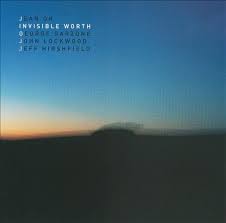
Guitarist Jean Oh released his debut album Invisible Worth featuring George Garzone, John Lockwood, and Jeff Hirshfield. He is pushing himself to have his voice defined in music, both as a sideman and as a band leader.
More Posts: bandleader,guitar,history,instrumental,jazz,music
Daily Dose Of Jazz…
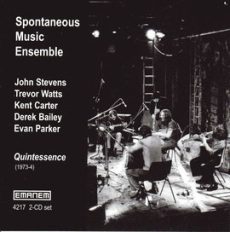
John William Stevens was born on June 10, 1940 in Brentford, Middlesex, England, the son of a tap dancer. He listened to jazz as a child but was more interested in drawing and painting, through which he expressed himself throughout his life. He studied at the Ealing Art College and then started work in a design studio, but left at 19 to join the Royal Air Force. It was here that he studied the drums at its School of Music in Uxbridge, England and where he met Trevor Watts and Paul Rutherford, two musicians who became close collaborators.
In the mid-1960s, Stevens began to play in London jazz groups with Tubby Hayes and Ronnie Scott, and in 1965 he led a quartet. He moved away from mainstream jazz when he heard free jazz from the U.S. by musicians like Ornette Coleman and Albert Ayler. By 1966, he formed the Spontaneous Music Ensemble (SME) with Watts and Rutherford. The band moved into the Little Theatre Club at Garrick Yard, St Martin’s Lane, London, England. In 1967, they released their debut album, Challenge, however, his interest turned to quiet music, non-Western music and improvisation.
Stevens would go on to play with free improvisors Derek Bailey, Peter Kowald, Julie Tippetts and Robert Calvert, until the mid-1970s when the SME settled down to regulars Stevens, Nigel Coombes on violin, and Roger Smith on guitar. During the same period he consistently played with guitarist and songwriter John Martyn as part of a trio that included bassist Danny Thompson, recording Martyn’s 1976 Live at Leeds.
The Eighties saw John becoming an educator involved with Community Music, an organisation through which he took his form of music making to youth clubs, mental health institutions, the Lewisham Academy of Music, and other unusual places. Notes taken during these sessions were later turned into a book for the Open University called Search and Reflect.
Drummer John Stevens died at the age of 54 from a heart attack on September 13, 1994.
More Posts: bandleader,drums,educator,history,instrumental,jazz,music