

Daily Dose Of Jazz…
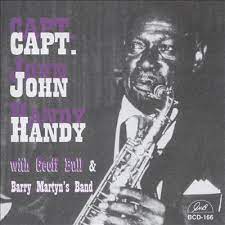
Captain John Handy was born on June 24, 1900 in Pass Christian, Mississippi. His father, John Handy Sr., had a family band that included two of his brothers, Sylvester and Julius. Although he also played guitar, mandolin, and drums at an early age, he chose reeds to develop his professional musical career, beginning with clarinet and then migrating to saxophone.
He moved to New Orleans, Louisiana in 1915 and during the 1920s played clarinet working with Kid Rena and Punch Miller. He switched to alto saxophone in 1928. From the early 1930s he led the Louisiana Shakers with his brother Sylvester, and toured throughout the South. In the latter 1930s Handy worked with Charles Creath in St. Louis, Missouri.
Captain John returned to New Orleans in the 1940s, where he performed with the Young Tuxedo Brass Band. Handy was interviewed several times for the Hogan Jazz Archive at Tulane University in New Orleans in the late 1950s and early Sixties. During the 1960s, he played with Kid Sheik Cola and the Preservation Hall Jazz Band and recorded for GHB, RCA, and Jazz Crusade.
Alto saxophonist Captain John Handy, who was part of the New Orleans jazz revival, transitioned in New York on January 12, 1971 at the age of 70.

More Posts: bandleader,clarinet,history,instrumental,jazz,music,saxophone
Daily Dose Of Jazz…
Hank Shaw was born Henry Shalofsky was born June 23, 1926 in London, England. At the age of 15 he played with Teddy Foster’s band during World War II. In the latter half of the decade he played around his hometown with Oscar Rabin, Frank Weir, and Tommy Sampson, then switched permanently from swing to playing bebop music in 1946 after hearing Dizzy Gillespie.
Visiting the United States in 1947 he came with close friend and fellow pioneer bebopper altoist Freddy Syer. However, unable to secure work permits they moved to Canada where they played with Oscar Peterson and Maynard Ferguson. Returning to England in 1948, Hank was one of the early Club Eleven players, along with Ronnie Scott, John Dankworth, Lennie Bush, and others. He also played with many of these musicians on the recordings of Alan Dean’s Beboppers.
After Club Eleven shuttered, Shaw played with Vic Lewis and toured Europe with Cab Kaye, then joined Jack Parnell’s ensemble in 1953 and Ronnie Scott’s nonet in 1954. He joined Jamaican alto saxophonist Joe Harriott in his celebrated quintet in 1958 but left with pianist Harry South when Harriott sought to introduce his “free-form” concept. Shaw played regularly both live and as a session musician for many British jazz musicians over the course of the next twenty or so years, working with Joe Harriott, Tony Crombie, Don Rendell, Tony Kinsey, Stan Tracey, Bill Le Sage, and others.
He led a quartet at the 100 Club in the Sixties, and played in the Bebop Preservation Society and the John Burch Quartet for over two decades each. He retired due to ill health in the late 1990s. Bebop trumpeter Hank Shaw transitioned four months past his 80th birthday on October 26, 2006 in Kent, England.
More Posts: bandleader,history,instrumental,jazz,music,trumpet
Daily Dose Of Jazz…
Lemuel A. Davis was born in Tampa, Florida on June 22, 1914. He started playing alto saxophone in high school and worked in semi-pro bands before moving to New York City in the early Forties. There his career started with pianist Nat Jaffe. He went on to play with the Coleman Hawkins Septet in 1943 and with Eddie Heywood’s group.
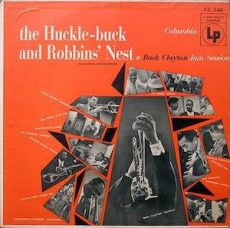
Throughout the 1940s, he played in a variety of jazz groups. Lem composed the bebop tune Lem Me Go in 1946 and recorded it with Eddie Safranski’s All Stars along with Vido Musso, Sanford Gold and Denzil Best. Then in 1953 he appeared on Buck Clayton’s The Hucklebuck recording. He continued playing in New York City throughout the 1950s, recording four albums with Buck Clayton between 1954 and 1956. He recorded little thereafter.
Alto saxophonist Lem Davis, mostly associated with swing music, transitioned on January 16, 1970 in New York City.
More Posts: history,instrumental,jazz,music,saxophone
Daily Dose Of Jazz…
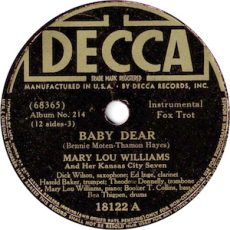
Booker Collins was born on June 21, 1914 in Roswell, New Mexico. Emerging from the New Mexico Military Institute to play in Bat Brown’s Band, a territory band. By the mid-’30s he was keeping very good company playing with pianist Mary Lou Williams and Her Kansas City Seven, cutting sides with her when he was only 16. In 1934, his break came when he got into the band of Andy Kirk and His Clouds Of Joy, staying for the next decade and playing alongside Williams in the rhythm section. Kirk’s hiring replaced the tuba with the double bass.
Booker’s final job of note was with Chicago, Illinois guitarist and drummer Floyd Smith as part of his trio, a stint that lasted from 1946 until the early ’50s, when this great bass man finally laid his big instrument down in terms of full-time playing. He made a few appearances at festival occasions in the ensuing decades but was in Chicago’s recording studios in the late ’50s cutting sides for independent labels.
Returning to performing he joined a combo called the Shades of Rhythm to backup blues singer Mad Man Jones on the demanding Come Here. Collins’ involvement with this group of shifting personnel began in 1952 when he was part of a version that took the risk of cutting sides for the Chance label.
He also performed and recorded with Bert Johnson and the group Six Men And A Girl. Little is known about the death of double bassist Booker Collins who also played the valve trombonist and tuba. It appears he faded into obscurity.
More Posts: bass,history,instrumental,jazz,music,trombone,tuba
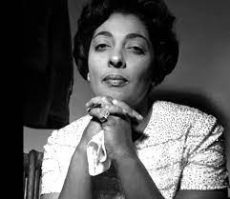
Three Wishes
Girl talk always ensued when Pannonica and Carmen McRae were together and when she wanted to know what her friend would say asked her what her three wishes would be and she told her:
- “I wish that we had more people that appreciated good American music.”
- “I wish my father were alive – it’s in the wrong order! That should come first.”
- “And the other one… I hope that I’ll know when I’ve had it.”
*Excerpt from Three Wishes: An Intimate Look at Jazz Greats ~ Compiled and Photographed by Pannonica de Koenigswarter

More Posts: baroness,history,instrumental,jazz,music,pannonica,three,vocal,wishes