

Daily Dose Of Jazz…
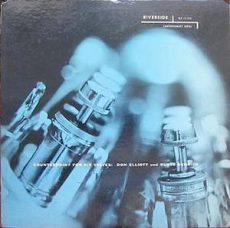
Lyle “Rusty” Dedrick was born on July 12, 1918 in Delevan, New York. His first call to jazz came when he was in a music store in Buffalo, New York and heard a Louis Armstrong record. So taken was he that he bought the record, then returned home to save money for a record player. After brief studies at Fredonia State Teachers College, he spent a two-year jazz apprenticeship working with the band known as “Mr. And Mrs. Swing,” the Red Norvo/Mildred Bailey Orchestra, featuring the arrangements of a young Eddie Sauter.
He followed this with two stints with Claude Thornhill (1941-42 and 1946-47) and the chance to play a book by Gil Evans. This experience, plus private studies with Paul Creston and Stefan Wolpe, were good preparation for a long career in the New York City jazz commercial music field.
His credits included writing and/or playing with Maxine Sullivan, Lee Wiley, Lionel Hampton and others, along with radio and television studio work with Arthur Godfrey, Ed Sullivan, Sid Ceasar and more. At the same time, Rusty was recording his own LPs.
In 1971 Dedrick joined the faculty of the Manhattan School of Music as Director of Jazz Studies. He guest conducted many all-county high school jazz bands, as well as the prestigious American Jazz Orchestra. Swing and bebop jazz trumpeter, arranger, composer and educator Rusty Dedrick, who recorded three albums as a leader, transitioned on December 25, 2009 in Summitville, New York

More Posts: arranger,bandleader,composer,educator,history,instrumental,jazz,music,trumpet
Daily Dose Of Jazz…
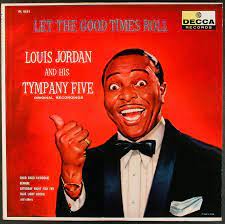
Louis Thomas Jordan was born on July 8, 1908 in Brinkley, Arkansas. His father, James Aaron Jordan, was a music teacher and bandleader for the Brinkley Brass Band and the Rabbit Foot Minstrels. His mother died when he was young and his grandmother Maggie Jordan and his aunt Lizzie Reid raised him. At an early age he studied clarinet and saxophone with his father and by his teens he was a member of the Rabbit Foot Minstrels and was playing professionally in the late 1920s.
In the early Thirties he was performing in Philadelphia, Pennsylvania and New York City with Charlie Gaines. He recorded with Clarence Williams and was a brief member of the Stuff Smith Orchestra. Joining the Chick Webb Orchestra he sang and played alto saxophone, however, in 1938 he started a band that recorded a year later as the Tympany Five.
In 1942, Jordan and his band moved to Los Angeles, California where he began making soundies, the precursors of music video. He appeared on many Jubilee radio shows and a series of programs for the Armed Forces Radio for distribution to American troops overseas. Though a hernia condition kept him out of the war his recordings made him very popular with both black and white soldiers.
During the 1940s Jordan and the band became popular with such hits as Choo Choo Ch’Boogie, Knock Me a Kiss, Is You Is or Is You Ain’t My Baby, and Five Guys Named Moe. Within a year of his breakthrough, the Tympany Five’s appearance fee rose from $350 to $2,000 per night. But the breadth of Jordan’s success and the size of his combo had larger implications for the music industry. His raucous recordings were notable for the use of fantastical narrative, best exemplified on Saturday Night Fish Fry, a two-part 1950 hit that was split across both sides of a 78-rpm record. It was one of the first popular songs to use the word “rocking” in the chorus and to feature a distorted electric guitar.
From July 1946 through May 1947, Jordan had five consecutive number one songs, holding the top slot for 44 consecutive weeks. In 1961, the IRS filed an income tax lien against Jordan and he had to sell property well below its value to pay off his debts. Musician Ike Turner stepped in and contacted and convinced the president of Jordan’s booking agency in Chicago, Illinois. to send Jordan a check for $20,000. He was unaware of this deed.
Over his career he charted dozens of singles, eighteen #1 and fifty-four in the Top Ten. He ranked fifth among the most successful musicians of the period 1942~1995, however, many he did not own the rights to, hence no financial benefit. Saxophonist, multi~instrumentalist, songwriter and bandleader Louis Jordan suffered a heart attack and transitioned on February 4, 1975, in Los Angeles.
More Posts: bandleader,history,instrumental,jazz,music,saxophone,songwriter
Daily Dose Of Jazz…
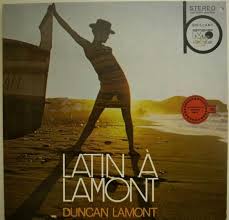
Duncan Lamont was born on July 4, 1931 in Greenock, Scotland. His first instrument was trumpet and he clearly showed promise right from the start. His father played accordion and soon he was joining him on the many gigs all over town. Falling in love with music he practiced all the time and began making a name for himself. In his teens he formed a jazz band with some of his fellow teenage enthusiasts and after taking part in a ‘Melody Maker’ magazine contest, received an offer to join Kenny Graham’s band and turn professional. Initially turning down the offer for work in the shipyards, friends persuaded him to go to London, England and joined the band. It was here that he met and eventually married vocalist Bridget Harrison.
Struggling with his lip he decided to quit the band and return home at just 21 years old. Once again a friend interceded and suggested he try the tenor saxophone, and found an affinity with it. Mastering the instrument he hit the road withthe big bands which led him back to London. A call to become a part of the Swinging Scots recording with Johnny Keating proved fortuitous and he became Keating’s go to saxophonist.
For the next thirty years, session work for TV, films and radio was to be a big part of his life. In this capacity, it’s fair to say he worked with most of the 20th century icons of popular entertainment, from Bing Crosby to Paul McCartney. During the 1960’s, to fuel his jazz needs he became a member of the Johnny Scott Quintet. Encouraged to write for the band’s book, Duncan gravitated to leading his own big band on the BBC.
His most enduring musical partnership was with trumpeter Kenny Wheeler, which lasted decades. As the industry changed Lamont turned his attention to songwriting, composing and lyrics. Having written hundreds of songs, many were recorded by the likes of Blossom Dearie, Natalie Cole, George Shearing, Cleo Laine and a long list of great vocalists. Returning home to Greenock a month towards the end of his career, he performed a homecoming gig with singers Esther Bennett and Daniela Clynes. Tenor saxophonist Duncan Lamont transitioned on July 2, 2019 at 87.
More Posts: bandleader,history,instrumental,jazz,music,saxophone
The Quarantined Jazz Voyager
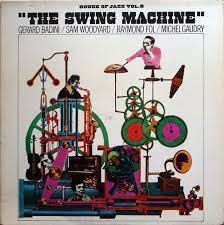
Closing out the final week of the month is The Swing Machine. It’s another offering from the continent that this Jazz Voyager has discovered not in his collection but one that requires sharing.The title really says it all so aptly named by tenor saxophonist Gérard Badini in preparation for a good time!
The album was recorded May 30, 1975 at the Hoche Studio in Paris, France and was produced by Jacques Lubin. The recording engineer was Gerhard Lehner, the liner notes were written by Alexandre Rado, and the photography by Christian Rose.
Tracks | 44:48- It Don’t Mean A Thing (Duke Ellington, Irving Mills) ~
- Let’s Do It (Cole Porter) ~
- Sam Woodyard Is Back In Town (Gérard Badini) ~
- Cute (Neal Hefti)
- Asphodèle (Raymon Fol) ~
- Stomp, Lok And Listen ( Duke Ellington) ~
- Michel Gaudry ~ Double Bass
- Drums – Sam Woodyard ~ Drums
- Raymond Fol ~ Piano, Celesta
- Gérard Badini ~ Tenor Saxophone

More Posts: adventure,album,club,genius,jazz,museum,music,preserving,restaurant,saxophone,travel
Daily Dose Of Jazz…
James Archibald McLin was born in Brooksville, Florida on June 26, 1908. He started on piano before picking up the banjo, then later the guitar. He played locally in Florida before relocating to New York City in 1928. He played both guitar and banjo in the early 1930s for James P. Johnson, Ward Pinkett, and Roy Eldridge.
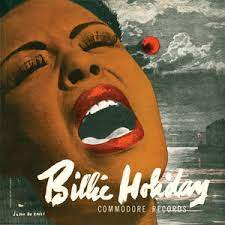
Later in the decade he recorded with Willie “The Lion” Smith, Buster Bailey, Midge Williams, and Billie Holiday. In the early 1940s he worked with Sidney Bechet, Dave Nelson, and Claude Hopkins, then played trombone and mellophone in a military band while serving in the United States Navy during World War II. After his discharge he worked again with Hopkins and played guitar for The Ink Spots.
Banjoist and guitarist Jimmy McLin transitioned on December 15, 1983 in St. Petersburg, Florida.
