

Daily Dose Of Jazz…
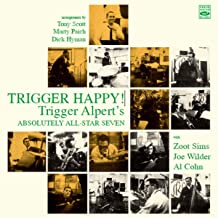
Herman “Trigger” Alpert was born on September 3, 1916 in Indianapolis, Indiana. Attending Indiana University, he studied the bass and soon after was playing with guitarist Alvino Rey in New York City. In the early 1940s he toured with the Glenn Miller band and his enthusiastic playing style can be witnessed during a 1941 performance of In The Mood in Sun Valley Serenade.
During the rest of the decade, he worked with Louis Armstrong, Roy Eldridge, Ella Fitzgerald, Bud Freeman, Woody Herman, Jerry Jerome, Bernie Leighton, Ray McKinley, Frank Sinatra, and Muggsy Spanier. In the 1950s and early 1960s, he recorded as a sideman with Don Elliott, Coleman Hawkins, Gene Krupa, Mundell Lowe, Buddy Rich, Artie Shaw, and the Sauter-Finegan Orchestra.
Until the late 1960s, Trigger was a member of the CBS Orchestra and the CBS band for the television series the Garry Moore Show with Carol Burnett and the Barbra Streisand television specials My Name Is Barbra and Color Me Barbra.
Alpert wrote two instructional books: Walking the Bass in 1958 and the Electric Bass in 1968. He recorded a single album as a leader titled Trigger Happy on the Riverside label in 1956.
Retiring from music in 1970, he made his longtime interest in portrait photography a full-time profession. Bassist Trigger Alpert passed away on December 21, 2013 at an assisted living facility in Jacksonville Beach, Florida.

More Posts: bandleader,bass,history,instrumental,jazz,music,photographer
Daily Dose Of Jazz…
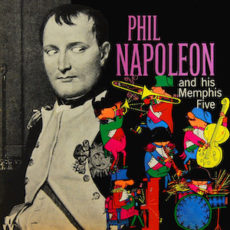
Phil Napoleon was born Filippo Napoli on September 2, 1901 in Boston, Massachusetts. He began with classical training and was performing publicly by age 5. In the 1910s, he was one of the first musicians in the northeastern United States to embrace the new jass style brought to that part of the country by musicians from New Orleans, Louisiana.
At 16 with pianist Frank Signorelli he formed the group The Original Memphis Five in 1917. He became one of the most sought after trumpeters of the 1920s and the group became one of the most prolific in New York City at the time. In 1922-1923 they made over a hundred recordings. Napoleon’s 1927 version of Clarinet Marmalade was a particular success. The group split up in 1928.
During the 1930s, Phil mainly worked as a session trumpeter, working in the RCA Radio Orchestra in the early 1930s, and in 1937 unsuccessfully tried to form his own orchestra. He recorded with the Cotton Pickers and the Charleston Chasers and also worked with blues singers Leona Williams and Alberta Hunter.
Napoleon joined Jimmy Dorsey’s then Los Angeles, California based group in the mid 1940s, and he appeared with the band in the film Four Jills in a Jeep. Parting with Dorsey in 1947, he moved back to New York City and worked as a studio musician at NBC until 1949-1950 when he reformed The Original Memphis Five. During the early 1950s the group became noted for their performances at Nick’s in New York City. He worked frequently with his nephew Marty Napoleon, a jazz pianist. In 1959, Napoleon and The Five performed at the Newport Jazz Festival, later released as an album.
In 1966 Phil opened up his own club named Napoleon’s Retreat in Miami, Florida and continued to perform Dixieland jazz in the club up until the 1980s. Trumpeter and bandleader Phil Napoleon passed away on October 1, 1990 in Miami.
More Posts: bandleader,history,instrumental,jazz,music,trumpet
Daily Dose Of Jazz…
George F. Clarke was born on August 28, 1911 in Memphis, Tennessee. He attended Manassas High School, where he was Jimmie Lunceford’s pupil before joining the orchestra and playing with Lunceford until 1933.
Relocating to Buffalo, New York, there he played with Guy Jackson, Lil Armstrong and Stuff Smith in 1935. He and Smith worked together again on tour in 1939-1940 and in the recording studio. Returning to Buffalo, Clarke led an ensemble at a local club from 1942 to 1954.
Following this he moved to New York City and worked with Wild Bill Davis and Jonah Jones, and toured internationally in Europe in 1959 with Cootie Williams and Africa with Cozy Cole in 1962. He was occasionally active through the ‘60s in New York City. Tenor saxophonist George Clarke passed away in September 1985 in the Bronx, New York.

More Posts: history,instrumental,jazz,music,saxophone
Daily Dose Of Jazz…
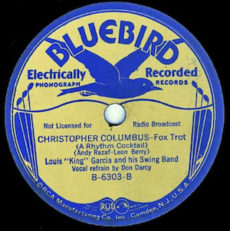
Louis “King” Garcia was born on August 25, 1905 in Juncos, Puerto Rico and played early in his life in the Municipal Band of San Juan, whose director was Juan Tizol’s uncle, Manuel Tizol. This led to some work with the Victor Recording Orchestra.
Moving to the United States in the early 1920s during the Jazz Age, he played with the Original Dixieland Jazz Band and the Emil Coleman Orchestra. The Thirties saw him increasingly working in the studios, including his most important association, Jimmy and Tommy Dorsey, which he recorded with both together and separately. He also played with the Vic Berton Orchestra, Richard Himber, Nat Brandwyne, Amanda Randolph, Louis Prima, and vocalist Amanda Randolph.
In the 1940s he returned to play with Coleman again, and led his own Latin ensemble that decade. By the 1960s he had moved to California and faded from the scene, essentially retiring due to failing health.
Trumpeter and bandleader King Garcia, who spent most of his career in the United States, passed away in Los Angeles, California on September 4, 1983.
More Posts: bandleader,history,instrumental,jazz,music,trumpet

Daily Dose Of Jazz…
Bumps Myers was born Hubert Maxwell Meyers on August 22, 1912 in Clarksburg, West Virginia. Moving to southern California with his family when he was nine years old, he began playing with Curtis Mosby in the late 1920s.
The 1930s saw him playing with Buck Clayton including on a tour of China. In addition, he played with Lionel Hampton and Les Hite. In the 1940s Bumps performed extensively with Benny Carter, Lester Young, Jimmie Lunceford, Sid Catlett, T-Bone Walker, Benny Goodman, and Russell Jacquet.
Through the 1950s he continued performing live and working as a session musician, with Jimmy Witherspoon, Helen Humes, Red Callender, Louie Bellson, and Harry Belafonte. After working with Horace Henderson in the early 1960s, he put together his own group Bumps Myers & His Frantic Five and recorded prior to retiring due to health problems.
Tenor saxophonist Bumps Myers, who also on occasion played alto and soprano, passed away on April 9, 1968 in Los Angeles, California.
More Posts: bandleader,history,instrumental,music