

Daily Dose Of Jazz…
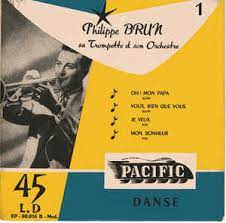
Philippe Brun was born on April 29, 1908 in Paris, France and first began playing professionally in the late 1920s with the bands of Gregor, Danny Polo, and Ray Ventura. In the early 1930s he spent time in London, England working with Bert Ambrose, Jack Hylton, and Fred Waring.
Returning to Paris around 1936, he performed with Jazz du Poste Parisien and with Ventura again, as well as with Django Reinhardt and Alix Combelle. He was recorded as a leader from 1937-1940. During World War II he worked in Switzerland, with Eddie Brunner, André Ekyan, Edmond Cohanier, and Teddy Stauffer.
Brun’s wife, Annie Fratellini, a vocalist and comedian, also performed with Raymond Fol and Kenny Clarke. Trumpeter Philippe Brun passed away on January 15, 1994 in Paris.
More Posts: bandleader,history,instrumental,music,trumpet

Daily Dose Of Jazz…
Raymond Fol was born in Paris, France on April 28, 1928 and along with his brother Hubert was raised in a musical household. He began playing piano at five years of age, and both he and his brother played in Claude Abadie’s ensemble after the end of World War II.
The Fol brothers then formed their own group, the Be Bop Minstrels, however, Raymond worked around this time with musicians such as Pierre Braslavsky, Jean-Claude Fohrenbach, Django Reinhardt, Roy Eldridge, and Johnny Hodges. In 1952, he did a European tour in Dizzy Gillespie’s band, and for several years in the middle of the decade was a regular at Paris’s Club Saint-Germain. He also worked in the 1950s with Sidney Bechet, Claude Luter, Guy Lafitte, and Stephane Grappelli.
He worked briefly in Rome, Italy in 1958, then returned to Paris, playing both piano and celesta at the Club Saint-Germain. In the 1960s and 1970s he worked with Kenny Clarke, Duke Ellington, Paul Gonsalves, Cat Anderson, and Gerard Badini. Raymond also recorded a few times on solo piano in the first half of the 1970s.
Pianist Raymond Fol passed away in the City of Lights on May 1, 1979.
More Posts: bandleader,history,instrumental,jazz,music,piano
Daily Dose Of Jazz…
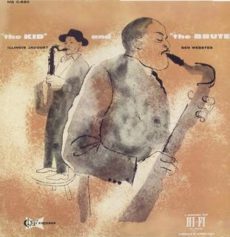
Rick Henderson was born on April 25, 1928 in Washington, D.C. and studied composition as a high schooler and played locally in the late 1940s. He served in the Army from 1951 to 1953, then joined Duke Ellington’s Orchestra after being recommended by Clark Terry.
He played with Ellington during his years on Capitol Records, doing arrangements in addition to his duties as a player. He also composed tunes such as Carney for the Ellington band. After leaving Ellington’s employ in 1956, Rick returned to D.C. where he led the Howard Theatre’s house band until 1964.
Following this he worked as an arranger and composer for jazz orchestras, military bands and school ensembles. Among those who used his charts, in addition to Ellington, were Count Basie, Illinois Jacquet, and Billy Taylor. Henderson continued to lead bands into the 1990s, including the University of Maryland Jazz Ensemble from 1977 to 1978.
Saxophonist and arranger Rick Henderson passed away from arteriosclerotic cardiovascular disease on May 21, 2004.
More Posts: arranger,bandleader,history,instrumental,jazz,music,saxophone

Daily Dose Of Jazz…
John G. Blowers Jr. was born April 21, 1911 in Spartanburg, South Carolina and learned to play percussion during his schooldays and began performing with the Bob Pope Band in 1936.
After attending Oglethorpe College, in 1937 he travelled to New York City, where he found employment as a drummer in Greenwich Village. In 1938 he joined Bunny Berigan’s band, and in 1942 he began performing with the up-and-coming Frank Sinatra, who asked Johnny to record with him. They performed and recorded together regularly until the 1950s.
In 1947, he opened Club Blowers in the Queens district. In addition to Sinatra, Blowers performed with Louis Armstrong, Perry Como, Bing Crosby, Sidney Bechet, Eddie Fisher, Ella Fitzgerald, Judy Garland, Billie Holiday, and Mel Tormé.
Johnny Blowers, drummer of the swing era, passed away on July 17, 2006.
More Posts: bandleader,drums,history,instrumental,jazz,music
Daily Dose Of Jazz…
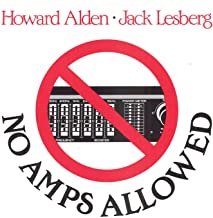
Jack Lesberg was born February 14, 1920 in Boston, Massachusetts. He had the misfortune of playing in that city’s Cocoanut Grove on the night in 1942 when 492 people lost their lives in a fire. His escape was memorialized by fellow bassist Charles Mingus.
Jack performed in the New York City Symphony under Leonard Bernstein in the 1940s. Lesberg continued to tour in the 1980s and performed in Menlo Park, California in 1984. Jack played with Louis Armstrong, Earl Hines, Jack Teagarden, Coleman Hawkins, Sarah Vaughan, Urbie Green, George Barnes, Ruth Brown, Tony Bennett, Johnny Hodges and Benny Goodman among others, He went on several international tours.
Double-bassist Jack Lesberg, who co~led two sessions and twenty-one as a sideman, passed away from Alzheimer’s Disease in Englewood, California at the age of 85 on September 17, 2005.

More Posts: bandleader,bass,history,instrumental,jazz,music