

Daily Dose Of Jazz…
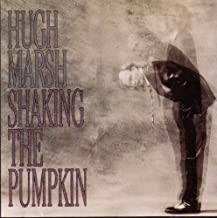
Hugh Marsh was born June 5, 1955 in Montreal, Quebec, Canada and brought up in Ottawa, Ontario, where he learned to play the violin from the age of five. While in high school, when trying to play the saxophone he was led to exploring jazz, funk and rhythm and blues. With his father’s encouragement, he transferred these improvisation skills to the electric violin.
By 1978, Marsh was invited by jazz musician Moe Koffman to perform with him in a concert series at the Art Gallery of Ontario in Toronto. This led to gigs at top Toronto clubs and to perform with Canadian jazz musicians Doug Riley, Claude Ranger, Sonny Greenwich and Don Thompson. In 1979 he joined Bruce Cockburn, recording and touring with him.
In 1984, he recorded his independent album The Bear Walks and was distributed by Duke Street Records. He was joined by Doug Riley on keyboards, Peter Cardinali on bass, and Michael Brecker on tenor saxophone. His next recording ventured into other genres mixed with jazz. Since 1990 HUgh has recorded and toured with Celtic songstress Loreena McKennitt, contributing to six multi-platinum albums and a number of world tours. He has worked with Turkish Sufi deejay Mercan Dede, and has worked with Turkish artists Ihsan Ozgen, Kani Karaca, Goksel Baktagir and Ozcan Deniz.
Marsh would go on to collaborate on film scoring projects with composers Harry Gregson Williams and Don Rooke, and with Hans Zimmer on scores for Tears of the Sun and The Da Vinci Code.
In 2004 he joined clarinetist Don Byron’s new quartet “Swiftboat”, along with bassist Kermit Driscoll, and drummer Pheeroan Aklaff. He toured as a member of trumpeter Jon Hassell’s new quartet with bassist Peter Freeman and percussionist Steve Shehan. A four-time winner of the Jazz Report Award for violinist of the year and a three-time recipient of the National Jazz Award for violinist of the year, he has been nominated for a 2007 Juno Award in the best contemporary jazz album category.
Violinist Hugh Marsh continues to perform and record across genres, regularly performing with Rheostatics.
More Posts: bandleader,history,instrumental,jazz,music,violin
Daily Dose Of Jazz…
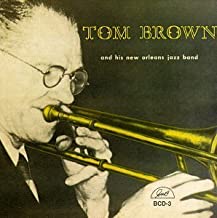
Tom Brown was born in Uptown New Orleans, Louisiana on June 3, 1888. He played trombone with the bands of Papa Jack Laine and Frank Christian, and by 1910 he was usually working with leading bands under his own name. The band played in a style then locally known as “hot ragtime” or “ratty music”. In early 1915, his band was heard by Vaudeville dancer Joe Frisco who then arranged a job for Brown’s band in Chicago, Illinois.
Tom Brown’s Band from Dixieland opened up at Lamb’s Cafe in Chicago, this band seems to be the first to be popularly referred to as playing Jass. The term jass, at that time, had a sexual connotation, which drew more people to come to hear the band out of curiosity. Realizing the publicity potential he started calling his group Brown’s Jass Band.
Heading to Chicago, Illinois he enjoyed over four months of success there before moving to New York City, where they played for an additional four months more prior to returning to New Orleans in 1916. Once home, Tom immediately put together another band with Larry Shields, Alcide Nunez, and Ragbaby Stevens, then went to work for Bert Kelly in New York City, replacing the Original Dixieland Jass Band at Reisenweber in 1918. He started doing freelance recording work with New York dance and novelty bands, then joined the band of Harry Yerkes.
Brown also played the Vaudeville circuit in the acts of Joe Frisco and Ed Wynn. Late 1921 he returned to Chicago and joined Ray Miller’s Black & White Melody Boys, with whom he made more recordings. During this period he also co-lead a dance band with his brother Steve. Back in New Orleans he played with Johnny Bayersdorffer and Norman Brownlee’s bands, making a few excellent recordings.
During the Great Depression he supplemented his income from music by repairing radios. He opened up a music shop and a junk shop on Magazine Street. He played string bass in local swing and dance bands. With the revival of interest in traditional jazz he played in various Dixieland bands in the 1950s. Making his last recording just weeks before his death, his trombone playing apparently did not suffer from the fact that he had neither teeth or dentures at the time. Trombonist Tom Brown, who also played string bass, passed away in New Orleans on March 25, 1958.
More Posts: bandleader,history,instrumental,jazz,string bass,trombone
Daily Dose Of Jazz…
Ernest Hood was born on June 2, 1923 in Portland, Oregon. During the 1940s he was a jazz guitarist in the Portland, Oregon area in the 1940s. He played with his brother Bill and saxophonist Charlie Barnet.
Hood contracted polio in the 1950s, which confined him to using a wheelchair for the rest of his life. No longer able to hold a guitar, he started playing the zither. He played zither on some of Flora Purim’s early albums.
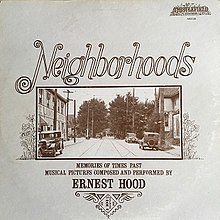
His only studio album, Neighborhoods, was recorded and self~released in 1975 and is a work of ambient music that explores the soundscapes of Portland, Oregon suburbia through a collage of field recordings layered with Hood’s zither and synthesizer melodies. Only one thousand copies were pressed during its original production run. After remaining in obscurity for over 40 years, it was reissued by Freedom to Spend in 2019.
Hood, who often went by Ern or Ernie, was a major figure in Portland’s music scene. He helped found KBOO, a nonprofit FM radio station that still exists today in the city. The radio show he hosted, Radio Days, on KBOO and KOAP, aimed for the same kind of audience his record Neighborhoods did, one that wanted to relive the serenity of the past.
He was also involved in launching the city’s first jazz club, The Way Out. Avant~garde zither and keyboardist, and radio host Ernest Hood, passed away in 1995.
More Posts: bandleader,club owner,history,instrumental,jazz,keyboards,music,radio host,zither

Daily Dose Of Jazz…
Marc Steckar was born on June 1, 1935 in Cherbourg, France. He began learning the cello from age eight, then played the trumpet. During his studies at the Paris National Conservatory, he switched to the trombone in 1953, which he studied with André Lafosse. After an interruption due to his military service in the Algerian War, he completed his training and in 1959 he received the second prize for trombone.
In the next few years he worked in the big band of Benny Bennet, in the Aimé Barelli orchestra in the Monte Carlo casinos and in Olympia where he played Marlene Dietrich and Nat King Cole, with whom he toured Europe. He played in the orchestra of Paul Mauriat accompanying Charles Aznavour, then in the big band of Daniel Janin who played behind Édith Piaf, Jacques Brel, Gilbert Bécaud and Sammy Davis Jr. in 1961.
Over the next few years he worked as a studio musician, among others for Michel Legrand , Vladimir Cosma and for various television shows, but also again at the Olympia for Roland Petit and Zizi Jeanmaire. Between 1973 and 1983, Marc accompanied Claude Nougaro with Eddy Louiss and Maurice Vander before becoming a member of Martial Solal’s big band. He recorded film music with Vander.
He went on to form Steckar TUBAPACK, and the Elephant Tuba Horde Big Band. Steckar is also on albums by François Jeanneau, Illinois Jacquet and Sonny Rhodes. Tubist Marc Stekar, who played trombone, bass trombone, euphonium, and was a composer, passed away on June 27, 2015 in Bessancourt, Val-d’Oise, France.
More Posts: bandleader,composer,euphonium,history,instrumental,jazz,music,trombone,tuba
Daily Dose Of Jazz…
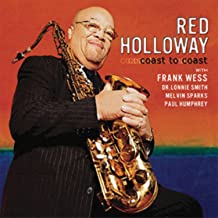
Red Holloway was born James Wesley Holloway on May 31, 1927 in Helena, Arkansas, and started playing banjo and harmonica before switching to tenor saxophone when he was 12 years old. Graduating from DuSable High School, where he had played in the school big band with Johnny Griffin and Eugene Wright, and attended the Conservatory of Music, Chicago, Illinois.
Joining the Army when he was 19, Red became bandmaster for the U.S. Fifth Army Band, and after completing his military service returned to Chicago and played with Yusef Lateef and Dexter Gordon, among others. In 1948, he joined blues vocalist Roosevelt Sykes, and later played with other rhythm & blues musicians such as Willie Dixon, Junior Parker, and Lloyd Price.
In the 1950s, he played in the Chicago area with Billie Holiday, Muddy Waters, Chuck Berry, Ben Webster, Jimmy Rushing, Arthur Prysock, Dakota Staton, Eddie “Cleanhead” Vinson, Wardell Gray, Sonny Rollins, Red Rodney, Lester Young, Joe Williams, Redd Foxx, B.B. King, Bobby Bland, and Aretha Franklin. During this period, he also toured with Sonny Stitt, Memphis Slim and Lionel Hampton. He became a member of the house band for Chance Records in 1952. He subsequently appeared on many recording sessions for the Chicago-based independents Parrot, United, States, and Vee-Jay.
From 1963 to 1966, he was in organist Brother Jack McDuff’s band, which also featured guitarist George Benson, who was then at the start of his career. In 1974, Holloway recorded The Latest Edition with John Mayall and toured Europe, Japan, Australia and New Zealand. From 1977 to 1982, he worked with Sonny Stitt, recording two albums together. Following Stitt’s death, he played and recorded with Clark Terry.
Tenor saxophonist Red Holloway passed away in Morro Bay, California, aged 84 of a stroke and kidney failure on February 25, 2012, one month after Etta James, with whom he had worked extensively.

More Posts: bandleader,composer,history,jazz,music,saxophone