

Daily Dose Of Jazz…
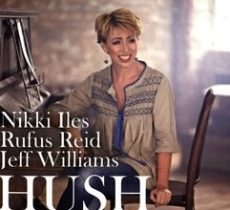
Nikki Anne Iles was born Nikki Anne Burnham on May 16, 1963 in Dunstable, Bedfordshire, England. Her primary school musical education began when she learned to play the harmonica and the clarinet. At eleven she won a junior exhibition at the Royal Academy of Music, where she studied clarinet and piano from 1974 to 1981. She became a member of the Bedfordshire Youth Jazz Orchestra before going to the Leeds College of Music from 1981 to 1984.
Settling in Yorkshire after graduating from the Leeds College of Music, she married trumpeter Richard Iles and took his name. She joined his band Emanon, with which she played some of her compositions. Iles began playing with several London-based bands, led by Steve Argüelles, Mick Hutton and Stan Sulzmann.
Iles won the 1996 John Dankworth Special Award at the BT Jazz Festival, but following a serious car crash after a gig, she opted to settle in London, England. She went on to be a senior lecturer at Middlesex University, and taught at the University of York, Leeds College of Music, the Guildhall School of Music, and in Bulgaria, Holland, France, and Finland.
Composer, pianist and educator Nikki Iles, who was awarded the British Empire Medal (BEM) at the 2022 New Year Honours for services to music, continues her career as a composer, educator and musician.

More Posts: bandleader,composer,educator,history,instrumental,jazz,music,piano
Daily Dose Of Jazz…
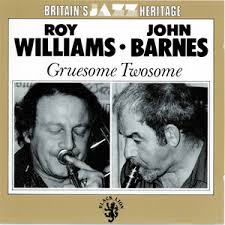
John Barnes was born in Manchester, England on May 15, 1932. He started out his career as a flügelhorn player in the early 1950s, and adapted his playing skills to the clarinet, an instrument he favored. He played traditional jazz with Alan Elsdon, The Mike Daniels’ Delta Jazzmen and also The Zenith Six.
In May 1964, after a bad car crash Barnes was replaced by Al Gay, until his full rehabilitation as a member of Alex Welsh band. He continued and extended his career musically from 1967 with the Scottish dixieland jazz trumpet and cornet player Alex Welsh and his Jazz Band, which lasted ten years until 1977.
He began playing alto, baritone, soprano saxophone and the flute. During this period he rose to fame in the jazz arena appearing at the Newport Jazz Festival aged 37 in 1969. His skills on baritone saxophone earned him a huge jazz fan base, some suggesting he was the best they had seen in Europe. After leaving Welsh, Barnes worked as co-leader, with trombonist Roy Williams of the Midnite Follies Orchestra, which included many American jazz artists.
John worked with Janet Jackson, Leo Sayer, Humphrey Lyttelton, Gerry Mulligan, Spike Robinson, Bobby Wellins and Keith Nichols. He considered Coleman Hawkins and Johnny Hodges to be his two main saxophone influences throughout his career.
In 2011, while on holiday in Greece, Barnes suffered a stroke. As a result of his stroke, a benefit concert was held for him the following year at the 100 Club in Oxford Street, London.
Saxophonist, clarinetist and flutist John Barnes died on April 18, 2022 at the age of 89.
More Posts: bandleader,clarinet,flute,history,instrumental,jazz,music,saxophone
Jazz Poems
FOR ERIC DOLPHY
on flute
spinning spinning spinning
love
thru / out
the universe
i
know
exactly
whut chew mean
man
you like
titter
my sister
who never expressed LOVE
in words (like the white folks always d
she would sit in the corner o
and cry i
everytime n
I g
got a whuppin
Etheridge Knight
from Jazz Poems ~ Selected and Edited by Kevin Young
More Posts: book,classic,collectible,history,jazz,library,poet
Daily Dose Of Jazz…
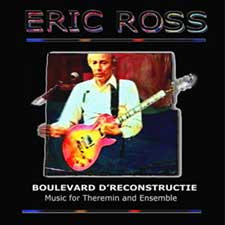
Eric Ross was born on May 14, 1948 in Carbondale, Pennsylvania and began studying piano at the age of seven under Jean Krantz-Thomas. Ten years later he started to write his own compositions and in the late 1960s and early 1970s he studied guitar and attended the electronic music composition course with Charles Dodge at Columbia University.
1972 saw him finishing college and beginning his career as a musician by playing and working in recording studios. Three years later Eric began playing the theremin and the following year he played his music exclusively, allowing him to develop it as a voice in his compositions. In 1982 he released his first album, Songs for Synthesized Soprano, and performed in concert at the Lincoln Center in New York.
He has performed throughout the United States and toured Europe, in addition to performing on radio, television and film. For over twenty years Eric’s ensemble featured John Abercrombie, Larry Coryell, Andrew Cyrille, Oliver Lake, Leroy Jenkins, Youseff Yancy, Lydia Kavina, and Robert Dick, among others.
Along with his wife Mary, the couple created memorable multimedia performances that intertwined music with images, video projections, and dance. As an educator he has lectured on the theremin, piano, guitar, and electronic music at colleges, universities and schools in the USA and Europe.
Pianist and guitarist Eric Ross, who also plays synthesizers and is a master of the theremin, continues to blend classical, jazz, serial and avant-garde in his performances.
More Posts: bandleader,guitar,history,instrumental,jazz,music,piano,synthesizer,theremin
Daily Dose Of Jazz…
Jim Douglas was born Robert James Elliot Douglas on May 13, 1942 in Gifford, East Lothian, Scotland. He played drums in his youth before switching to guitar and in his teens he accompanied clarinettist Pete Kerr.
As part of a Dixieland band, he performed in Germany in 1960 and soon after Jim began playing with Alex Welsh. In 1971 he appeared on the album Freddy Randall and His Famous Jazz Band. Other than Kerr and Welsh, he worked with Alan Elsdon, Lennie Hastings, Ed Polcer, and Keith Smith.
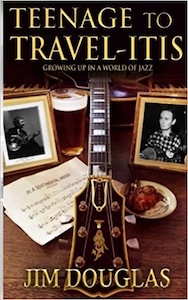
Douglas wrote and self-published a semi-autobiographical book, Tunes, Tours and Travel-itis – Eighteen Years of Facts, Faces and Fun with the Alex Welsh Band. He followed this up three years later with Teenage to Travel-itis – Growing Up in a World of Jazz. The sequel chronicles his adventures in the Jazz world before and after his time with the Alex Welsh Band.
Guitarist, banjoist, and author Jim Douglas, who played with Red Allen, Earl Hines, and Ruby Braff from 1962 until 1981 while in the Welsh band, continues to perform.
More Posts: author,bandleader,banjo,guitar,history,instrumental,jazz,music