

Requisites
Something For Lester ~ Ray Brown | Carl Anthony
This week I am standing in for our regular Requisites host and writer Eddie Carter, who is on an anniversary vacation. He will return next Sunday with another prolific review of an album for your collection.
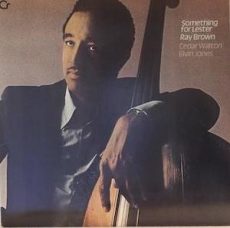
This week I have selected Something for Lester, an album by bassist Ray Brown that was recorded on June 22, 23 & 24 1977 at Contemporary’s Studio in Los Angeles, California. The session was recorded in the bop and cool jazz genres and was released on the Contemporary label the following year.
The producers on the sessions were John Koenig and Lester Koenig. The photograph was taken by Bret Lopez, the design was provided by George Kershaw, with liner notes by Leonard Feather and the recording and sound was performed by the Koenig brothers and Roy DuNann.
Of the seven compositions presented here by the trio, four are classics, two are by Cedar Walton and one was composed by Brown. The conversation between the players is easy and comfortable as they navigate through each song. If you enjoy small group sessions you’ll find these consummate musicians will deliver what you like.
Tracks | 41:10
- Ojos de Rojo (Cedar Walton) – 5:16
- Slippery – 7:27 (Ray Brown)
- Something in Common (Walton) – 4:50
- Love Walked In (George Gershwin, Ira Gershwin) – 5:25
- Georgia on My Mind (Hoagy Carmichael, Stuart Gorrell) – 7:11
- Little Girl Blue (Richard Rodgers, Lorenz Hart) – 6:17
- Sister Sadie (Horace Silver) – 4:54
- Ray Brown – bass
- Cedar Walton – piano
- Elvin Jones – drums

More Posts: bass,choice,classic,collectible,collector,history,instrumental,jazz,music
Daily Dose Of Jazz…
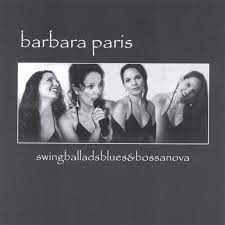
Barbara Paris was born on October 2, 1954 in Denver, Colorado and from an early age listened to Nat King Cole, Dinah Washington, Mel Torme and Frank Sinatra. Constantly listening to the radio she memorized every song she heard. She sang with her church choir, played violin, took piano lessons and began playing the guitar at 15. She started out singing folk music but gravitated to jazz.
After high school graduation at 16, she moved to Boulder, Colorado and began a successful hairdresser career. However, it was on vacation in St. Thomas that she met Louis Armstrong veteran Eddie Shu and subsequent encouragement led her to the stage.
Barbara made her debut as a jazz singer while in Paris, France. There an acquaintance told her about Denver resident pianist Joe Bonner and upon her return tracked him down and a 23 year musical partnership commenced. She has worked with Freddie Hubbard, Junior Mance, Joe Pass, and recorded with Nancy Wilson’s rhythm section, pianist Llew Matthews, bassist John B. Williams and drummer Roy McCurdy, among numerous others.
Vocalist Barbara Paris continues to pursue performing, composing, recording, and clinics.

More Posts: bandleader,history,instrumental,jazz,music,vocal
Daily Dose Of Jazz…
Graham Burbridge was born on October 1, 1933 in Stepney, London, England. He started drumming about the age of six, playing things like British Grenadiers with Boy Scouts Bands. It was only after the war when he was around twelve that he found jazz and progressed from Spike Jones through Spanier, Bunk Johnson to Lennie Tristano. It was a fairly rapid musical education that sat him on the modern side of the fence in his genre choice.
Graham played drums in the RAF with a Military Band, but also managed to get into the dance band. Back in civilian life in 1954 he worked a daytime job and played in a trio in the evening with Pete Elderfield and Maurice Hinson. His early interests in jazz led him to all the clubs, sitting in whenever he could. One night in Humph’s he was invited to play with the Sandy Brown Band and the next day was asked to join the band full time, and his professional career took off. He played with Brown until Sandy retired.
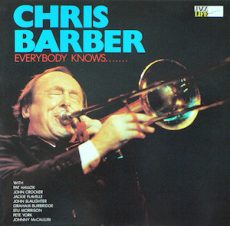
Joining the Chris Barber Band in 1957 was fortuitous, as the relationship lasted nearly two decades. Off stage Burbridge’s interests ran towards new and antique guns, and building model aircraft, something that had been a part of his life for a long time. His interest in guns was a new endeavor but also helped to re-energize and replace the nervous energy used on stage.
Drummer Graham Burbridge transitioned in 2003.
More Posts: bandleader,history,instrumental,jazz,music,piano
Daily Dose Of Jazz…
William Luther Johnson was born on September 30, 1912 in Jacksonville, Florida and studied piano as a child and began playing the alto saxophone at the age of 16. After working with lesser-known bands he studied in conservatories in Wisconsin and Illinois before attending Marquette University.
While in Milwaukee, Wisconsin he played with Jabbo Smith and others. He worked with Baron Lee and Tiny Bradshaw, and in 1936 joined Erskine Hawkins, with whom he performed into the early 1940s, recording with him from 1939 to 1942. He composed Tuxedo Junction with Hawkins and appeared with the band in the short film Deviled Hams in 1937.
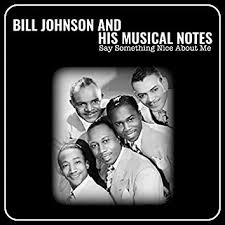
Around mid-1946 he recorded under Bill Johnson and Orchestra, with several of the members becoming the Musical Notes. Bill Johnson and the Musical Notes recorded for Harlem, RCA, King, Regal, Tru-Blue.He recorded for Ronnex as the Bill Johnson Quartet, and the Bill Johnson Quintet for Baton. Over the years, there were many personnel changes, but Bill and Gus Gordon were on all the recordings.
In the Fifties failing health caused the breakup of the group, although he re-formed it on a couple of occasions. Alto saxophonist, clarinetist, and arranger Bill Johnson, who was diagnosed with lung cancer in 1957, transitioned on July 5, 1960 at 47 years old in New York City.

More Posts: arranger,bandleader,clarinet,history,instrumental,jazz,music,saxophone
Daily Dose Of Jazz…
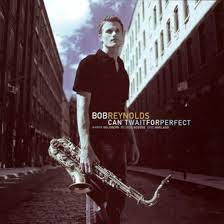
Bob Reynolds was born in Morristown, New Jersey on September 29, 1977. His family moved to Jacksonville, Florida where he started playing saxophone at age 13. Attending high school at Douglas Anderson School of the Arts he became part of the well-known jazz band. After graduating, he attended Berklee College of Music where he studied with George Garzone and Hal Crook.
He played with John Mayer’s band for five years, then worked with Brian Blade, Aaron Goldberg, Gregory Hutchinson, and Tom Harrell. A solo recording artist since the turn of the century, his 2006 album Can’t Wait for Perfect was voted Best Debut in the Village Voice jazz poll.
As a member of the popular genre-bending instrumental group Snarky Puppy since 2014, he has won Grammy Awards with the band for the albums Culcha Vulcha and Live at the Royal Albert Hall.
Tenor saxophonist Bob Reynolds has received four ASCAP Young Jazz Composer awards, and Berklee’s Billboard Magazine Endowed Scholarship, and continues to performa and record.
More Posts: bandleader,history,instrumental,jazz,music,saxophone