

Daily Dose Of Jazz…
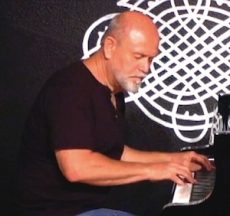
D C DowDell was born on August 9, 1951 in Southern California and studied Music Education at UCLA and earned a Masters of Music Composition at University of North Texas. He has been influenced by Bill Evans, Keith Jarrett, Kenny Baron and Herbie Hancock. His style and piano technique blends the fine inner voicings of modal with the highly energetic impressions of the avante garde.
He has appeared with Bobby Vinton, Marilyn McCoo and Rosemary Clooney just to name a few. His passion for jazz led him to composing and arranging charts for top vocalists, solo instrumental artists and orchestra. His influences are Gil Evans, Bob Florence and George Russell.
Pianist D C DowDell moved to Ocean Beach, California where he continually plays locally with jazz ensembles and teaches jazz theory and composition at A Passion for Jazz! Music Studios. He first published his Basic Musicianship in 1993, a primary music reference and theory text.

More Posts: arranger,bandleader,composer,educator,history,instrumental,jazz,music,piano
Daily Dose Of Jazz…
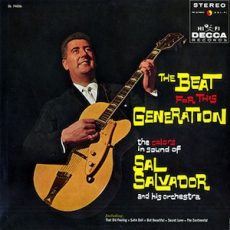
Vinnie Dean was born Vincent Nicholas diVittorio on August 8, 1929 in Mount Vernon, New York. He was primarily an alto saxophonist, but also played flute and piccolo.
After World War II he played in New York City with Shorty Sherock and Johnny Bothwell, and recorded with Charlie Spivak and Charlie Barnet in the late 1940s. The 1950s saw him playing with Elliot Lawrence, Stan Kenton, Ralph Burns, and Eddie Bert, recording with all of them.
He was less active from the late-1950s, but still performed or recorded later in his career with Hal McKusick, Ray McKinley, Urbie Green, Sal Salvador, and Benny Goodman, as well as returning to play with Lawrence and Barnet.
From the 1960s onward he was involved in the music business, operating a publishing outlet, a booking agency, a recording studio, and a vinyl shop. Alto saxophonist Vinnie Dean died in Danbury, Connecticut on September 14, 2010 at the age of 81.
More Posts: flute,history,instrumental,jazz,music,piccolo,saxophone
Daily Dose Of Jazz…
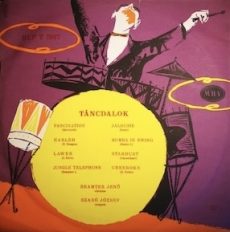
Jeno Beamter was born on August 7, 1912 in Budapest, Hungary. Graduating from high school in 1930 he was already trained as a drummer at the age of seven, although he was taught to play the violin. He completed his musical studies privately. From 1930 , he was taught to play the drums by Vilmos Roubal, a member of the Opera House. He soon began to play the vibraphone.
From 1933 he played in various bands, Bubi Vibraphone Ensemble, Solymossy–Beamter Duo, Ernő Vécsey Ensemble, Martiny Band, and Szabó–Beamter Duo. He made his first recordings with the Smiling Boys band.
The various jazz formations of Jenő Horváth’s Radiola Band, the Herrer band, the Durium band, Tabányi and its soloists, János Gaál Gyulai’s small band, and the Deák Big Band were the prominent bands in which he played. He made guest appearances in Austria, Switzerland, the GDR, England, and Yugoslavia.
In the 1970s, he performed with Barbra Streisand and Frank Sinatra in a joint show at the Kennedy Center. Jeno performed live with Tabányi on Hungarian Radio for fifteen years, almost every Sunday.
Drummer, vibraphonist, composer and educator Jeno Beamter, who performed in the traditional, modern and was one of the legendary figures of Hungarian swing music, died on January 11, 1984 in the city of his birth.
More Posts: composer,drums,educator,history,instrumental,jazz,music,vibraphone
Daily Dose Of Jazz…
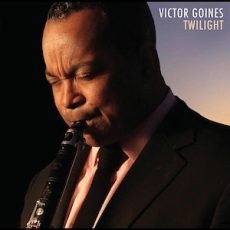
Victor Louis Goines, born August 6, 1961 in New Orleans, Louisiana. He graduated from St. Augustine High School in New Orleans and has been a member of Jazz at Lincoln Center Orchestra and the Wynton Marsalis Septet since 1993.
Goines has collaborated with Terence Blanchard, Dee Dee Bridgewater, Ruth Brown, Ray Charles, Bo Diddley, Bob Dylan, Dizzy Gillespie, Freddie Green, Lionel Hampton, Freddie Hubbard, B.B. King, Lenny Kravitz, Branford Marsalis, Ellis Marsalis, James Moody, Dianne Reeves, Marcus Roberts, Diana Ross, Eric Clapton, Wycliffe Gordon, and Stevie Wonder.
He has performed on more than 20 recordings, including the soundtracks for three Ken Burns documentaries and the 1990s films Undercover Blues, Night Falls on Manhattan, and Rosewood. He has composed more than 200 original works, including Jazz at Lincoln Center and ASCAP commissions.
He has also served on the faculties of Florida A&M University, University of New Orleans, Loyola University of New Orleans, and Xavier University of Louisiana. Goines is an artist for Buffet Crampon and Vandoren.
Saxophonist and clarinetist Victor Goines, who was director of the jazz program at Juilliard from 2000 to 2007, has served as president and chief executive officer of Jazz St. Louis since September 2022.
More Posts: bandleader,clarinet,history,instrumental,jazz,music,saxophone
On The Bookshelf
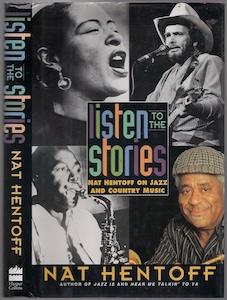
Listen To The Stories
Nat Hentoff has been listening to jazz, blues, country, and gospel since he was eight years old and tuned in (under the bedsheets) to Fats Waller broadcasting from Chicago’s Hotel Sherman during the Depression – and he has been writing about it nearly ever since, with ever-increasing passion.
This new book is the fruit of long nights of listening to, watching, traveling and talking with, and knowing firsthand jazz musicians and country and gospel singers from all over the nation – a book of truly American originals.
In this 220 page collection of stories he writes poignant descriptions of the early days of Roy Eldridge, the last years of Billie Holiday and Bird. He chronicles accounts of Duke, the Count, and Dizzy. Listen to the Stories covers new recordings and old legends, remarkable lives and unforgettable music.
