

Daily Dose Of Jazz…
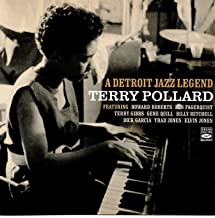
Terry Pollard (August 15, 1931 in Detroit, Michigan and began her career by collaborating with other Detroit musicians, such as Billy Mitchell and Elvin Jones, in the house band at the Blue Bird Inn. Johnny Hill, and the Emmitt Slay Trio.
Discovered by Terry Gibbs, she toured with him in the early 1950s, playing piano and vibraphone. They recorded several albums, including Terry Gibbs Quartet – Featuring Terry Pollard. Pollard appeared with Gibbs on an episode of The Tonight Show hosted by Steve Allen. Her collaborations with Gibbs from 1953 to 1957 marked the height of her career.
Pollard also performed with John Coltrane, Charlie Parker, Miles Davis, Chet Baker, Nat King Cole, Dinah Washington, Duke Ellington and Ella Fitzgerald
Recording a self-titled solo album for Bethlehem Records in 1955, Terry won Down Beat magazine’s New Artist award in 1956. She retired from her full-time music career shortly thereafter in order to raise a family, but she continued to play locally in Detroit and performed with Yusef Lateef, Dorothy Ashby, Don Fagerquist, and Diana Ross and the Supremes among others.
Her contributions to the mid-century Detroit jazz scene were recognized in the book Before Motown: A History of Jazz in Detroit 1920-1960, by Lars Bjorn and Jim Gallert. Pianist, vibraphonist Terry Pollard, who was inducted into the Michigan Jazz Hall of Fame, passed away on December 16, 2009 in Detroit.

More Posts: bandleader,history,instrumental,jazz,music,piano,vibraphone
Daily Dose Of Jazz…
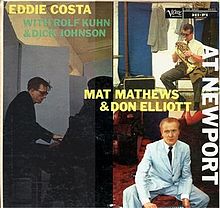
Edwin James Costa was born on August 14, 1930 in Atlas, Pennsylvania, near Mount Carmel, in Northumberland County. He was taught and influenced on piano by his older, musically trained brother, Bill, and a local piano teacher. He took paid jobs as a pianist from the age of 15, and in contrast to his piano training, he was self-taught on vibes.
In 1949 he played and toured for a few months with violinist Joe Venuti. He then worked for his brother in New York until 1951, when Eddie was drafted into the army. During this time in the armed forces, he performed in Japan and Korea. After his discharge, he returned home and worked around the New York area, including for bands led by Kai Winding, Johnny Smith, and Don Elliott.
n 1957 he was chosen as Down Beat jazz critics’ new star on piano and vibes – the first time that one artist won two categories in the same year. He became known for his percussive, driving piano style that concentrated on the lower octaves of the keyboard.
Costa had an eight-year recording career, during which he appeared on more than 100 albums, with five of them were under his own leadership. As a sideman, he appeared in orchestras led by Manny Albam, Gil Evans, Woody Herman, and others; played in smaller groups led by musicians including Tal Farlow, Coleman Hawkins, Gunther Schuller, and Phil Woods; and accompanied vocalists including Tony Bennett and Chris Connor. Costa died, aged 31, in a car accident in New York City.
His first recording as a leader was in 1956, with his trio featuring bassist Vinnie Burke and drummer Nick Stabulas. Around this time, he was nicknamed The Bear by Burke for his powerful playing. He and Burke joined Tal Farlow and became the resident trio at the Composer Club. In 1957 Costa was again leader, recording Eddie Costa Quintet with Woods, Art Farmer, Teddy Kotick, and Paul Motian. He would go on to record 1958’s Guys and Dolls Like Vibes with Bill Evans, Wendell Marshall, and Motian.
Late at night on July 28, 1962, pianist, vibraphonist, composer, and arranger Eddie Costa passed away in a car crash, involving no other vehicles, on New York’s Westside Highway at 72nd Street in New York City.
More Posts: arranger,composer,history,instrumental,jazz,music,piano,vibraphone
Daily Dose Of Jazz…
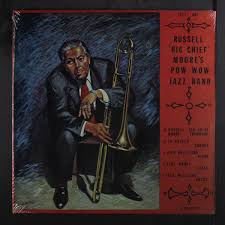
Big Chief Russell Moore was a Pima American Indian born on August 13, 1912 in Komatke, Arizona and lived in Blue Island, Illinois from age twelve, where he studied trumpet, piano, drums, French horn, and trombone. Moving to Los Angeles, California in the early 1930s, he worked freelance with Lionel Hampton, Eddie Barefield, and others. Departing Los Angeles for New Orleans, Louisiana in 1939, he worked with Oscar Celestin, Kid Rena, A.J. Piron, Paul Barbarin, Ernie Fields, Harlan Leonard, and Noble Sissle.
He played with Louis Armstrong’s last big band from 1944 to ‘47, then worked freelance on the Dixieland jazz circuit. The 1950s saw him playing with Ruby Braff, Pee Wee Russell, Eddie Condon, Wild Bill Davison, Jimmy McPartland, Tony Parenti, Mezz Mezzrow, Sidney Bechet, and Buck Clayton. He returned to play in the Louis Armstrong All-Stars in 1964–65, but fell ill and had to leave the group. After recovering he led a Dixieland group of his own, which toured Canada repeatedly.
He worked with pianist Eddie Wilcox shortly before Wilcox died in 1968, then played with Cozy Cole in 1977 and Keith Smith in 1981. Trombonist Big Chief Russell Moore, who recorded as a leader for Vogue, Trutone, and Jazz Art record labels, passed away in Nyack, New York on December 15, 1983.
More Posts: bandleader,history,instrumental,jazz,music,trombone
Hollywood On 52nd Street
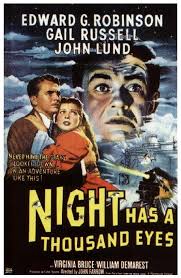
The Night Has A Thousand Eyes is a song composed by Jerry Brainin, with lyrics by Buddy Bernier. The song was written for the 1948 film noir Night Has a Thousand Eyes and was performed by an unknown band as rhumba in the background of a party.
The film stars Edward G. Robinson and was directed by John Farrow. The film is based on the novel of the same name by Cornell Woolrich, originally published under the pseudonym George Hopley.
Since its introduction, the song has been recorded by a number of artists, among them John Coltrane, Sonny Rollins, Horace Silver, UAB SuperJazz featuring Ellis Marsalis, Harry Belafonte, Paul Desmond with Jim Hall, Toshiko Akiyoshi, Pharoah Sanders, Irene Kral, Harry Beckett, Petula Clark, Gloria Lynne, and Carmen McRae.
The Story
The film opens in New Orleans, where John Triton (Robinson) is “The Mental Wizard”, a nightclub fortune teller. During a show one evening, Triton suddenly urges an audience member to rush home, cautioning that her son is in danger. As the story unfolds, Triton struggles with his new-found psychic ability, as all of his relentlessly bleak predictions prove accurate. Jerome Cowan plays Whitney Courtland, Triton’s best friend, who becomes wealthy using tips from the now-psychic Triton.

Daily Dose Of Jazz…
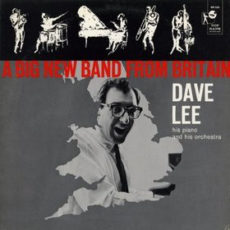
Dave Lee was born on August 12, 1926 in Newington, London, England and took lessons as a child. When his photographer father was transferred during the war to the North East to work on camouflaging military equipment, it was here that he started to perform in local groups. His big break came in 1942 when he won the Melody Maker poll for Best New Jazz Pianist.
A move to South Africa in 1947 had him working as a resident musician for night clubs in Port Elizabeth and Johannesburg. He went on to study at the Johannesburg Conservatory of Music gaining a Mus.Bac. By 1954 Lee invited Johnny Dankworth to perform in South Africa, and it was Dankworth who persuaded him to return to England as a pianist/arranger for the Johnny Dankworth band. From 1955 to 1959 he played on all of the recordings made by the Johnny Dankworth Orchestra.
David performed with Terry and McGhee, the Buddy Tate Quartet and Jack Parnell. He also arranged for Norman Wisdom, Benny Hill, Cleo Laine and Judy Garland. From 1959 he led a trio who recorded a number of successful albums, including A Big New Band from Britain, which was in The Cashbox Top Ten for six weeks. The trio also produced music for the 1960s TV series The Avengers, for which John Dankworth had written the original theme music, and the Trio features prominently in the 1962 episodes The Removal Men. They would go on to appear in several other episodes.
With his composing career beginning in the 1950s, he was writing jingles for television ads, then teamed up with lyricist Herbert Kretzmer and wrote hit songs Bangers and Mash, Goodness Gracious Me, and Kinky Boots and music for the West End stage musical Our Man Crichton in 1964.
His film music career began in 1960 with low-budget features, but gradually he progressed to fine orchestral scores for important movies. In 1983, Lee was elected BBC Jazz Society Musician of the Year, and in 1990 was one of the founders of jazz-only radio station 102.2 Jazz FM. Still busy in his 90s, pianist, arranger, orchestra leader, songwriter and film composer David Lee’s novel Nothing Rhymes with Silver about a fictional jazz pianist was published in 2007.
More Posts: arranger,bandleader,history,instrumental,jazz,music,piano