

Daily Dose Of Jazz…
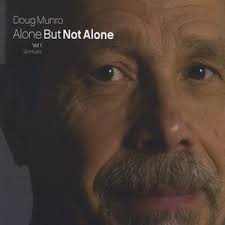
Douglas Anthony Munro was born July 9, 1953 in Yonkers, New York. He started his musical studies at age seven, taking drum lessons and by age fourteen, he was playing dances in Yonkers and New York City. At 20, he broke his back in a gymnastics accident, which ended his career as a drummer. However, in 1977 the 24 year old underwent a successful back surgery, and began playing guitar to pass the time during recovery
After his recovery he became a guitarist, performed locally and taught guitar lessons. In 1986 he released the LP Courageous Cats. and towards the end of the decade Doug met record producer Joe Ferry, and began a 25 year professional relationship. He would go on to divide his career into arranging, performing, teaching, and producing with Ferry. In 2004 he started a series of four Boogaloo recordings for Scufflin’ Records. The first, Boogaloo to Beck, featured Lonnie Smith, David “Fathead” Newman, and Lafrae Olivia Sci. He would go on to release to Brazilian jazz albums under the Big Boss Bossa Nova title.
The early Nineties saw Doug arranging and producing with Joe Ferry. Their first album, We Remember Pastorius, was a tribute to jazz bassist Jaco Pastorius. He would go on to co-produce and arrange a series of recordings for Shanachie Records. This period saw him delving into ska, receiving two Grammy nominations. In 1997 Munro added orchestrations to the original motion picture soundtrack for the Muhammad Ali documentary When We Were Kings which won the Academy Award for Best Documentary Film.
Munro continued to work on over 40 recording albums into the new millennium with Vitamin Records. He has produced lessons for Just Jazz Guitar, Premier Guitar, and TrueFire.com. He founded the jazz studies program in the Conservatory of Music at Purchase College in 1993, and served as the director of the program from 1993-2002. He retired in 2019 as Professor Emeritus and Director Emeritus of the Jazz Studies program at the Conservatory of Music at Purchase College.
Guitarist, arranger, producer, composer, author, and educator Doug Munro specializes in jazz, bebop, Brazilian jazz, jazz fusion, and gypsy swing. Since 1986 he has released over fifteen albums as a band leader and has appeared on over 75 recordings as a guitarist, sideman, producer, and arranger. He has been nominated for two Grammy Awards and was the recipient of two NAIRD Awards by the American Association of Independent Music.

More Posts: arranger,bandleader,composer,educator,guitar,history,instrumental,jazz,music,producer
Daily Dose Of Jazz…
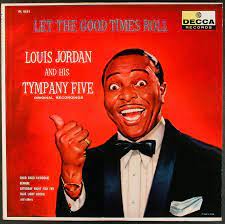
Louis Thomas Jordan was born on July 8, 1908 in Brinkley, Arkansas. His father, James Aaron Jordan, was a music teacher and bandleader for the Brinkley Brass Band and the Rabbit Foot Minstrels. His mother died when he was young and his grandmother Maggie Jordan and his aunt Lizzie Reid raised him. At an early age he studied clarinet and saxophone with his father and by his teens he was a member of the Rabbit Foot Minstrels and was playing professionally in the late 1920s.
In the early Thirties he was performing in Philadelphia, Pennsylvania and New York City with Charlie Gaines. He recorded with Clarence Williams and was a brief member of the Stuff Smith Orchestra. Joining the Chick Webb Orchestra he sang and played alto saxophone, however, in 1938 he started a band that recorded a year later as the Tympany Five.
In 1942, Jordan and his band moved to Los Angeles, California where he began making soundies, the precursors of music video. He appeared on many Jubilee radio shows and a series of programs for the Armed Forces Radio for distribution to American troops overseas. Though a hernia condition kept him out of the war his recordings made him very popular with both black and white soldiers.
During the 1940s Jordan and the band became popular with such hits as Choo Choo Ch’Boogie, Knock Me a Kiss, Is You Is or Is You Ain’t My Baby, and Five Guys Named Moe. Within a year of his breakthrough, the Tympany Five’s appearance fee rose from $350 to $2,000 per night. But the breadth of Jordan’s success and the size of his combo had larger implications for the music industry. His raucous recordings were notable for the use of fantastical narrative, best exemplified on Saturday Night Fish Fry, a two-part 1950 hit that was split across both sides of a 78-rpm record. It was one of the first popular songs to use the word “rocking” in the chorus and to feature a distorted electric guitar.
From July 1946 through May 1947, Jordan had five consecutive number one songs, holding the top slot for 44 consecutive weeks. In 1961, the IRS filed an income tax lien against Jordan and he had to sell property well below its value to pay off his debts. Musician Ike Turner stepped in and contacted and convinced the president of Jordan’s booking agency in Chicago, Illinois. to send Jordan a check for $20,000. He was unaware of this deed.
Over his career he charted dozens of singles, eighteen #1 and fifty-four in the Top Ten. He ranked fifth among the most successful musicians of the period 1942~1995, however, many he did not own the rights to, hence no financial benefit. Saxophonist, multi~instrumentalist, songwriter and bandleader Louis Jordan suffered a heart attack and transitioned on February 4, 1975, in Los Angeles.
More Posts: bandleader,history,instrumental,jazz,music,saxophone,songwriter
Daily Dose Of Jazz…
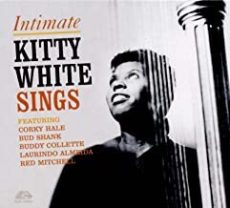
Kitty White was born Kitty Jean Bilbrew on July 7, 1923 in Los Angeles, California. Raised in a musical family, her parents were singers, and her uncle was a well-known vaudevillian and disc jockey. Her twin sister, Maudie Jeanette, also sang and briefly worked with Duke Ellington’s revue, Jump for Joy, but never pursued an active career. Their mother, known as A.C. Bilbrew, organized an all-black chorus that performed in the 1929 film Hearts of Dixie.
She started her career at the age of sixteen as a singer and a pianist, appearing in local nightclubs around Los Angeles. Branching out she opened at the Black Orchid in Chicago, Illinois and was introduced to the executives of Mercury Records, where she became a recording artist.
Kitty picked up her catchy jazz name legitimately by marrying songwriter Eddie White in the 1940s. She moved to Palm Springs, California in 1967 and sang at the Spa Hotel for sixteen years.
Recording mostly on the West Coast, she worked with Buddy Collette, Gerald Wiggins, Chico Hamilton, Bud Shank and Red Callender. She sang many demo recordings for her friend, Los Angeles blues composer Jessie Mae Robinson, including I Went To Your Wedding, a No. 1 hit for Patti Page in 1953. She was also the sole female voice on Elvis Presley’s song Crawfish from the King Creole film soundtrack.
Vocalist Kitty White, who recorded eight albums as a leader and had two compilations released, transitioned in Palm Springs, at the age of 86 on August 11, 2009 after suffering a stroke.
More Posts: bandleader,history,instrumental,jazz,music,vocal
Daily Dose Of Jazz…
Frank Rehak was born July 6, 1926 in New York City and began on piano and cello before switching to trombone. He worked with Gil Evans and Miles Davis. He also appeared with Davis on the broadcast The Sounds of Miles Davis.
A heroin addiction combined with other financial problems led to his withdrawal from music and his lapsing into relative obscurity. It was probably partially contributed to his failed marriage to nightclub dancer Jerri Gray. In an effort to deal with these issues he spent time at Synanon, which led to his mention in Art Pepper’s autobiography.
Trombonist Frank Rehak transitioned in Badger, California on June 22, 1987 of throat cancer at the age of 60.
More Posts: history,instrumental,jazz,music,trombone
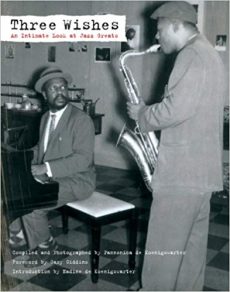
Three Wishes
Nica questioned Yasuhivo Koyama about his three wishes if by some miracle he was to be granted them and he told her he would wish for:
- “To realize my special ideas. Especially concerned to express my original ideas and my own theory.”
- “To use the improvisation in proper order.”
- “To pray, so to work in best places.”
*Excerpt from Three Wishes: An Intimate Look at Jazz Greats ~ Compiled and Photographed by Pannonica de Koenigswarter
Yasuhivo Koyama
More Posts: baroness,history,instrumental,jazz,music,pannonica,three,wishes