

Daily Dose Of Jazz…
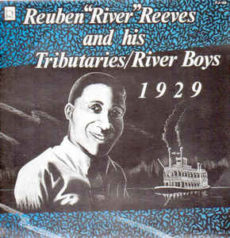
Reuben “River” Reeves was born in Evansville, Indiana on October 25, 1905 and started out playing locally in the Midwest before moving to New York City in 1924. The next year he moved to Chicago, Illinois and by 1926 joined Erskine Tate’s orchestra, then played with Fess Williams and Dave Peyton by the end of the decade. While in Chicago he took lessons from a German trumpet player, Albert Cook, who played in the Chicago Symphony.
While playing at the Regal Theater in 1929, Peyton featured Reuben, his hot trumpet player, on a night where Louis Armstrong had a gig across the street at the Savoy, to outdo the latter which didn’t work. Signed to Vocalion he recorded as a bandleader with his groups the Tributaries and the River Boys. His sidemen were his brother, trombonist Gerald Reeves, and clarinetist Omer Simeon and in 1929, twenty sides were recorded in 1929.
He played under Cab Calloway in the early Thirties, and recorded again with the River Boys in 1933. He toured as a leader for two years from 1933 to 1935, then played freelance through the late 1930s. During World War II, he led an Army band called the Jungleers. Stationed at the Army Jungle Training Center on the northeast coast of Oahu, Hawaii. There they were popular participants in Battle of the Band competitions that were an integral part of the extraordinary music scene in Hawaii during the war.
After the war, he played in Harry Dial’s Blusicians in 1946. Trumpeter and bandleader Reuben Reeves, whose entire output as a bandleader has been released to a single compact disc by RST Records, passed away in September 1975 in New York City.

More Posts: bandleader,history,instrumental,jazz,music,trumpet
Daily Dose Of Jazz…
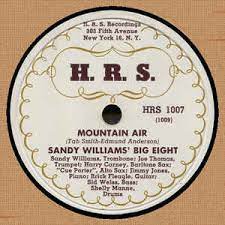
Alexander Balos “Sandy” Williams was born on October 24, 1906 in Summerville, South Carolina, the son of a preacher. The family of thirteen moved to Washington D.C. when he was very young however, losing their parents six months apart, they were sent to an orphanage in Delaware. There he joined the school band, but was put on tuba rather than trombone despite his requests. Taking private lessons while attending Armstrong High School, he occasionally played with his professor’s sons, and played with several bands before he started playing with the Lincoln Theater pit band.
Fletcher Henderson strongly influenced Williams jazz musicianship which received local notice. He played with Claude Hopkins, and later in 1929 joined Horace Henderson. He became a staple player in the Chick Webb band from 1933-1940 where he later worked with Ella Fitzgerald. Through the Forties he went on to work with other bands including Cootie Williams, Sidney Bechet, Duke Ellington, Art Hodes and Roy Eldridge, with whom he toured Europe in 1947.
By the early Forties Sandy was suffering from alcoholism, and despite his attempts to become sober, he continued to drink with many of his band leaders until he suffered from a severe breakdown with his health in 1950 causing him to retire from music.
Although he attempted to return to music, his dental health affected his embouchure causing him to quit music entirely. Trombonist Sandy Williams passed away on March 25, 1991 in New York City.
More Posts: bandleader,history,instrumental,jazz,music,trombone

Daily Dose Of Jazz…
Betty Bennett was born in Lincoln, Nebraska on October 23, 1921. Her first major signing was with the Claude Thornhill band in 1946 the band in which her husband, bassist Iggy Shevak, was playing. Shortly after her husband left to join Alvino Rey, Bennett followed him there.
In 1949, she joined Charlie Ventura’s band before going on to join Benny Goodman in 1959. Her second album, Nobody Else But Me, featured arrangements by Shorty Rogers and her second husband, André Previn.
She later married guitarist Mundell Lowe in 1975. Vocalist Betty Bennett, who was a big band singer and recorded five albums as a leader, passed away on April 7, 2020 at the age of 98.
More Posts: bandleader,history,instrumental,jazz,music,vocal
Daily Dose Of Jazz…
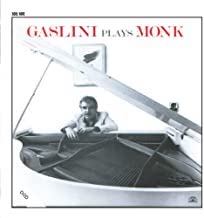
Giorgio Gaslini born October 22, 1929 in Milan, Italy. He began performing aged 13 and recorded with his jazz trio at 16. In the 1950s and 1960s, He performed with his own quartet. He was the first Italian musician mentioned as a “new talent” in the Down Beat poll and the first Italian officially invited to a jazz festival in the USA New Orleans 1976-77.
He collaborated with leading American soloists, such as Anthony Braxton, Steve Lacy, Don Cherry, Roswell Rudd, Max Roach, but also with the Argentinian Gato Barbieri and Frenchman Jean-Luc Ponty. He also adapted the compositions of Albert Ayler and Sun Ra for solo piano, which the Soul Note label issued. He also composed the soundtrack of Michelangelo Antonioni’s 1961 La notte (The Night).
From 1991 to 1995, Gaslini composed works for Carlo Actis Dato’s Italian Instabile Orchestra, and was the first to teach jazz courses at the Santa Cecilia Academy of Music in Rome in 1972. In the Seventies he scored ten films between 1970 to 1977.
Pianist, composer and conductor Giorgio Gaslini, who composed symphonic works, operas, and ballets, passed away on July 29, 2014 at 84 in Borgo Val di Taro, Italy in the province of Parma.
More Posts: bandleader,composer,conductor,history,instrumental,jazz,music,piano

The Quarantined Jazz Voyager
For Musicians Only is an album by Dizzy Gillespie, Stan Getz and Sonny Stitt incorporating bebop influences. Produced by Norman Granz, it was recorded on October 16, 1956 at Radio Recorders in Hollywood, California. It wasn’t released until 1958 on the Verve label. It has been described as the real thing, no pretense.
The story behind this session from Stan Levy’s point of view is that everything was done in one take, no 2nd takes, no overdubbing. It was virtually a live, real bebop session, nothing worked out, just play by the seat of your pants or get off the bandstand. Like it or not, that was the way it was with Bird and those cats, the real thing, no pretense.
The album is known for the front line’s winding, intricate solos. This has led to praise for the back line, particularly bassist Ray Brown, for keeping some semblance of the original tune going behind the solos.
Track List | 42:59- Bebop (Gillespie) ~ 12:48
- Dark Eyes (Traditional) ~ 12:10
- Wee (Allen’s Alley) (Denzil Best, Gillespie) – 8:28
- Lover Come Back to Me (Sigmund Romberg, Oscar Hammerstein II) ~ 9:33
- Dizzy Gillespie ~ trumpet
- Sonny Stitt ~ alto saxophone
- Stan Getz ~ tenor saxophone
- John Lewis ~ piano
- Herb Ellis ~ guitar
- Ray Brown ~ bass
- Stan Levey ~ drums

More Posts: adventure,album,club,genius,jazz,museum,music,preserving,restaurant,saxophone,travel,trumpet