

Requisites
Night Flight To Dakar ~ Al Cohn, Billy Mitchell, Dolo Coker, Leroy Vinnegar, Frank Butler | By Eddie Carter
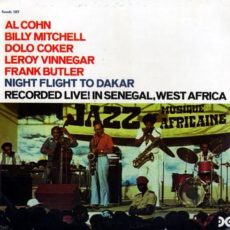
Submitted for your consideration this morning is the second of two albums recorded during The Xanadu All-Stars’ first tour in Senegal, West Africa. Night Flight To Dakar (Xanadu Records 185) was released in 1982 after the first LP, Xanadu In Africa hit the stores a year earlier. The personnel consists of Al Cohn and Billy Mitchell on tenor sax; Dolo Coker on piano; Leroy Vinnegar on bass and Frank Butler on drums. My copy used in this report is the original release. On the four quintet tunes, Cohn is heard on the left channel and Mitchell on the right channel.
The album opens with the title tune, Night Flight To Dakar was composed by Coker as a tribute to his bandmates and in honor of the ensemble’s trip to Africa. It’s a tune the group has fun on with a vigorous beat by both horns in unison leading the trio on the melody. Al opens with a scintillating groove of spirited wailing as refreshing as a cold drink on a hot summer day or evening. Billy makes his point next with innovative energy on a superb statement. Dolo digs into the finale with a tasty reading before the front line shares the final two choruses into the reprise and close.
Don’t Let The Sun Catch You Crying was written by Joe Greene in 1946 and showcases the trio in a gorgeous performance. Dolo tenderly presents the melody and approaches the song’s only solo with delicate respect, sustained by Leroy and Frank’s gentle foundation. It’s back to a blowing session for the quintet’s first side finale with an uptempo version of Blues Up and Down by tenor saxophonists Gene Ammons and Sonny Stitt. This jazz favorite was written in 1950, making its first appearance on a Prestige 78-rpm single and reissued a year later on the LP, Battle of The Saxes.
The song is charged with electricity from the opening notes of the melody. Billy begins the fireworks with an exciting exhibition of musical virtuosity. Cohn comes right on his heels with a blistering heatwave of his own. Coker swings into a bouncy, happy groove on the next interpretation. Vinnegar steps up next with a rousing chorus shadowed by Butler, then swings swiftly on the next five verses. Butler makes a crisp contribution, exchanging the final statement with both saxes into a most satisfying conclusion.
Sweet Senegelese Brown by Billy Mitchell is dedicated to a woman from Georgia. This song opens Side Two built on the chords of the 1925 standard, Sweet Georgia Brown by Ben Bernie, Maceo Pinkard, and Kenneth Casey. Al and Billy provide the first two exemplary readings, but the showcase here belongs to Frank who has the longest solo at 5 ½ minutes. It’s not a bad performance, but his readings on Blues Up and Down and The King are better in my opinion. Dolo and Leroy don’t solo themselves but provide the propulsive power on the opening and closing themes and behind both saxophonists. The finale is by Count Basie and became a signature song for Illinois Jacquet.
The King is an uptempo cooker allowing everyone solo space and opens with a high-voltage melody collectively. Billy soars first into a fiercely, heated lead solo, then Al attacks the next one with the quick motion of a whirlwind. Dolo executes the next reading with rapid-fire agility, then Leroy takes a joyful excursion next. Frank exchanges a few riffs with Al and Billy, taking the ensemble home on a high note.
Night Flight To Dakar was recorded by American engineer Paul Goodman and he delivers an album with good sound quality. I say good because the one area that fails as you’re listening is when a musician is talking. You can barely make out what anyone is saying until the very end of The King when one of the guys says Merci Beaucoup to the crowd. That issue aside, the ensemble delivers a solid live performance with excellent musicianship and a soundstage from the instruments that’s good enough to provide excellent playback on any mid-fi or high-end audio system. I’m intrigued enough to start looking for the first album Xanadu In Africa for a serious listen and enjoyed the music on Night Flight To Dakar enough to recommend it for fans of Al Cohn, Billy Mitchell, Dolo Coker, Leroy Vinnegar and Frank Butler.
~ Blues Up and Down, Battle of The Saxes (Prestige PRLP 107); Don’t Let The Sun Catch You Cryin’ (Prestige 877); Xanadu In Africa (Xanadu Records 180) – Source: Discogs.com ~ Sweet Senegelese Brown – Source: Album liner notes by Don Schlitten © 2020 by Edward Thomas Carter
More Posts: choice,classic,collectible,collector,history,instrumental,jazz,music,saxophone

Daily Dose Of Jazz…
Gil Coggins was born Alvin Gilbert Coggins on August 23, 1928 in New York City to parents of West Indian heritage. His mother was a pianist and had her son start on the piano from an early age. Attending school in both New York City and Barbados, he went to the High School of Music & Art in Harlem.
In 1946, Gil met Miles Davis while stationed at Jefferson Barracks in Missouri. After his discharge he began playing piano professionally, working with Davis on several of his Blue Note and Prestige releases. He went on to record with John Coltrane, Sonny Rollins, Lester Young, Art Blakey’s Jazz Messengers, Ray Draper, and Jackie McLean.
Coggins retired from playing jazz professionally in 1954 and took up a career in real estate, only playing music occasionally. He did not record as a leader until 1990, when Interplay Records released Gil’s Mood. He continued performing through the 1990s and the early years of the 2000s.
On February 15, 2004 pianist Gil Coggins, whose second album as a leader Better Late Than Never was released posthumously, passed away from complications sustained in a car crash eight months earlier in Forest Hills, New York.

More Posts: bandleader,history,instrumental,jazz,music,piano

Daily Dose Of Jazz…
Lou Colombo was born in Brockton, Massachusetts on August 22, 1927 and started playing the trumpet when he was twelve. At seventeen he turned his attention to professional baseball and was signed with the Brooklyn Dodgers for seven years until a knee injury ended his career at 24.
Turning his attention to music Lou dove in full-time, mostly as an ensemble player and studio musician, playing and recording in the big bands of Dizzy Gillespie, Artie Shaw, Benny Goodman, Buddy Morrow, and Pérez Prado. He also worked sessions with Meredith D’Ambrosio on the 1989 recording South to a Warmer Place, George Masso on That Old Gang of Mine, 1996) and Jerry Jerome’s Something Borrowed, Something Blue.
Under his own name, Colombo recorded some albums one, including 1,990 at Concord Records, a tribute album for Bobby Hackett, one with Dave McKenna and Keith Copeland. Active on the Cape Cod jazz scene for five decades, trumpeter Lou Colombo passed away due to a traffic accident on March 3, 2012 at the age of 84.
More Posts: bandleader,cornet,flugelhorn,history,instrumental,jazz,music,trumpet

Daily Dose Of Jazz…
Marlon Jordan was born August 21, 1970 in New Orleans, Louisiana, one of six performers of a prominent family of New Orleans musicians. He is the son of saxophonist Edward “Kidd” Jordan and classical pianist Edvidge Jordan, and his brother Kent is a flutist, his sister Rachel is a violinist, and sister Stephanie is a jazz singer.
Starting on playing trumpet in the fourth grade, he graduated from the famed New Orleans Center for the Creative Arts. A major influence was Wynton Marsalis and Terence Blanchard who he knew when he was a child. Marlon recorded as a sideman with his brother Kent in 1987 and Dennis González in 1988.
In 1988 at age 18 he recorded his debut album as a leader, For You Only, with Branford Marsalis, brother Kent, and Elton Heron. Taking his quintet on the road, with Wynton Marsalis, Miles Davis and George Benson, he was billed as one of the headlining act in a series of JVC Jazz Festival dates. They would go on to play some of the country’s top jazz clubs, as well as in concerts.
He has recorded with his immediate family, Stephanie, Edward, Rachel, Kent, along with uncle Alvin Batiste, cousin Jonathan Bloom, uncle Maynard Chatters, and Chatters’ son, Mark.
In 2005, Marlon and sister Stephanie toured Bucharest, Germany, Lithuania and Ukraine as Jazz Ambassadors on a European Tour as part of the Higher Ground Relief effort sponsored by the U.S. Department of State, and Jazz at Lincoln Center to thank the people of Europe for their support of New Orleans and the Gulf region following Hurricane Katrina. Trumpeter, composer and bandleader Marlon Jordan continues to perform, record, and tour.
More Posts: bandleader,composer,history,instrumental,jazz,music,trumpet

The Quarantined Jazz Voyager
As the social distancing and my personal quarantine continues, the next album this jazz voyager is East To Wes by guitarist Emily Remler. Recorded in May 1988 on the Concord Records label. This is her last session to be recorded and released before her death. Having put together one of the finest rhythm sections, it has been hailed as her finest effort.
Track Listing | 51:18- Daahoud (Clifford Brown) ~ 5:19
- Snowfall (Claude Thornhill) ~ 6:39
- Hot House (Tadd Dameron( ~ 5:45
- Sweet Georgia Fame (Blossom Dearie/Sandra Harris) ~ 5:38
- Battle For A Music Box (Emily Remler) ~ 7:25
- Blues For Herb (Emily Remler) ~ 6:26
- Softly In A Morning Sunrise (Oscar Hammerstein II/Sigmund Romberg) ~ 8:14
- East To Wes (Emily Remler) ~ 6:14
- Emily Remler ~ guitar
- Hank Jones ~ piano
- Buster Williams ~ double bass
- Marvin “Smitty” Smith ~ drums

More Posts: adventure,club,genius,guitar,jazz,museum,music,preserving,restaurant,travel,voyager