

The Quarantined Jazz Voyager
Reading the history of humanity, evidence proves that bad decisions are not relegated to bad people but are also made by good people. If taking off a face mask is your back to normal, in my opinion, you’re not reaching high enough and the brass ring has passed you by. Legislators and the media are confounding the public with different opinions, playing the he said she said game. The collusion is abomidable and most are buying into it. Remain vigilant, protect yourself, remain healthy.
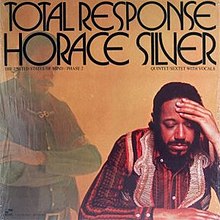
This week I have chosen Total Response (subtitled The United States of Mind Phase 2) for our listening pleasure. It is an album by pianist Horace Silver that was recorded on two separate dates, November 15, 1970 (tracks 1,2,6,9) and January 29, 1971 (tracks 3,4,5,7,8). It was recorded at Van Gelder Studios in Englewood Cliffs, New Jersey, released in April 1972 on Blue Note Records, and produced by Francis Wolff and George Butler.
In 2004, it was included as the second of a trilogy of albums compiled on CD as The United States of Mind. Track List | 45:11 All compositions by Horace Silver
- Acid, Pot or Pills ~ 4:26
- What Kind of Animal Am I ~ 3:38
- Won’t You Open up Your Senses ~ 3:56
- I’ve Had a Little Talk ~ 3:46
- Soul Searching ~ 4:15
- Big Business ~ 5:22
- I’m Aware of the Animals Within Me ~ 3:45
- Old Mother Nature Calls ~ 6:17
- Total Response ~ 5:22
- Horace Silver – electric piano
- Cecil Bridgewater – trumpet, flugelhorn
- Harold Vick – tenor saxophone
- Richie Resnicoff – guitar
- Bob Cranshaw – electric bass
- Mickey Roker – drums
- Salome Bey (1, 2, 5-7, 9), Andy Bey (3, 4, 8) – vocals

More Posts: adventure,album,club,genius,jazz,museum,music,piano,preserving,restaurant,travel
The Quarantined Jazz Voyager
Remaining hesitant to be in crowds of people without a mask, more and more people are unmasking while we are still in the pandemic. Legislators are speaking unmask rhetoric and otherwise responsible people are listening. This Jazz Voyager is listening to my conscience and protecting myself and those around me.
This week I have chosen another quartet recording by the New York Jazz Quartet, founded by pianist Roland Hanna. The first iteration of the group consisted of flautist Hubert Laws, bassist Ron Carter, and drummer Billy Cobham. In 1974 the lineup changed to Frank Wess, bassist George Mraz, and drummer Ben Riley. Drummers Richie Pratt and Grady Tate also were enlisted to contribute their talents to the group at different times through the decade the band was together. The group recorded for the Inner City, Enja, Salvation and Sonet Records from 1972 to 1982
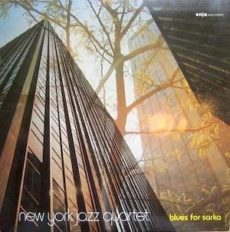
This album is the group’s fourth release, Blues For Sarka, recorded live on May 17, 1978 at The Domicile in Munich, West Germany. It was produced by Horst Weber and Matthias Winckelmann, recorded by Carlos Albrecht and released the same year on Enja Records. The cover photography was taken by Josef Werkmeister and the cover design was by Weber & Winckelmann
Track List | 45:11 All compositions by Roland Hanna except as indicated- All Blues (Miles Davis) ~ 15:29
- Rodney Round Robin ~ 5:44
- I’ll Tell You Tonite (George Mraz) ~ 7:14
- Blues for Sarka (George Mraz) ~ 7:11
- Smelly Jelly Belly ~ 9:33
- Frank Wess ~ flute, tenor saxophone
- Roland Hanna ~ piano
- George Mraz ~ bass
- Grady Tate ~ drums
More Posts: adventure,album,bass,club,drums,flute,genius,jazz,museum,music,piano,preserving,restaurant,saxophone,travel
The Quarantined Jazz Voyager
It is amazing but not surprising how people want to get back to the same old routine they were in before the pandemic instead of inventing themselves anew. As I move around my city I see more and more people not wearing masks in enclosed spaces. I am not surprised by the robotic sense of normalcy by society.
This week I have selected an album by the underrated and often unappreciated vocalist Irene Kral. The younger sister of pianist Roy Kral, I discovered her towards the end of her career in 1977 when I heard her album Where Is Love. I was enamored by her voice and the quiet understatement of her singing. Unfortunately I never had the opportunity to hear her live as she transitioned the followin year in August.
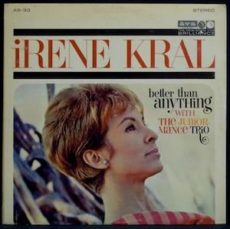
The album I present today is her third studio session, Better Than Anything, recorded on June 17 & 18, 1963 at the World Pacific Studios in Los Angeles, California. It was produced by Joe Burnett, engineered by Richard Bock and released the same year on Äva Records and distributed by MGM. Making up the quartet with Irene is the Junior Mance Trio.
The cover design was by Richter & Mracky Design Associates, the photography by Fred Seligo and the liner notes were written by Tommy Wolf.
Track List | 29:24
- Better Than Anything (David “Buck” Wheat, Bill Loughborough) ~ 2:21
- The Touch Of Your Lips (Ray Noble) ~ 2:22
- The Meaning of the Blues (Bobby Troup, Leah Worth) ~ 3:11
- Rock Me To Sleep (Benny Carter, Paul Vandervoort II) ~ 2:20
- No More (Tutti Camarata, Bob Russell) ~ 3:10
- Passing By (Laurent Hess, Charles Trenet, Jack Lawrence) ~ 1:54
- It’s a Wonderful World (Jan Savitt, Harold Adamson, Johnny Watson) ~ 2:34
- This Is Always (Mack Gordon, Harry Warren) ~ 3:23
- Just Friends (John Klenner, Sam M. Lewis) ~ 2:40
- Guess I’ll Hang My Tears Out to Dry (Jule Styne, Sammy Cahn) ~ 3:35
- Nobody Else But Me (Jerome Kern, Oscar Hammerstein II) ~ 1:54
- Irene Kral ~ vocals
- Junior Mance ~ piano
- Bob Cranshaw ~ bass
- Mickey Roker ~ drums
More Posts: adventure,album,bass,club,drums,genius,jazz,museum,music,piano,preserving,restaurant,travel,vocal
The Quarantined Jazz Voyager
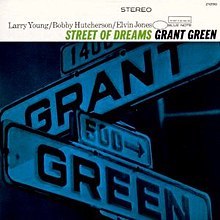
This week another great album is being featured for us to listen to titled Street of Dreams recorded at Van Gelder Studio in Englewood Cliffs, New Jersey on November 16, 1964 by jazz guitarist Grant Green. The album was produced by Alfred Lion, however, wasn’t released until August 1967 on the Blue Note label. The photograph used on the album cover features street signs that are at an actual street corner in the North Beach neighborhood of San Francisco, California.
The conversation between these four giants of jazz is comfortable and easy. They play off one another, adding to the strength of the album. Consisting of a mere four songs, one can hear the short story they create.
The album includes Billy May’s Somewhere in the Night, which was the theme of the television program Naked City, and Lazy Afternoon, from the 1954 musical The Golden Apple. On the whole, this is an enjoyable thirty-three minutes of mid~tempo jazz. While you’re listening, think about protecting your community as we continue to experience the ravages of this pandemic… which, by the way, although it may feel like it, hasn’t gone away yet people!
Track List | 33:34- I Wish You Love (Léo Chauliac, Charles Trenet) ~8:46
- Lazy Afternoon (John La Latouche, Jerome Moross) ~ 7:44
- Street of Dreams (Victor Young, Sam M. Lewis) ~ 9:03
- Somewhere in the Night (Billy May, Milt Raskin) ~ 8:01
- Grant Green ~ guitar
- Bobby Hutcherson ~ vibes
- Larry Young ~ organ
- Elvin Jones ~ drums
More Posts: adventure,album,club,genius,guitar,jazz,museum,music,preserving,restaurant,travel
The Quarantined Jazz Voyager
The virus is still raging across America and now has a new host… the children. I have personally known a half dozen friends who have contracted Covid from children or grandchildren who are back in school and bring it home. Be vigilant my people and stay safe and healthy.
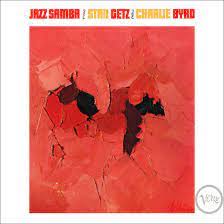
This week I am putting on the turntable the bossa nova/jazz album titled Jazz Samba. It is an album by Stan Getz and Charlie Byrd released by Verve Records in 1962. It was recorded on February 13, 1962 in Pierce Hall, All Souls Unitarian Church, Washington, D.C. and released the following April. It ws produced by Creed Taylor.
The idea for the album came about while the Charlie Byrd Trio was on a State Department goodwill tour in Brazil, drummer Buddy Deppenschmidt spent his free time with local musicians, teaching them American jazz and learning bossa nova from them. It was his idea to record an album combining jazz and bossa nova with Stan Getz.
Jazz Samba signaled the beginning of the bossa nova craze in America. Stan Getz was the featured soloist and the tracks were arranged by Charlie Byrd. It was recorded live in less than three hours and started a bossa nova craze both nationally and internationally.
It is the only jazz album to reach number one on both the jazz and pop Billboard charts and remained high on the charts for 70 weeks. Desafinado, the hit single from the album, was inducted into the Grammy Hall of Fame in 2000 and the album was inducted into the Grammy Hall of Fame in 2010.
Stan Getz won the Grammy Award for Best Jazz Performance of 1963 for Desafinado, and Robert Dimery included Jazz Samba in his book 1001 Albums You Must Hear Before You Die. The painting on the cover is by Olga Albizu.
Tracks | 33:12
Side One
- Desafinado (Antônio Carlos Jobim, Newton Mendonça) ~ 5:51
- Samba Dees Days (Charlie Byrd) ~ 3:34
- O Pato (Jayme Silva, Neuza Teixeira) ~ 2:31
- Samba Triste (Baden Powell, Billy Blanco) ~ 4:47
Side Two
- Samba de Uma Nota Só (Antônio Carlos Jobim, Newton Mendonça) ~ 6:11
- É Luxo Só (Ary Barroso) ~ 3:40
- Bahia (aka ‘Baia’) (Ary Barroso) ~ 6:38
- Stan Getz – tenor saxophone
- Charlie Byrd – guitar
- Gene Byrd – guitar, bass
- Keter Betts – double bass
- Buddy Deppenschmidt – drums, percussion
- Bill Reichenbach Sr. – drums, percussion
More Posts: adventure,album,club,genius,guitar,jazz,museum,music,preserving,restaurant,saxophone,travel