

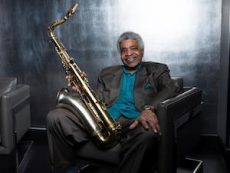
GEORGE COLEMAN
George Coleman – tenor saxophone
Peter Bernstein – guitar
Tadataka Unno – piano
John Webber – bass
George Coleman Jr. – drums
Legendary tenor saxophonist George Coleman—a renowned performer and living legend—is no stranger to SMOKE Jazz Club. The NEA Jazz Master opened the club in 1999 and returned to christen its reopening in July 2022. This upcoming visit has Coleman at the helm of a special quintet that includes guitarist Peter Bernstein, bassist John Webber, and his drummer son George Coleman Jr. He is still making some of the most inspired music of his celebrated career, which has included work with B.B. King, Miles Davis, and Herbie Hancock, among many others. Originally from Memphis, Tennessee, the blues remains at the heart of Coleman’s harmonically advanced music. Downbeat reports, “When you hear the tenor sax of George Coleman, you know it’s him within a few notes. That deep park of a tone evokes a time and place—be it his historic work with Max Roach, Chet Baker, and Miles Davis, or as a leader in his own right.”
Showtimes: 7:00pm | 9:00pm | 10:30pm
Streaming: $15.oo ~ Friday & Saturday Shows
Fess Applied To All Ticket/Pass Purchases
More Posts: adventure,album,club,festival,genius,jazz,museum,music,preserving,restaurant,saxophone,travel
Daily Dose Of Jazz…
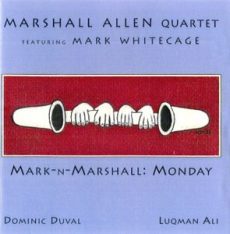
Marshall Belford Allen was born in Louisville, Kentucky on May 25, 1924. During World War II he enlisted in the 92nd Infantry Division and was stationed in France. He studied alto saxophone in Paris, France and played in Europe with Art Simmons and James Moody.
Best known for his mastery of explosive, jarring, chaotic sound effects on the alto saxophone, the opportunity came to create a long association with Sun Ra, with whom he performed almost exclusively from 1958 to Ra’s death in 1993. Marshall recorded with Paul Bley in 1964 and Olatunji during the mid-1960s.
Since Sun Ra death Allen has led the Arkestra and has recorded two albums. Allen often appeared in New York-area collaborations with bassist Henry Grimes, and participated in the Innerzone Orchestra with Francisco Mora Catlett, Carl Craig and others in an appreciation of Sun Ra’s music.
In 2022, the building at 5626 Morton Street known as the Arkestral Institute of Sun Ra was listed as a historic landmark in the Philadelphia Register of Historic Places. Free and avant-garde jazz alto saxophonist Marshall Allen, who also plays flute, oboe, piccolo, and EWI, at the age of 99 continues to live at the Institute, which has been his home since 1968.
More Posts: bandleader,ewi,flute,history,instrumental,jazz,music,oboe,piccolo,saxophone
Daily Dose Of Jazz…
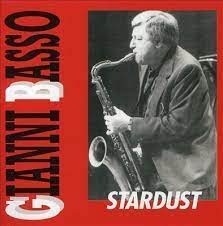
Gianni Basso was born May 24, 1931 in Asti, Italy. He started his career shortly after World War II, at first as a clarinetist, then switched to the tenor saxophone playing in Germany and Belgium with Raoul Faisant’s Big Band.
By the Fifties he became established as a commercial GB or general business player in Milan, Italy and had a steady presence at jazz events. The middle of the decade saw Gianni studying music in Turin, Italy and collaborating with trumpeter and composer Oscar Valdambrini. They created a small group combo which soon became one of the most popular jazz groups in Italy during the Fifties.
Due to their popularity Basso went on to work with a number of touring American jazz musicians, including Chet Baker, Buddy Collette, Slide Hampton, Maynard Ferguson, Phil Woods and Gerry Mulligan.
During the Seventies he founded the Saxes Machine and fronted the Gianni Basso Big Band. His senior years had him settling into the Rome, Italy studio scene while playing clubs and enjoying his historical stature.
Tenor saxophonist Gianni Basso, who was influenced by Stan Getz, transitioned on August 17, 2009.
More Posts: bandleader,history,instrumental,jazz,music,saxophone

Daily Dose Of Jazz…
Rod Cless was born George Roderick Cless on May 20, 1907 in Lenox, Iowa. He began playing in bands in college including the Varsity Five, darlings of Iowa State University. In the mid-’20s he relocated to Des Moines, Iowa where he first came into contact with an important influence, bandleader Frank Teschemacher, known as “Tesch” to his musical cohorts. The two went to Chicago, Illinois together and began playing with groups such as the orchestra of Charlie Pierce.
The late ’20s saw Cless touring in the south with Frank Quartell’s Band, including his first journey to New Orleans, Lousiana. Back in Chicago he squatted at the Wigwam Club and enlisted with the combo of Louis Panico, a fairly calm bandleader despite contrary indications suggested by his surname. During this time Rod began playing more saxophone and took part in gigs with a less pronounced jazz content. Extended club residencies and stay-at-home employment allowed him to expand his clarinet instruction.
By the spring of 1939 he returned to pure jazz work joining up with Muggsy Spanier’s band the Ragtimers, followed by two years with pianist Art Hodes. Other gigs in the ’40s included work with Marty Marsala, Ed Farley, Georg Brunis, and Wild Bill Davidson as well as Bobby Hackett. In 1944 he played with Max Kaminsky at New York City’s Pied Piper Club. when Cless suffered catastrophic injuries toppling over the railings of an apartment, subsequently surviving for only four days in the hospital. ~
Named George Roderick Cless, he was related by marriage to the much better-known reedman Bud Freeman, but certainly had a respectable career in the Dixieland ensembles of leaders such as Muggsy Spanier and Bobby Hackett.
After walking home the last night of a gig at the Pied Piper in New York City, clarinetist and saxophonist Rod Cless, who recorded with Muggsy Spanier tunes for Bluebird Records, fell several stories over the balcony of his apartment and transitioned from the fall four days later on December 8, 1944 at the age of 37.
More Posts: clarinet,history,instrumental,jazz,music,saxophone
Daily Dose Of Jazz…
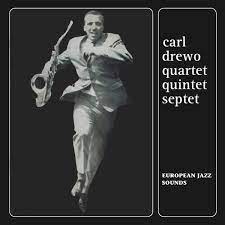
Karl Drewo was born May 17, 1929 in Vienna, Austria and as a child studied piano and accordion, but switched to tenor saxophone in his teens. In the late 1940s he worked with Charlie Gaudriot and Paul Reischman, followed by performing with Gert Steffens and Horst Winter in the early Fifties. He was a member of the Austrian All Stars in the mid-1950s and from 1956 to 1958 he worked with Fatty George.
He continued on by becoming a member of Kurt Edelhagen’s orchestra, where he played into the early 1970s. In the 1960s he recorded with Francy Boland, Kenny Clarke, Zoot Sims, and Jimmy Woode, among others.
After leaving Edelhagen’s group, he played with the Österreichischer Rundfunk band, and in the 1980s was a member of Peter Herbolzheimer’s ensemble. Later that decade he took a position as a lecturer at an arts school in Graz, Austria. In the Nineties he played with the Lungau Big Band, Rudolf Josel, and Rudi Wilfer.
Saxophonist Karl Drewo, often spelled Carl Drewo or Drevo, transitioned on May 10, 1995 in Wels, Austria.
More Posts: bandleader,history,instrumental,jazz,music,saxophone