

Requisites
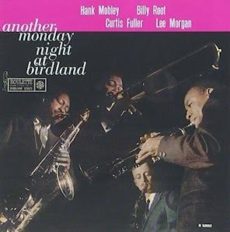
Another Monday Night at Birdland ~ Hank Mobley, Billy Root, Curtis Fuller, Lee Morgan | By Eddie Carter
This morning’s choice from the library brings us back to The Jazz Corner of The World for another live set by Lee Morgan on trumpet, Curtis Fuller (tracks: A2, B1, B2) on trombone, Hank Mobley, Billy Root on tenor sax. Another Monday Night at Birdland (Roulette R 52022/SR 52022) is the companion album to Monday Night at Birdland. Rounding out the septet is Ray Bryant on piano, Tommy Bryant on bass, and “Specs” Wright on drums. “Symphony Syd” Torin is the Master of Ceremonies, and my copy used in this report is the 1988 Spanish Mono reissue (Fresh Sound Records FSR-632).
Side One starts with an exhilarating rendition of It’s You Or No One, written in 1948 by Jule Styne and Sammy Cahn. Lee leads the ensemble on the melody before Hank opens the solos energetically. Lee lays down some spirited energy on the second statement, then Billy states his case with a vigorous finale leading to the climax and Syd’s introduction of the next tune. Jamph was written by Curtis Fuller, and I first heard it on the album, Big Six (1958). The septet begins the theme at mid~tempo collectively, then Mobley soars into the lead solo with some energetic blowing. Fuller greets the next statement enthusiastically, followed by Morgan who wails mightily on a vigorous reading. Root keeps the beat on the fourth interpretation with a scene-stealing performance. Bryant takes care of business on the closer with an aggressive solo into the out chorus.
Side Two starts with Syd’s announcement of the next tune, Nutville by Lee Morgan with inspired playing by the septet on the infectious melody. Hank launches into a swinging improvisation that’s a delight. Lee exhibits his skills on a joyful excursion next. Billy comes after him with a stellar statement that made me sit up and take notice. Curtis wraps up the solos with a delightful interpretation that brings so much pleasure ahead of the ensemble’s exit and group introductions. Wee by Denzil Best is an uptempo cooker that flies out of the gate with a high-voltage melody in unison. Mobley steps into the spotlight first with a heated solo. Morgan uses a mute for the second statement and attacks with the speed of a whirlwind. Root displays some lightning-fast chops on the third presentation, and Bryant covers plenty of ground motoring in rapid-fire fashion on the next reading. Wright gets a concise comment during the theme’s reprise into the septet’s lively finale.
Another Monday Night at Birdland was produced by Rudy Taylor and like the first album, the soundstage is excellent for a live recording. This is a four-star blowing session that I’m sure any fan of Hank Mobley, Billy Root, Lee Morgan, and Curtis Fuller would dig. If you’re a fan of Hard-Bop, this album is a terrific addition to any jazz library and one of the best in the Birdland Series!
~ Big Six (Riverside Records RLP12-273), Monday Night at Birdland (Roulette R-52015/SR-52015) – Source: Discogs.com © 2021 by Edward Thomas Carter

More Posts: choice,classic,collectible,collector,history,instrumental,jazz,music,saxophone,trombone
Daily Dose Of Jazz…
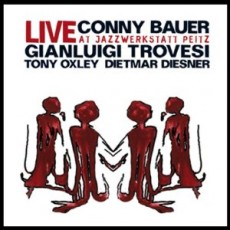
Conny Bauer was born Konrad Bauer on July 4, 1943 in Halle, Saxony-Anhalt, Germany. While in senior high school in 1957 he became interested in modern music and dance genres such as swing, boogie-woogie, blues and rock and roll. He taught himself to play guitar and piano and after graduation while trying to play in several bands was nicknamed “Conny” by his friends.
Recognizing his lack of musical knowledge to become a professional Bauer studied modern dance music from 1964 to 1968 taking up the trombone. In 1968 he left for Berlin to improve his skills with private lessons. From 1969 until 1971 he started his career as guitarist and singer in the band of Ernst-Ludwig Petrowsky, while doubling as a trombone soloist.
During the second half of the 1970s Bauer became a prominent jazz player in European free jazz, helping to found numerous groups that influenced the development of jazz in East Germany. By 1986 he was touring Japan, went on to direct the National Jazz Orchestra of the former East Germany, worked with artists such as Tadashi Endo, Sheryl Banks, Tony Oxley, Barry Altschul and George Lewis to name a few.
He has recorded two-dozen albums, received the German SWR jazz prize for his solo recordings Hummelsummen, and continues to perform, tour and record.
Daily Dose Of Jazz…
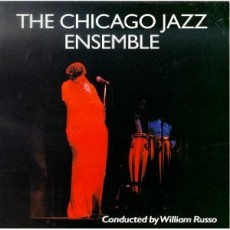
Bill Russo was born William Russo on June 25, 1928 in Chicago, Illinois and studied piano under Lennie Tristano. He would become an arranger and composer and by the 1950s was writing groundbreaking orchestral scores for the Stan Kenton Orchestra. He would compose for Kenton 23 Degrees N 82 Degrees W, Frank Speaking, Portrait of a Count and one of his most famous Halls Of Brass, featuring Buddy Childers, Maynard Ferguson and Milt Bernhart.
By the 60s Russo moved to England, founded the London Jazz Orchestra, and contributed to the Third Stream movement that sought to close the gap between jazz and classical music. Returning to Chicago by mid-decade he founded Columbia College’s music department, became the director of its Center for New Music, the college’s first full-time faculty member and the Director of Orchestral Studies at Scuola Europea d’Orchestra Jazz in Palermo, Italy.
Bill has composed classical symphonies, choral works, operas and several works for the theater. He has received a Koussevitsky award, had his work performed by the New York Philharmonic, the San Francisco and Chicago Symphony Orchestras, and has set music to the poetry of Gertrude Stein as well as scores for dance and film.
Russo has worked with Manny Albam, Teo Macero, Teddy Charles, Donald Byrd, Phil Woods, Bill Evans, Eddie Costa, Bob Brookmeyer, Al Cohn and Art Farmer among others. Starting the Chicago Jazz Ensemble, which is dedicated to preserving and expanding jazz, He was succeeded by Jon Faddis and it is currently under the artistic direction of Dana Hall. Trombonist, composer, arranger, eudcator and author Bill Russo passed away on January 11, 2003 after a bout with cancer. He was 74 years old.
Daily Dose Of Jazz…
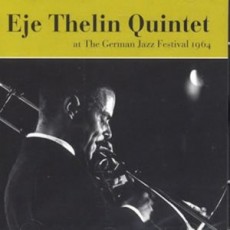
Eje Thelin was born Eilert Ove Thelin on June 9, 1938 in Jönköping, Sweden. He started his own quintet in 1961 and from 1969 to 1972 he was on the faculty of the Music Academy in Graz, Austria. For the rest of the 1970s, he led his own Eje Thelin Group in Sweden.
By the 1980s he expanded into composition, writing commissioned works for large European orchestras, sometimes featuring himself as soloist. In spite of the attention given to the obvious technical side of his playing, Thelin was also known for his warm approach to traditional ballads, a somewhat retro-romanticism that comes through in his later playing.
An innovator, Eje was widely admired among fellow trombonists for his facile technique, rhythmic intensity and was, perhaps, the first jazz trombonist to translate that technique into the so-called “Sheets of Sound” style that characterized much of the music of tenor saxophonist John Coltrane and, in general, free jazz of the late 1960s and 1970s. He would play with Joachim Kuhn and Don Cherry while leading his own groups.
Trombonist Eje Thelin, one of the strongest trombone voices of modal and free jazz to emerge in the European 60s, passed away on May 18, 1990.
More Posts: trombone
Daily Dose Of Jazz…
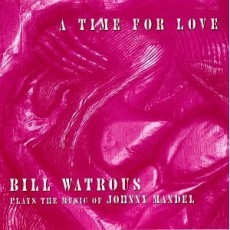
Bill Watrous was born William Russell Watrous III on June 8, 1939 in Middletown, Connecticut. Introduced to the jazz trombone at an early age by his trombonist father, it was while serving in the Navy that he studied with jazz pianist and composer Herbie Nichols. His first professional performances were in Billy Butterfield’s band.
Bill’s career blossomed in the 1960s, playing and recording with many Maynard Ferguson, Woody Herman, Quincy Jones, Johnny Richards and fellow trombonist Kai Winding. From 1965 – 68 he was a member of the house band on the Merv Griffin Show.
In the Seventies he played with the jazz-fusion group Ten Wheel Drive, formed his own band – The Manhattan Wildlife Refugee Big Band, recorded two albums for Columbia, and relocated to southern California.
He worked actively since the 1980s as a bandleader, studio musician, and performing at various jazz clubs. He is most known for his rendition of Johnny Mandel’s “A Time For Love”. Bill Watrous continued to perform and record as a solo artist, bandleader and in various small ensembles for a number of different labels until his passing on July 2, 2018 at age 79. He published an instructional manual Trombonisms and was on the faculty of the University of Southern California Thornton School of Music.
More Posts: trombone