

Hollywood On 52nd Street
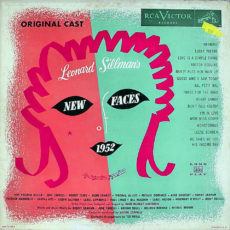
Guess Who I Saw Today is a popular jazz song composed by Murray Grand with lyrics by Elisse Boyd. The song was originally composed for Leonard Sillman’s Broadway musical revue New Faces of 1952 in which it was sung by June Carroll.
The revue opened on Broadway at the Royale Theatre on May 16, 1952 and ran for 365 performances. It was produced by Leonard Sillman, directed by John Murray Anderson and John Beal with choreography by Richard Barstow. The sketches were written by Ronny Graham and Brooks. The songs were composed by, among others, Harnick, Graham, Murray Grand and Arthur Siegel.
The cast featured Graham, Kitt, Clary, Virginia Bosler, June Carroll, Virginia De Luce, Alice Ghostley, Patricia Hammerlee, Carol Lawrence, Paul Lynde and Bill Milliken. De Luce and Graham won the 1952 Theatre World Award. The revue marked Kitt’s Broadway debut, singing a sultry rendition of “Monotonous”, about how boring a life of luxury was.
Two years later, the name was abridged to New Faces and was adapted into a motion picture filmed in Cinemascope and Eastmancolor and was released by 20th Century Fox on March 6, 1954. It helped jumpstart the Hollywood careers of several young performers including Paul Lynde, Alice Ghostley, Eartha Kitt, Robert Clary, Carol Lawrence, Ronny Graham, performer/writer Mel Brooks (as Melvin Brooks), and lyricist Sheldon Harnick.

Hollywood On 52nd Street
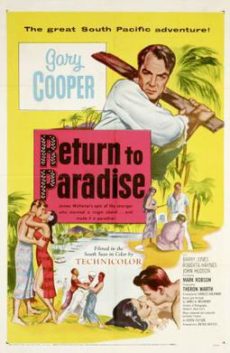
Return to Paradise is a jazz standard that was written by Dimitri Tiomkin and Ned Washington for the movie of the same name. The film was set and principal photography was shot in Samoa and released by United Artists in 1953. It starred Gary Cooper, Barry Jones and Roberta Haynes and the screenplay by Charles Kaufman was based on the 1951 short story Mr. Morgan by James Michener in his short story collection Return to Paradise, his sequel to Tales of the South Pacific.
The Story
During the 1920s, itinerant American beachcomber Mr. Morgan (Cooper) is deposited on the island of Matareva in the South Pacific. Deciding to stay, he is confronted by Pastor Cobbett (Jones), who lost both his father and his wife as a young missionary on the island and rules the island as a Puritanical despot, using local bullies as wardens to enforce his rules. Morgan wins the support of the natives after defeating the wardens with the aid of an empty shotgun.
Morgan has an illegitimate child with an island girl who dies in childbirth. Leaving his daughter with her grandmother he leaves the island, only to return during World War II. Cobbett has changed, his daughter Turia is now grown and in love with a stranded Navy pilot and Morgan now has to face the inevitable possibility of a repeat of his indiscretion with his daughter. Forcing the split by making the pilot and his crew leave the island, Turia is upset but reconciles with her father who decides to stay on with her on the island.
Review: Kathleen Bertrand | It’s Time To Love
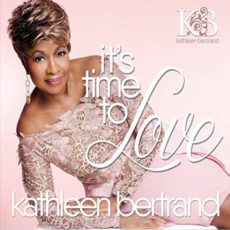
It’s Time To Love is a statement of purpose that is anything but simple. Knowing Kathleen as I do there is more than one layer to everything she does. I found this not only to be a personal message but a global appeal. On this project she pulls from several different sources and vantage points, distinguished by the cadre of the elite hometown musicians she has invited to have fun with her.
Her approach is unmistakable – pure and filled with joy. There is a clarity in her voice that is immediately recognizable from the first note you hear. Toss into the mix some very creative arrangements and you understand why Ms. Bertrand wholeheartedly believes it is time to love.
Bringing an impressive compilation of nine standards, originals, classic soul and gospel, she kicks off this offering with the title track that she composed with her musical director Phil Davis. Maintaining the groove she seamlessly moves into Diamonds, written for Rihanna’s 8th album, proving that no song is far from jazz with the proper arrangement. Reaching back to the 1946 musical St. Louis Woman she brings into the new millennium the classic Arlen/Mercer tune Come Rain Or Come Shine in an easy rendition that expresses yesterday’s view of today’s ride or die.
Always one to illuminate the talents of young writers she augments Tony Hightower’s Baby I’m Yours with additional lyrics, giving a lyrical homage to that very special person. Heading back to Broadway she juxtaposes the question of love with a 1947 Lerner and Loewe composition Almost Like Being In Love from Brigadoon, that has one understanding the feeling of being alive. Teaming up once again with Davis, their reputation as composers and arrangers firmly established, they pen and deliver another original Walking Through The Door, be it expectation or surprise, the need is the same. Walking us back in time to the Sixties and the music of another renowned team of Bacharach/David with Anyone Who Had A Heart.
Never far from the church, Kathleen chooses to rearrange with the assistance of Tyrone Jackson, the traditional It’s Me (Standing In The Need Of Prayer). As I listen to her rendering me back to my childhood, I am hearing so much of Mahalia Jackson in this passionate acknowledgement to the higher power. Closing out this recording she moves the message back to the joy of love with the Richard Clay, Carl Clay and Wayne Garfield composition Love From The Sun, made famous by Norman Connors. However, she turns once again to emerging artists, The Dangerfield Newbies, to arrange and produce this classic tune, clearly making this her own, as she inimitably does with every song she touches.
Earlier in this review I mentioned the elite cadre of Atlanta musicians and I would be remiss not to list them and allow you the opportunity to catch them in live performance when their names come across your radar. Order of appearance of the recording: Phil Davis, Rod Harris, Jr., Melvin Jones, Mike Burton, Katy Miner, Tyrone Allen, George Caldwell, Sean Jefferson, RiShon Odel, Russell Gunn, Robert Boone, Frankie Quinones, Joel Powell, Tyrone Jackson, Mace Hibbard, Sam Skelton, Kevin Smith, Chris Burroughs, Nelson Render and Marvin Pryor.
To say Kathleen Bertrand is an original does her a disservice for we are all one of a kind. What sets her apart is her innate ability to select and align songs in a manner that makes you anticipate hearing what comes next and a little saddened when the last song plays out. This album celebrates and laments the many facets of love. It is an enjoyable escape and journey through one’s heart, as we have all been where each songs takes us, that is, at one time or another. The one thing I know to be true, with Kathleen Bertrand, there will always be more and the best is yet to come.
carl anthony | notorious jazz | september 23, 2018
Give A Gift Of Jazz ~ Share 
#preserving genius
More Posts: bandleader,history,instrumental,jazz,music,review,vocal
Hollywood On 52nd Street
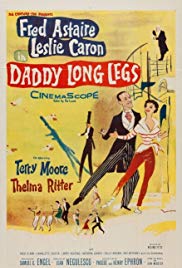
Something’s Gotta Give was composed by Johnny Mercer for his friend Fred Astaire who starred in the 1955 film Daddy Long Legs. It is the love song duet between him and Leslie Caron. The song playfully uses the irresistible force paradox – which asks what happens when an irresistible force meets an immovable object – as a metaphor for a relationship between a vivacious woman and an older, world-weary man. The man, it is implied, will give in to temptation and kiss the woman.
The film also stars Terry Moore, Thelma Ritter, Fred Clark and Ray Anthony who appears as himself with his orchestra. Filming took place on location at 20th Century Fox Studios in Hollywood and the Andrew Carnegie Mansion in Manhattan.
Storyline
On a trip to France, millionaire Jervis Pendleton III (Astaire) sees an 18 year old girl Julie Andre (Caron) in an orphanage. Immediately enchanted with her, but mindful of the difference in their ages and what the press may report should his involvement be discovered, he anonymously sponsors her to attend fictional college in New England. She writes him letters, which he doesn’t read. After 3 years, he goes to visit her at a dance, not telling her that he is her benefactor. They fall in love, but the usual movie-type difficulties get in the way before they can get together at the end.
Hollywood On 52nd Street
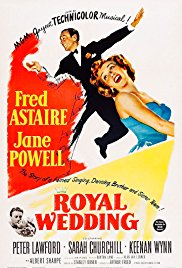
Too Late Now is a song composed by Burton Lane and the lyrics written by Alan Jay Lerner for the 1951 film Royal Wedding. The song was performed by Jane Powell.
The Story: The film centers around brother and sister dance team Tom and Ellen Bowen whose show closes in New York. Their agent, Irving Klinger (Keenan Wynn), books them in London for the same period as the Royal Wedding. They travel by ship where Ellen (Jane Powell) meets and becomes involved with Lord John Brindale (Peter Lawford). This causes her to miss a rehearsal. Tom (Fred Astaire) uses the time to dance with a hat rack and gym equipment.
Later Tom and Ellen attempt a graceful dance number as the ship rolls to and fro. Upon arrival brother and sister are met by Edgar Klinger (Wynn) who settles them into their hotel. Shortly afterward Tom holds auditions and meets Anne (Sarah Churchill). There is much indecision by the siblings about their romantic partners even though they are in-the-clouds. Ellen sings her third ballad, this time an open declaration of love, to Lawford with Too Late Now. Tom dances on the walls and ceiling of his hotel room. All ends well in this light musical. By the way, there is a vaudeville-style dance number in their show that features slapstick.
Too Late Now is the only song from this film that was to become a jazz standard.