

Daily Dose Of Jazz…
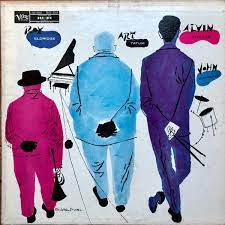
Alvin Stoller was born October 7, 1925 in New York City, New York and studied with drum teacher Henry Adler. He launched his career touring and recording with swing era big bands led by Benny Goodman, Tommy Dorsey, Harry James, and Charlie Barnet. He backed singers including Billie Holiday, Mel Tormé, and Frank Sinatra on some of their major recordings.
His drums may be heard on many of Ella Fitzgerald’s Songbook recordings; on Ella Fitzgerald Sings the Duke Ellington Songbook, having performed with the Duke Ellington orchestra itself, alongside Ellington’s own Sam Woodyard. From the moment Frank Sinatra started to record with Capitol Records in 1953, Stoller was the singer’s preferred percussionist and performed on nearly all Sinatra recordings until 1958.
He recorded with Art Tatum, Roy Eldridge, Oscar Peterson, Coleman Hawkins, Ben Webster, Benny Carter, Herb Ellis, and Erroll Garner among many other jazz musicians. The 1950s saw Stoller settlling in Los Angeles, California where he became respected for his work in the Hollywood studios which lasted for several decades.
Leonard Feather considered him a first-rate, swinging drummer. Buddy Rich, whom some consider to have been the greatest of all jazz drummers, chose Alvin to play drums on an album in which Rich sang suggests the esteem Stoller earned from his fellow musicians. He was the drummer on both Mitch Miller’s recording of The Yellow Rose of Texas and Stan Freberg’s parody of Miller’s recording.
Drummer Alvin Stoller, though an in-demand drummer during the Forties and Fifties and recorded more than five dozen albums, and eventually appeared to have been largely forgotten, transitioned on October 19, 1992.

More Posts: drums,history,instrumental,jazz,music
Daily Dose Of Jazz…
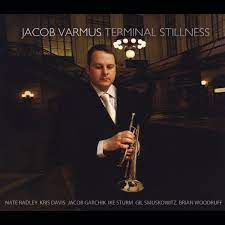
Jacob Varmus was born on October 6, 1973 in San Francisco, California. He first heard the trumpet’s call when he was two years old and ten years later had a trumpet of his own. He began winning top marks at all the California Music Educators’ Association festivals for his work as soloist and chamber musician.
Evolving parallel to his love of music was a talent for using language artistically thru poetry, critical essays, and autobiographical stories. In high school he won awards for poetry and sports journalism as well as music. His first year of college at the University of Iowa, Jacob studied poetry closely with MacArthur grant recipient Jorie Graham and classical trumpet virtuoso David Greenhoe.
An initiation to the music of John Coltrane sent Varmus to focus on jazz. In 1994 he moved to New York City to finish his BFA at the New School Jazz program. There he received timeless lessons from a long list of artists including Arnie Lawrence and Billy Harper. Here he became known to his peers and elders as a composer of harmonically intricate yet compellingly simple and striking tunes.
By his senior year he was being commissioned by the Jazz Composers’ Collective to write a suite combining jazz quintet with string quartet. It featured Ted Nash and Frank Kimbrough. He went on to enroll in composer workshops, receiving a further commission for jazz quartet.
As an educator he is on the faculty of the New York Jazz Academy. Trumpeter and composer Jacob Varmus continues to pursue his highly melodic yet rigorous music.
More Posts: bandleader,cornet,history,instrumental,jazz,music,trumpet
The Jazz Voyager
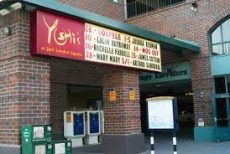
The friendly skies beckon once again for a continental flight to that well known city by the bay. San Francisco, California is the destination for the Jazz Voyager, specifically Oakland to one of my favorite hangs, Yoshi’s. With the larger space and expanded Japanese menu it quickly became one of the premiere jazz venues on the West Coast.
Having not seen him for more than a decade, I am looking forward to seeing Kurt Elling and Charlie Hunter, one of the male vocalists who came along to fill in the void with an individual sound. He is joined by 7 & 8 string guitarist Charlie Hunter as they bring Superblue to the stage.
Yoshi’s is located at 510 Embarcadero West, 94607. Get more info by visiting the Jazz Calendar at notoriousjazz.com/event/superblue-kurt-elling-and-charlie-hunter
Hitting the world’s best jazz spots!!! #JazzVoyager #Travel #Club #Adventure #WannaBeWhereYouAre #NotoriousJazz4You
More Posts: adventure,club,genius,guitar,jazz,music,preserving,travel,vocal
Daily Dose Of Jazz…
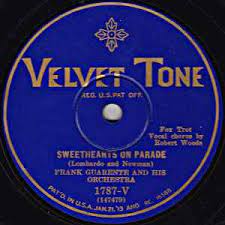
Frank Guarente was born Francisco Saverio Guarente on October 5, 1893 in Montemiletto, Italy and received formal training in music before emigrating to America in 1910. He settled in Allentown, Pennsylvania, where a brother of his lived.
Relocating to New Orleans, Louisiana in 1914, where he took a job in a bank and associated with ethnically Italian musicians such as Nick LaRocca and Tony Parenti. He met King Oliver and eventually started getting gigs with New Orleans brass bands. He played at Tom Anderson’s club and toured Texas under the name Ragtime Frank with his ensemble, the Alabama Five.
Serving in the United States Army during World War I in 1917, then played in Philadelphia, Pennsylvania with Charlie Kerr and Eddie Lang. Putting together his own group in 1921 in New York City, which included Arthur Schutt and Chauncey Morehouse. Soon after, Paul Specht picked his players up to join a larger orchestra, and Guarente played with Specht on European tours through 1924.
Leading a Specht side group called The Georgians, they recorded between 1922 and 1924 in the style of the Original Dixieland Jass Band. He left Specht in 1924, to form his own group, The New Georgians, that toured Europe and remained active until 1927. This he followed by working in England with the Savoy Orpheans and ensembles associated with Bert Firman.
Returning to the United States in 1928, he joined Specht’s orchestra again, playing until 1930. He joined Victor Young’s band in 1930, remaining there until 1936, and also played with Jimmy Dorsey, Tommy Dorsey, Jack Teagarden, Bing Crosby, and The Boswell Sisters on record and radio. In 1937 ill health forced him to stop performing and on July 21, 1942 in New York City, trumpeter, composer and bandleader Frank Guarente transitioned at the age of 48.
More Posts: history,instrumental,jazz,music,trumpet
Daily Dose Of Jazz…
Greely Walton was born in Mobile, Alabama on October 4, 1904. He played violin in his youth before settling on saxophone, and went on to study music at the University of Pittsburgh in the 1920s.
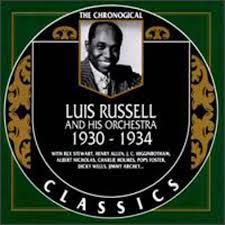
During the 1920s he first worked with Elmer Snowden, then with Benny Carter. For seven years beginning in 1930 he played with Luis Russell during which time they served as Louis Armstrong’s backing ensemble. After leaving Russell in 1938 he worked with Vernon Andrade, and in the Forties he worked with Horace Henderson, Cootie Williams, and Cab Calloway.
From 1945-47 he acted as musical director for The Ink Spots, and played with Noble Sissle and Sy Oliver towards the end of the decade. In the Fifties he worked in radio and television in the 1950s.
Retiring from music before the end of the decade, tenor saxophonist Greely Walton transitioned on October 9, 1993 in New York City.
More Posts: history,instrumental,jazz,music,saxophone