

Daily Dose Of Jazz…
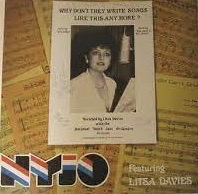
Litsa Jane Davies was born on June 27, 1963 in Hampshire, England. Growing up in Poole, Dorset, she attended Harry Harbin school where her music teacher recognized her vocal talent. At 14 she was singing with him on jazz gigs and appeared locally on television in 1977. By 1979 she was gigging with pianist Mike Hatchard and the following year began a six-year stint with the National Youth Jazz Orchestra. While with NYJO she sang on three albums, notably Why Don’t They Write Songs Like This Anymore?, which featured her throughout.
She performs with her own quintet and has toured with the European Jazz Orchestra. She has sung on radio with the BBC Big Band, the bands Night Owls and Bone Structure as well as her own group. During the early and mid-80s Litsa played festivals with her quintet, and sang with the Burch Trio and saxophonist Iain Ballamy. The following year she joined the cast of the London West End musical Chess at the Prince Edward Theatre going on to play the lead until the show closed in 1989. She continued to sing on BBC radio.
In 1990 Davies concentrated on raising her children while singing backup for Tom Jones and performing with various bands including the Ian Pearce Big Band, the Ross Mitchell Dance Orchestra and the Mark Graham Dance Band. By 1995 she reappeared with a week-long engagement at Ronnie Scott’s club.
Vocalist Litsa Davies, gifted with fine interpretative skills and intelligent phrasing, continues to deliver ballads and up-tempo songs with swing.

More Posts: bandleader,history,instrumental,jazz,music,vocal
Requisites
On The Spur Of The Moment ~ Horace Parlan | By Eddie Carter
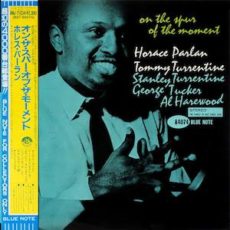
Any album by pianist Horace Parlan is always a delightful listen for yours truly. This morning’s choice from the library offered for your consideration is his 1961 release, On The Spur of The Moment (Blue Note BLP 4074/BST 84074). As a child, Horace was stricken with polio, resulting in the partial crippling of his right hand. He managed to develop a left-hand chord-voicing style and also learned to improvise with detailed comping using the right. Horace is supported on this date by Tommy Turrentine on trumpet, Stanley Turrentine (Tommy’s brother) on tenor sax, George Tucker on bass, and Al Harewood on drums. My copy used in this report is the 1984 Toshiba-EMI Japanese Stereo reissue (Blue Note BST 84074 – BNJ 71034).
Side One starts with an original by the leader, On The Spur of The Moment. Horace opens with a brief introduction segueing into the ensemble’s mid tempo melody. Tommy is up first and makes his mark with a gorgeous tone. Horace follows with some light-hearted swinging, then Stanley adds some soulful cooking to the third reading. George does some solid walking on the next solo and Al has a brief exchange with the front line ahead of the quintet’s closing chorus. Skoo Chee by Booker Ervin raises the energy level a few notches on the group’s collective melody. Stanley leads the way with a swinging opener, then Tommy attacks the second statement with spirited energy. Horace delivers a splendid solo next preceding Stanley’s vigorous closing statement and shouts during a slow fade.
And That I Am So In Love by Harold Ousley slows the pace down to midtempo with Stanley and the trio delivering a happy opening chorus. Stanley starts things off with a pleasant opening solo. Tommy follows with some thoughtfully interesting lines and Horace continues to mesmerize with a gorgeous finale before Stanley returns for the gentle dissolve into oblivion. Al’s Tune by Booker Ervin begins Side Two with the quintet’s easy-flowing melody. Tommy takes the lead this time with an exquisite opening statement. Stanley’s tenor brightens the second interpretation like the sun following the rain on a summer day. Horace serves up a sparkling reading next, followed by George who walks with authority on the finale into the ensemble’s conclusion.
Ray C. by Leon Mitchell is a slow blues that would be a perfect tribute to Ray Charles although this isn’t known according to Ira Gitler’s liner notes. The quintet creates a relaxed atmosphere on the bluesy theme, and Stanley, Tommy, Horace, and George all cruise at a comfortable speed before the quintet takes the song out. Roger Williams who wrote the album closer, Pyramid is a jazz pianist from Pittsburgh and the quintet begins the melody of this pretty song deceptively slowly. The pace picks up for Stanley who opens with an impressive interpretation. Tommy holds his own on the second statement with an exceptional performance and Horace puts the final stamp on the album with a sprightly finale leading to the ensemble’s out-chorus.
On The Spur of The Moment was produced by Alfred Lion and recorded by Rudy Van Gelder. This reissue was the first Stereo release of this album, and the sound quality is exceptional with a stunning soundstage. The musicians jump out of your speakers as if they’re playing in front of you. Tommy is on the left channel; Stanley is on the right channel, and the trio occupies both. Toshiba-EMI Limited has done an excellent job with the mastering of Rudy’s original tapes. This is one of three albums this group recorded together, the other two are Speakin’ My Piece (1960) and Comin’ Your Way (1987). If you’re in the mood for some Hard-Bop that swings, I offer for your next vinyl hunt, On The Spur of The Moment by Horace Parlan. It’s a great find for anyone who enjoys jazz and should fit nicely in any library!
~ Comin’ Your Way (Blue Note BLJ 84065), Speakin’ My Piece (Blue Note BLP 4043/BST 84043) – Source: Discogs.com © 2022 by Edward Thomas Carter
More Posts: choice,classic,collectible,collector,history,instrumental,jazz,music,piano
The Quarantined Jazz Voyager
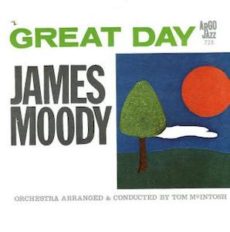
Once again the Jazz Voyager selects another rare gem from the stacks in his library and dusting it off places it on the turntable for another listen. This week it is an album by James Moody titled Great Day. The album was recorded on two simultaneous sessions, June 17 -18, 1963 at the Nola Penthouse Studio in New York City, produced by Esmond Edwards and released the same year on the Argo Records label.
The saxophone and flute work from Moody is always reliable and excellent for the avid listener. He has a penchant for switching from soul jazz to hard bop to mainstream, as he plays straight-ahead originals, standards, and ballads.
Benny Golson wrote the liner notes, Don Bronstein designed the cover and Esmond Edwards painted the cover art. The Great Day sessions historical significance is it is the first documented encounter for Thad Jones and Mel Lewis, who would go on to lead the Thad Jones~Mel Lewis Orchestra.
Tracks | 33:06 All compositions by Tom McIntosh, except as indicated- Great Day ~ 4:00
- The Search ~ 4:35
- Let’s Try ~ 3:22
- One Never Knows (John Lewis) ~ 5:18
- Opales’que (Dennis Sandole) ~ 5:01
- Blues Impromptu (James Moody) ~ 5:30
- Malice Toward None ~ 5:20
- James Moody ~ alto saxophone, tenor saxophone, flute
- Johnny Coles, Thad Jones ~ trumpet
- Hubert Laws ~ flute
- Hank Jones, Bernie Leighton ~ piano
- Jim Hall ~ guitar
- Richard Davis ~ bass
- Mel Lewis ~ drums
- Tom McIntosh ~ arranger, conductor, composer

More Posts: adventure,album,club,flute,genius,jazz,museum,music,preserving,restaurant,saxophone,travel
The Quarantined Jazz Voyager
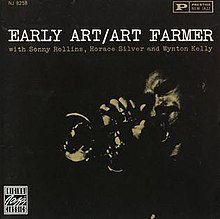
The Jazz Voyager has selected from the shelves in his library and dusted off an album by Art Farmer recorded in 1962 titled Early Art. The album features two sessions recorded in 1954 which was originally released on LP on the New Jazz label in 1962.
The album was produced by Bob Weinstock and recorded at Van Gelder Studio in Hackensack, New Jersey on January 20 (tracks 1-3, 5) and November 9 (tracks 4, 6-10). The cover design and photography was by Don Schlitten and the liner notes were written by Joe Goldberg.
The programming differs from what is listed, with Soft Shoe (which should have been the opener) is actually appearing fifth and the songs listed as appearing second through fifth have moved up to first through fourth. The Jazz Voyager is pleased to present this work by Farmer and is still practicing social distancing and wearing his mask.
Tracks | 41:52 All compositions by Art Farmer except as indicated- Confab in Tempo ~ 3:54
- I’ll Take Romance (Oscar Hammerstein II, Ben Oakland) ~ 4:57
- Wisteria ~ 4:32
- Autumn Nocturne (Kim Gannon, Josef Myrow) ~ 4:05
- Soft Shoe ~ 4:59
- I’ve Never Been in Love Before (Frank Loesser) ~ 3:49
- I’ll Walk Alone (Jule Styne, Sammy Cahn) ~ 3:55
- Gone With the Wind (Herbert Magidson, Allie Wrubel) ~ 4:07
- Alone Together (Arthur Schwartz, Howard Dietz) ~ 3:59
- Pre Amp ~ 3:35
- Art Farmer ~ trumpet
- Sonny Rollins ~ tenor saxophone (tracks 1-3,5)
- Horace Silver (tracks 1-3, 5), Wynton Kelly (tracks 4, 6-10) ~ piano
- Percy Heath (tracks 1-3, 5), Addison Farmer (tracks 4, 6-10) ~ bass
- Kenny Clarke (tracks 1-3, 5), Herbie Lovelle (tracks 4, 6-10) ~ drums
More Posts: adventure,album,club,genius,jazz,museum,music,preserving,restaurant,travel,trumpet
The Quarantined Jazz Voyager
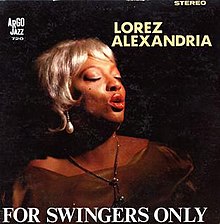
The Jazz Voyager has been combing the stacks of music in his library for the right album and has selected For Swingers Only by vocalist Lorez Alexandria that was released by the Argo label in 1963.
A stylized, disciplined, soulful, and satisfying session, the recording of this album took place over two days on January 2 & 3, 1963 at Ter Mar Recording Studios in Chicago, Illinois. The session was produced by Esmond Edwards.
Tracks | 29:00- Baltimore Oriole (Hoagy Carmichael, Paul Francis Webster) ~ 3:11
- Little Girl Blue (Richard Rodgers, Lorenz Hart) ~ 3:34
- All or Nothing at All (Arthur Altman, Jack Lawrence) ~ 4:55
- Traveling Down a Lonely Road (Nino Rota, Michele Galdieri, Don Raye) ~ 3:45
- Mother Earth (Peter Chatman) ~ 3:03
- Love Look Away (Richard Rodgers, Oscar Hammerstein II) ~ 3:49
- The End of a Love Affair (Edward C. Redding) ~ 2:49
- That Old Devil Called Love (Alan Roberts, Doris Fisher) ~ 3:54
- Lorez Alexandria – vocals
- Ronald Wilson – tenor saxophone, flute
- John Young – piano, arranger
- George Eskridge – guitar
- Jimmy Garrison – bass
- Phil Thomas – drums
- Cover Design ~ Don Bronstein
- Cover Photography ~ Roger Marshutz
- Engineer ~ Eddie Rio
- Liner Notes ~ Leonard Feather
More Posts: adventure,album,club,genius,jazz,museum,music,preserving,restaurant,travel,vocal