

Daily Dose Of Jazz…
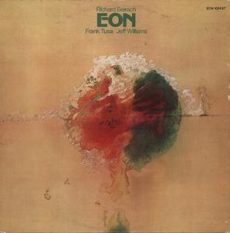
Richard Alan Beirach was born on May 23, 1947 in New York City, New York and initially studied both classical music and jazz. While still attending high school, he took lessons from pianist Lennie Tristano. He later studied at the Berklee College of Music, however, after one year he left and began attending the Manhattan School of Music. While there, he studied with Ludmilla Ulehla.
In 1972, graduating from the Manhattan School of Music he took with him a Master’s Degree in Music Theory and Composition. Beirach’s style is influenced by Art Tatum, Bill Evans, McCoy Tyner, and Chick Corea along with his earlier classical training and many touches of his individualism all its own.
He recorded 57 albums as a leader and as a sideman with George Adams, John Abercrombie, John Scofield, Chet Baker, Dave Liebman, Jeremy Steig, Steve Davis, Laurie Antonioli, and the Ron McClure Trio he recorded 17. Pianist and composer Richie Beirach continues to perform, compose and record.

More Posts: bandleader,composer,history,instrumental,jazz,music,piano
Daily Dose Of Jazz…
Denzil DaCosta Best was born April 27, 1917 in New York City, New York into a musical Caribbean family originally from Barbados. Trained on piano, trumpet, and bass, he concentrated on the drums starting in 1943. Between the years 1943 and 1946 he worked with Ben Webster, Coleman Hawkins, Illinois Jacquet and Chubby Jackson.
Known to sit in at Minton’s Playhouse, he took part in a recording with George Shearing in 1948 and was a founding member of his Quartet, remaining there until 1952. In 1949, he stepped out to play on a recording session with Lennie Tristano for Capitol Records and recorded later with Lee Konitz.
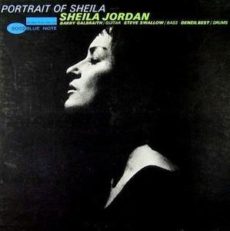
In 1953 a car accident fractured both legs and Best was forced into temporary retirement until 1954. His comeback had him playing with Artie Shaw, and then in a trio with Erroll Garner (1955–57), including Garner’s live album Concert by the Sea. He went on to play with Phineas Newborn, Nina Simone, Billie Holiday and Tyree Glenn. 1962 saw him in the drummer’s seat on Shiela Jordan’s first album Portrait of Sheila.
Best composed several bebop tunes, including Move, Wee, Nothing But D. Best, and Dee Dee’s Dance. With Thelonious Monk he composed Bemsha Swing and his composition 45 Degree Angle was recorded by Herbie Nichols and Mary Lou Williams.
Suffering from paralysis after the Jordan recording session, drummer, percussionist and composer Denzil Best, who was a prominent bebop drummer in the 1950s and early 1960s, transitioned after falling down a staircase in a New York City subway station at the age of 48 on May 24, 1965.
The Quarantined Jazz Voyager
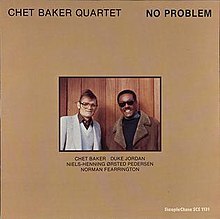
My choice this week is the album No Problem by the Chet Baker Quartet featuring Duke Jordan. The album was produced by Nils Winther, recorded at Sweet Silence Studios, Copenhagen, Denmark on October 2, 1979 and released the following year on the Steeplechase label. The recording engineers were Freddy Hansson and Thomas Brekling, with Tom West holding down the assisting engineer role.
This session came during Baker’s resurgence from losing his embouchure from a beating that broke his tooth, more than likely related to an attempted drug buy, though the story is a bit hazy. After getting dentures he developed a new embouchure in the Seventies and began a more mellow and wavering playing style. There’s always his signature vocals present during this period in his career.
Track List | 51:19 All compositions by Duke Jordan- No Problem ~ 9:45
- Sultry Eve ~ 7:04
- Glad I Met Pat ~ 5:08
- Kiss of Spain ~ 7:15
- The Fuzz ~ 6:05
- My Queen Is Home to Stay ~ 7:13
- Jealous Blues ~ 8:48 (Bonus Track On CD)
- Chet Baker ~ trumpet
- Duke Jordan ~ piano
- Niels-Henning Ørsted Pedersen ~ bass
- Norman Fearrington ~ drums

More Posts: bandleader,history,instrumental,jazz,music,piano,trumpet
The Quarantined Jazz Voyager
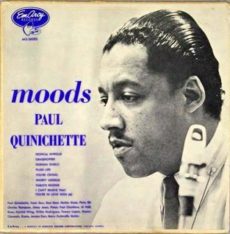
Moods, also referred to as Moods Featuring Paul Quinichette is the 1954 debut album by saxophonist Paul Quinichette. It features compositions and arrangements by Quincy Jones and was released in 1955 on the EmArcy label. The tracks were recorded on two session dates, on November 4th (tracks 5–8) and 22nd (tracks 1–4) 1954 with two different line-ups at Fine Sound Studios in New York City.
The second session featured an Afro-Cuban combo with Herbie Mann on flute and also on tenor saxophone and Latin percussion instead of a drum set. The difference between the two sessions was preserved in splitting the album with the later recorded Latin jazz session on the LP’s A-side, the more straight ahead approach on the other.
Tracks | 40:40 All compositions by Quincy Jones except as indicated
- Tropical Intrigue ~ 3:04
- Grasshopper ~ 4:02
- Dilemma Diablo ~ 4:03
- I Can’t Believe That You’re In Love With Me (Jimmy McHugh, Clarence Gaskill) ~ 6:44
- Plush Life ~ 7:48
- You’re Crying ~ 3:13
- Shorty Georgie (Harry Edison, Count Basie) ~ 6:33
- Pablo’s Roonie ~ 4:53
- Paul Quinichette – tenor saxophone
- Herbie Mann – flute, tenor saxophone
- Jimmy Jones – piano
- Al Hall – bass
- Tommy Lopez – congas
- Manny Oquendo – bongos
- Willie Rodriguez – timbales
- Paul Quinichette – tenor saxophone
- Sam Most – flute
- Sir Charles Thompson – piano
- Jerome Darr, Barry Galbraith – guitar
- Paul Chambers – bass
- Harold Wing – drums
More Posts: adventure,album,club,genius,jazz,museum,music,preserving,restaurant,saxophone,travel

Daily Dose Of Jazz…
Anthony Tillmon Williams was born of African, Portuguese, and Chinese descent on December 12, 1945 in Chicago, Illinois and grew up in Boston, Massachusetts. He studied with drummer Alan Dawson at an early age, and began playing professionally at the age of 13 with saxophonist Sam Rivers. Saxophonist Jackie McLean hired Williams when he was 16.
At 17 Williams gained attention when he joined Miles Davis in what was later dubbed Davis’s Second Great Quintet. A vital element of the group, his playing helped redefine the role of the jazz rhythm section through the use of polyrhythms and metric modulation.
He recorded his first two albums as leader at nineteen for the Blue Note label, Life Time in 1964) and Spring in 1965.. He also recorded as a sideman for the label including, in 1964, Out to Lunch! with Eric Dolphy and Point of Departure with Andrew Hill.
By 1969, he had formed his trio, the Tony Williams Lifetime, with John McLaughlin on guitar and Larry Young on organ. Lifetime was a pioneering band of the fusion movement. Disbanding the group, in 1975 he put together a band he called The New Tony Williams Lifetime, featuring bassist Tony Newton, pianist Alan Pasqua, and English guitarist Allan Holdsworth, which recorded two albums for Columbia Records..
In mid-1976, Tony reunited with Herbie Hancock, Ron Carter, and Wayne Shorter. Freddie Hubbard replaced Miles Davis who was in the midst of a six-year hiatus. The resulting record was later released as V.S.O.P. and the group toured for several years and produced a series of live albums released under the name V.S.O.P. or V.S.O.P.: The Quintet.
1979 saw Williams, McLaughlin and bassist Jaco Pastorius united for a one-time performance at the Havana Jazz Festival. This trio came to be known as the Trio of Doom. In 1985, returning to Blue Note he released six albums through 1993, playing his compositions almost exclusively ubtil he left Blue Note for the final time.
He lived and taught in the San Francisco Bay Area, was one of the pioneers of jazz fusion, and was inducted into the Modern Drummer Hall of Fame in 1986. On February 20, 1997 he checked into Seton Medical Center in Daly City, California, suffering from stomach pain. Three days later, while recuperating from gallbladder surgery, drummer Tony Williams passed away of a heart attack at 51 on February 23, 1997.
More Posts: bandleader,drums,history,instrumental,jazz,music