

Daily Dose Of Jazz…
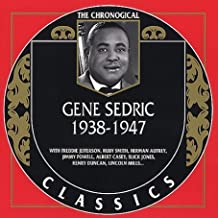
Gene Sedric, born Eugene Hall Cedric on June 17, 1907 in St. Louis, Missouri into a family where his father played ragtime piano. He played with Charlie Creath in his hometown and then with Fate Marable, Dewey Jackson, Ed Allen, and Julian Arthur.
Joining Sam Wooding’s Orchestra in 1925 he toured Europe with him until 1931 when the unit dissolved. During his time in Europe he recorded with Alex Hyde. When he returned to New York City he played with Fletcher Henderson and Alex Hill, before joining Fats Waller’s Rhythm in 1934, where he remained to 1942. When Waller went on solo tours Sedric found work gigging alongside Mezz Mezzrow in 1937 and Don Redman from 1938 to 1939).
Sedric put together his own group in 1943, prior to playing with Phil Moore in 1944 and Hazel Scott in 1945. He put together another ensemble from 1946–51, playing in New York City. His later associations through the late 1940s into the early 60s include time with Pat Flowers, Bobby Hackett, Jimmy McPartland, Mezzrow again, Conrad Janis, and Dick Wellstood. He recorded sparingly as a leader in 1938, 1946, and with Mezzrow in 1953.
Clarinetist and tenor saxophonist Gene Sedric, who acquired the nickname “Honey Bear” in the 1930s because of his large camel hair coat, passed away on April 3, 1963 in New York City.
More Posts: bandleader,clarinet,history,instrumental,jazz,music,saxophone
Daily Dose Of Jazz…
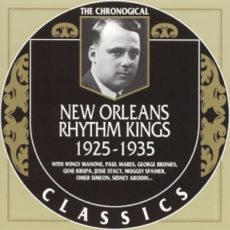
Paul Mares was born on June 15, 1900 in New Orleans, Louisiana and was self-taught on the cornet and trumpet and picked up his early experience laying the riverboat Capitol playing with the Tom Brown Band. Leaving his hometown in 1919 he moved to Chicago, Illinois and worked with Ragbaby Stevens before freelancing around the city.
In 1921 Paul formed the Friars Society Orchestra, a group that prominently featured trombonist George Brunies and clarinetist Leon Rappolo. From 1922-23, the band recorded for Gennett Records and became one of the best-regarded bands in the city. The band, which broke up in 1924, included up-and-coming jazz musicians, including the members of the Austin High School Gang and Bix Beiderbecke.
Mares who was influenced by King Oliver, played in New York for a short time, went back to New Orleans the following year and led a couple more sessions. In 1934, a move to Chicago the following year had him making a brief comeback and leading a recording session that resulted in four titles before he retired again.
By 1935 Mares he was playing trumpet and fronting a recording session with his band called Paul Mares and his Friars Society Orchestra. The name referred to the Friar’s Inn club where the Rhythm Kings had first played in Chicago. The 1935 band included the white New Orleanian and N.O.R.K. veteran Santo Pecora on trombone, the black New Orleanian Omar Simeon on clarinet and the Chicagoan altoist Boyce Brown, as well as George Wettling on drums, pianist Jess Stacey, bassist Pat Pattison, and guitarist Marvin Saxbe.
He then largely retired from playing to work in the family fur business, and the New Orleans Rhythm Kings passed into history. He ran a barbeque restaurant, did defense plant work during World War II, and returned to music in 1945, leading a final band from 1945-48 that unfortunately never recorded. Cornetist and trumpeter Paul Mares passed away on August 18, 1949 in Chicago.
More Posts: bandleader,cornet,history,instrumental,jazz,music,trumpet
Daily Dose Of Jazz…
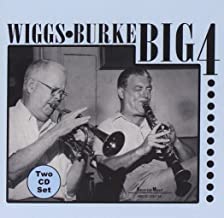
Raymond Burke was born Raymond Barrois on June 6, 1904 in New Orleans, Louisiana. His first instrument was a flute he carved from a fishing pole, then played the tin whistle, kazoo, and clarinet. His first job in music came in 1913 when he panhandled on the kazoo with future New Orleans Rhythm Kings drummer Leo Adde who played percussion on a cigar box.
A polite, albeit eccentric with wavy hair and a thin mustache, the conservatively dressed clarinetist did not drink, smoke, or gamble. Burke rarely left the city except for out-of-town gigs or tours with the Preservation Hall Jazz Band later in life.
In the 1930s Burke played with The Henry Belas Orchestra, spent a short period of time in Kansas City for a musical job, but soon returned. In the 1940s and ’50s, he played with Alvin Alcorn, Sharkey Bonano, and frequently in a trio with pianist Jeff Riddick and bassist Sherwood Mangiapane. Through the 1960s and 70s Burke he played with Preservation Hall musicians.
For a time he ran a rabais shop, a personal collection that the owner makes semi-available to the public for sale. Located in a residential section of Bourbon Street which had light pedestrian traffic the shop was filled with old jazz records, historical memorabilia, musical instruments and equipment, books, magazines, and a collection of sheet music. It generated little financial income.
During his active years, he never achieved mainstream popularity or commercial success. He was known for playing modestly, and in large ensembles, his clarinet could easily be overpowered. Refusing to let contemporary music influence his sound for commercial reasons, he associated with “Second Line” jazz, which differentiated White imitators who simplified the style from Black or Creole musicians.
He gained some popularity around 1939 when fans started using portable recorders at live performances during local jam sessions. Clarinetist Raymond Burke, who played in the Dixieland style, passed away on March 21, 1986.
More Posts: bandleader,clarinet,history,instrumental,jazz,music
Daily Dose Of Jazz…
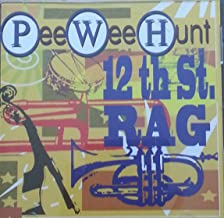
Pee Wee Hunt was born Walter Gerhardt Hunt on May 10, 1907 in Mount Healthy, Ohio. Developing a musical interest at an early age, his mother played the banjo and his father played the violin. The teenager was a banjoist with a local band while he was attending college at Ohio State University where he majored in Electrical Engineering. During his college years, he switched from banjo to trombone. Graduating from the Cincinnati Conservatory of Music, he joined Jean Goldkette’s Orchestra in 1928.
Pee Wee was the co-founder and featured trombonist with the Casa Loma Orchestra, but he left the group in 1943 to work as a Hollywood radio disc jockey before joining the Merchant Marine near the end of World War II. He returned to the West Coast music scene in 1946 and his Twelfth Street Rag became a three million-selling number one hit in 1948.
Hunt was satirized as Pee Wee Runt and his All-Flea Dixieland Band in Tex Avery’s animated MGM cartoon Dixieland Droopy in 1954. His second major hit was Oh! in 1953, his second million-selling disc, which reached number three in the Billboard chart.
Trombonist Pee Wee Hunt passed away after a long illness at age 72, on June 22, 1979 in Plymouth, Massachusetts.

More Posts: bandleader,banjo,history,instrumental,jazz,music,trombone
Daily Dose Of Jazz…
Jack Bland was born on May 8, 1899 in Sedalia, Missouri and learned to play the banjo. In 1924 he co-founded the Mound City Blue Blowers with Red McKenzie in St. Louis, Missouri. Their first hit record was Arkansas Blues, a success in Chicago and the American midwest. After Eddie Lang joined the group towards the end of 1924, they toured England.
The late 1920s saw Bland playing more cello and guitar and in 1929, Lang left the group, replaced by Gene Krupa. Also in 1929, the Blue Blowers appeared in a 1929 short film, The Opry House. Muggsy Spanier, Coleman Hawkins, and Eddie Condon would all play in the ensemble in the 1930s, which moved to more of a Dixieland sound.
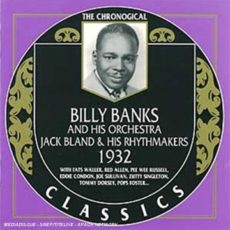
Bland did session work in New York City with the Billy Banks Orchestra in the 1930s, with Pee Wee Russell, Red Allen, and Zutty Singleton. Following this, he recorded with a group called the Rhythmakers that included Pops Foster and Fats Waller at times.
By the 1940s Jack was playing on 52nd Street at Jimmy Ryan’s Club, playing with Allen and Singleton as well as Edmond Hall, Vic Dickenson, Ike Quebec, and Hot Lips Page. Some of their sessions were recorded by Milt Gabler and released on Commodore Records. From 1942 to 1944 he played with Art Hodes and also with Muggsy Spanier; he led his own band from 1944 to 1950.
In the 1950s, guitarist and banjoist Jack Bland moved to Los Angeles, California, retired from performing, and worked as a taxicab driver until he passed away in August 1968.
More Posts: banjo,cello,guitar,history,instrumental,jazz,music