

Daily Dose Of Jazz…
Jerome Darr was born on December 21, 1910 in Baltimore, Maryland. His first major professional affiliation was in a jug band, the Washboard Serenaders. The guitarist was a member of this group from 1933 through 1936, a tenure that included a well-received European tour.
He had an incredibly versatile and prolific career. He showed up on sessions from blues to bebop and even strummed a few arpeggios behind Frankie Lymon & the Teenagers.
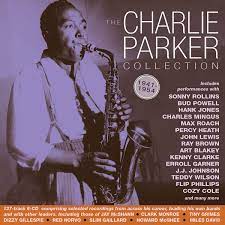
Though Jerome was not hiding in a closet during the ’40s, the guitarist simply focused on work as a studio musician during an era when the efforts of such players went largely uncredited. He was a player in the classic jazz context of Buddy Johnson’s band in the early ’50s, or was working with the much more modernistic Charlie Parker during roughly the same period.
He played on some 20 recording sessions between 1935 and 1973, though to his credit or noncredit, his playing included many other styles besides jazz. In his final years, Darr was mostly swinging in the busy band of trumpeter Jonah Jones, in a sense coming full circle with the type of playing he had started out with.
Guitarist Jerome Darr passed away on October 29, 1986 in Brooklyn, New York.
More Posts: guitar,history,instrumental,jazz,music
Daily Dose Of Jazz…
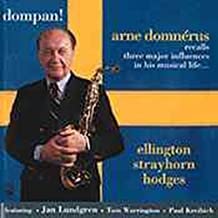
Sven Arne Domnérus was born on December 20, 1924 in Stockholm, Sweden and began to play the clarinet at the age of 11. By the time he left school he had taken up the saxophone and turned professional. In 1949 he performed at the Paris Jazz Festival and with Charlie Parker when he was on tour in Sweden in 1950.
A few years later Arne recorded with Clifford Brown, Art Farmer, and James Moody. From the middle 1950s to the middle 1960s he was a featured soloist in the Swedish Radio Big Band. With Bengt-Arne Wallin, Rolf Ericson, and Åke Persson (the latter two were former members of Duke Ellington’s Orchestra), he participated in the Jazz Workshops organised for the Ruhrfest in Recklinghausen by Hans Gertberg from the Hamburg radio station.
He recorded several times with Quincy Jones in Sweden and is featured throughout The Midnight Sun Never Sets, composed and arranged by Jones and recorded under Jones’ direction by Harry Arnold’s orchestra in 1958. Domnérus’ playing in his early career was typical of the cool, sophisticated, technically accomplished and lyrical style of Swedish modern jazz during the 1950s.
As a leader Domnerus recorded forty~four albums and another 104 as a sideman with Alice Babs, Lars Gullin, Bengt Hallberg, Dizzy Gillespie, Thad Jones, George Russell, Toots Thielemans, Red Rodney, James Moody, Leonard Feather and Monica Zetterlund, among others too numerous to mention.
Saxophonist, clarinetist and composer Arne Domnerus, who wrote for film and television, and retired from playing due to his declining health, passed away on September 2, 2008 in his hometown.
More Posts: bandleader,clarinet,composer,history,instrumental,jazz,music,saxophone
Daily Dose Of Jazz…
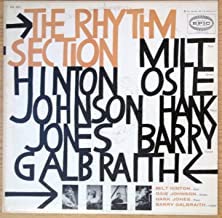
Joseph Barry Galbraith, born on December 18, 1919 in Pittsburgh, Pennsylvania.
Moving to New York City in the early 1940s he found work playing with Babe Russin, Art Tatum, Red Norvo, Hal McIntyre, and Teddy Powell. He played with Claude Thornhill in 1941–1942 and again from 1946–1949 after serving in the Army. In ‘53 he did a tour with Stan Kenton.
Having extensive work as a studio musician for NBC and CBS in the 1950s and 1960s, presented him with the opportunity to work with among others Miles Davis, Michel Legrand, Tal Farlow, Coleman Hawkins, George Barnes, John Lewis, Hal McKusick, Oscar Peterson, Max Roach, George Russell, John Carisi, and Tony Scott.
He accompanied on the recording of singers Anita O’Day, Chris Connor, Billie Holiday, Helen Merrill, Sarah Vaughan and Dinah Washington. He was a mentor to Ralph Patt.
In 1961, he appeared in the film After Hours. In 1963-1964 he played on Gil Evans’s album The Individualism of Gil Evans, and in 1965 he appeared on Stan Getz and Eddie Sauter’s soundtrack to the 1965 film Mickey One.
As an educator he taught for five years from 1970 to 1975 at CUNY (City University of New York) and published a guitar method book in 1982. From 1976–77 Galbraith taught guitar at New England Conservatory in Boston, Massachusetts.
Guitarist and bandleader Barry Galbraith passed away from cancer at the age of 63 on January 13, 1983 in Bennington, Vermont.
More Posts: bandleader,guitar,history,instrumental,jazz,music
Daily Dose Of Jazz…
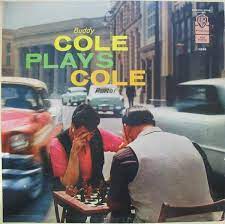
Buddy Cole was born Edwin LeMar Cole on December 15, 1916 in Irving, Illinois. He started his musical career in the theater, playing between movies and by age 19 he was recruited to be part of the Gil Evans band.
Moving to Hollywood, California in the second half of the 1930s, Buddy played in dance bands, including those led by Alvino Rey and Frankie Trumbauer. From the 1940s, his main work was as a studio musician, utilizing piano, electric organ, celeste, harpsichord and Novachord.
Cole worked with Henry Mancini, who used his Hammond organ for the soundtrack to the TV series Mr. Lucky. He also played most of the piano parts in the 1951 film Young Man with a Horn, subbing for Hoagy Carmichael, who appeared on screen. He also wrote the music for the television game show Truth or Consequences.
He performed on Bing Crosby’s hits In a Little Spanish Town and Ol’ Man River, and on the albums Some Fine Old Chestnuts and New Tricks. Buddy also played on Rosemary Clooney’s radio program and some recordings from the show were released on the album Swing Around Rosie.
Pianist, organist, orchestra leader, and composer Buddy Cole, who recorded several organ albums as a leader for Warner Brothers, Columbia, Alshi and Doric, passed away on November 5, 1964 in Hollywood, California.
More Posts: bandleader,composer,history,instrumental,jazz,music,organ,piano
Daily Dose Of Jazz…
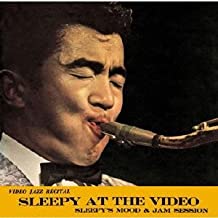
Hidehiko “Sleepy” Matsumoto (松本英彦) was born on October 12, 1926 in Okayama, Japan. He attended Fuchu High School where he learned the saxophone followed by matriculation through the University of Electro-Communications.
In the late 1940s he played bebop in Japan with the group CB Nine, then joined The Six Josés and The Big Four, a group which included George Kawaguchi, Hachidai Nakamura, and Mitsuru Ono.
In 1959 he became a member of Hideo Shiraki’s small ensemble, and played with Gerald Wilson at the 1963 Monterey Jazz Festival and Toshiko Akiyoshi in 1964. Starting in 1964 Hidehiko led his own ensembles, which included sidemen Takeshi Inomata, Akira Miyazawa, George Otsuka, and Isao Suzuki.
On July 22 and 24, 1966, he played with the John Coltrane quintet in Tokyo, Japan while the group toured Japan. Tenor saxophonist and bandleader Hidehiko “Sleepy” Matsumoto passed away on February 29, 2000 in Tokyo, Japan.
More Posts: bandleader,history,instrumental,jazz,music,saxophone