

Daily Dose Of Jazz
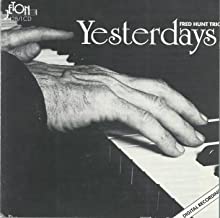
Fred Hunt was born Herbert Frederick Hunt was born in London, England on September 21, 1923. As the younger son of a pianist mother and a cellist father, he enjoyed thorough musical education from his distinguished parents. A self-taught pianist, he started playing piano at the age of 13 and played local gigs before joining the Royal Air Force.
After his discharge, Hunt began his musical career playing semi-professionally with Mike Daniels and the Cy Laurie Four in 1951. Becoming professional and went on to join Alex Welsh’s band from 1954 to 1962 and again from 1964 to 1974.
As Welsh’s primary pianist, and often a featured soloist, he became one of Britain’s leading trad jazz musicians and recorded with Eddie Davis, Bud Freeman, Eddie Miller, and Ben Webster in 1967. Accompanying visiting Americans, he recorded with the four-tenor group, Tenor Of Jazz, featuring Webster and Eddie “Lockjaw” Davis, which toured in the late 60s.
Departing Welsh in 1974, he played in Copenhagen and South Africa, however, after 1976 he split his time between Britain, Denmark, and Germany. He led a trio featuring drummer Lennie Hastings beginning in 1978 and the following year the German label Erus Records released a direct cut LP called Yesterdays which featured his trio with bassist Brian Mursell and drummer Roger Nobes in front of a live audience.
He toured with Wild Bill Davison in the latter part of the 1970s and played with Welsh once more in the early 1980s before retiring due to failing health after being incapacitated and confined to a wheelchair. He worked frequently at London’s PizzaExpress Jazz Club until 1986. Pianist Fred Hunt, who became a top pianist in both modern jazz and trad jazz musical settings, passed away on April 25, 1986. in Weybridge, Surrey aged 62.

More Posts: history,instrumental,jazz,music,piano
Daily Dose Of Jazz…
Red Kelly, born Thomas Raymond Kelly on August 29, 1927 in Shelby, Montana initially took lessons on drums, but he was unable to work the hi-hat because polio had inhibited the use of his feet. Switching to double-bass during his teen years, in 1949 he began playing bass in a big band led by Charlie Jackson.
In the early 1950s he toured with Charlie Barnet, Herbie Fields, Claude Thornhill, and Red Norvo. It was while working with Norvo that led to the moniker Red. Kelly and bassist Red Mitchell were living in the same apartment, and when Norvo called Mitchell to invite him to tour, he got Kelly on the phone instead.
He played with Woody Herman for several years, including on a 1954 tour of Europe, and around this time Red also recorded with Dick Collins and Nat Pierce. Relocated to the West Coast, he started playing briefly in Seattle, Washington and then in Los Angeles, California with Maynard Ferguson, Med Flory, Stan Kenton, and Lennie Niehaus.
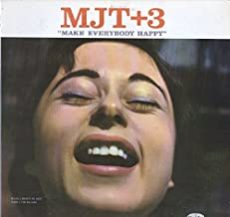
He was a member of the Modest Jazz Trio with Red Mitchell and Jim Hall, who recorded an album in 1960, and worked with Harry James for most of the 1960s. Later in his life he moved to Tacoma, Washington where he left the music business and ran his own restaurant, Kelly’s. Double-bassist Red Kelly passed away on June 9, 2004 in Tacoma, Washington.

More Posts: bass,history,instrumental,jazz,music

Daily Dose Of Jazz…
Michael Arlt was born in Bünde, Westfalen, Germany on July 1, 1960 and began playing guitar as a teenager. From the beginning, he was interested in a musical gamut, playing in rock, blues, fusion, and free bands. Going to Boston, Massachusetts in the mid-Eighties, he studied at Berklee College of Music, took private lessons from Mike Metheny, and then continued his studies in the Netherlands at the Amsterdam Academy of Arts under Wim Overgaauw.
Since that time, Michael has performed in a variety of ensembles with musicians like Maria de Fatima, Jerry Granelli, Sigi Busch, Rick Hollander, Leszek Zadlo, Wolfgang Ekholt, Joris Teepe, Paquito D’Rivera, Herbert Joos, and Luciano Biondini. He has recorded with Roman Schwaller, Houston Person and Red Holloway. He founded his own trio and the group Brassless with who he recorded. With Don Kostelnik and Duck Scott he forms the organ trio We Three who recorded several albums.
Arlt has been a part of the Lemongrass and Weathertunes music projects, which were founded by the brothers Roland and Daniel Voss. Since the late 1990s, Arlt has been playing with Rick Hollander, in the trio of Reinette van Zijtveld and in a duo with Christian Eckert. As a lecturer, he has taught jazz guitar and harmony at the University of Music in Würzburg since 1990. Guitarist Michael Arlt continues to explore and perform in the genre. of modern jazz.

More Posts: bandeader,guitar,history,instrumental,jazz,music
Daily Dose Of Jazz…
Aubrey Frank was born on June 3, 1921 in London, England. He started playing alto saxophone at fourteen, then switched to tenor the following year. HIs first gig was with Jack Harris, then joined the RAF but continued playing with Ambrose, Johnny Claes, Geraldo, Lew Stone, and George Evans. He was in the first Ted Heath band and the RAF Fighter Command Band. During World War II he played with Sam Donahue and Glenn Miller.
Leaving the RAF, he continued to work with Ambrose until 1947, as well as the Skyrockets and the Squadronnaires. From 1949 to 1954 a member of Jack Nathan’s band alongside Ronnie Scott and Harry Klein. He freelanced and became a staple on early British bebop dates where his adaptability allowed him to play in any type of band, from Dixieland to modern jazz.
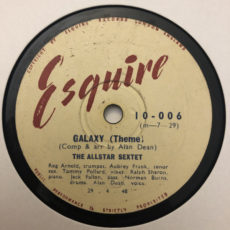
He recorded with the George Shearing Sextet, Harry Hayes, Alan Dean All-Star Sextet and had a long career regarded as a first-class session musician but was a jazzman at heart. With the advent of bop, his style changed little, leading the Aubrey Frank Modern Music Sextet consisting of Hank Shaw or Wyatt Forbes, Harry Klein, Andy Denits, Stan Wasser, and Douggie Cooper. Tenor saxophonist Aubrey Frank passed away on his seventy-second birthday in 1993.

More Posts: bandleader,history,instrumental,jazz,music,saxophone
Daily Dose Of Jazz…
Pierre Favre was born June 2, 1937 in Le Locle, Switzerland and originally was a self-taught drummer. He went on to study classical composition and immersed himself in the diverse percussion music of the wider world, particularly those of India, Africa, and Brazil. Gradually he consolidated all of this new information in the “sound-color poems” he was writing for his Singing Drums group.
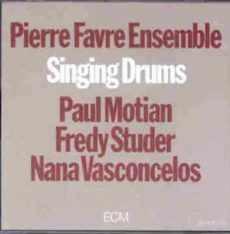
He recorded the album Singing Drums for ECM in 1984 with Paul Motian, Fredy Studer, and Nana Vasconcelos. Over the course of his career, Pierre has recorded twenty-nine as a sideman working with John Surman, Tamia, Michel Godard, Mal Waldron, Paul Giger, Jiří Stivín, Michel Portal, Samuel Blaser, the ARTE Quartett, Barre Phillips, Irene Schweizer, Philipp Schaufelberger, Manfred Schoof, Joe McPhee, Dino Saluzzi, London Jazz Composers Orchestra, Stefano Battaglia, Furio Di Castri, Paolo Fresu, Jon Balke, Denis Levaillant, Yang Jing, and Andrea Centazzo.
As a leader, drummer and percussionist Pierre Favre has recorded seven albums and continues to perform and record.
More Posts: bandleader,drums,history,instrumental,jazz,music