

Daily Dose Of Jazz…
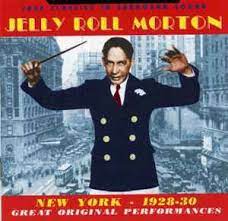
Lee L. Blair was born on October 10, 1903 in Savannah, Georgia and was a left-handed autodidact on banjo, aside from a few lessons taken from Mike Pingitore, the banjoist for Paul Whiteman. He played and recorded in New York City, New York with Thomas Morris’s Seven Hot Babies in 1926, then played with Charlie Skeete in 1926-28, before playing and recording with Jelly Roll Morton’s Red Hot Peppers in 1928-30.
In the Thirties he went on to play with Billy Kato, then played and recorded with Luis Russell and Louis Armstrong from 1935 to the end of the decade. He worked part-time in music through the 1940s, then joined Wilbur De Paris’s New New Orleans Jazz Band in the 1950s at Jimmy Ryan’s Club on West 52nd Street in New York City.
The summer of 1957 had him touring Africa with the DeParis band for the State Department. During the 1960s he played less, concentrating on raising chickens on his farm in Belmore, Long Island, but appeared at the 1964 World’s Fair in a trio with Danny Barker and Eddie Gibbs. He freelanced around New York with Hank Duncan and others until his death.
He never recorded as a leader, but appears on record with Morris, Morton, Russell, Armstrong, and De Paris, as well as with Dick Cary, Pee Wee Erwin, and Leonard Gaskin among others. He is honored in the jazz section of the Georgia Music Hall of Fame in Macon, GA.
Banjoist and guitarist Lee Blair, who never recorded as a leader, transitioned on October 15, 1966 in New York City.

Daily Dose Of Jazz…
Manny Flores Jr. was born in El Paso, Texas on October 9, 1954. He spent his first eighteen years of life as an army brat, traveling and listening to music in a variety of different places. He began his playing career in the summer of 1971 at a gig at the Fort Huachuca NCO Club. At this time his inspiration for the bass was fellow left-handed bass player Paul McCartney. Graduating from Buena High School in Sierra Vista, Arizona in l972.
He also listened to jazz when he would buy Blue Note LPs at the bargain bin with Eric Dolphy and Charles Mingus among his favorites. He then graduated from Cochise College in Douglas, Arizona in 1974 with an Associates degree in Liberal Arts. By 1975 he was back in his hometown of El Paso and began playing in various groups including Top 40 and Country/Western groups in New Mexico, Wyoming and Arizona. Enrolling at the University of Texas at El Paso, he received his Bachelor of Music Education degree in 1982.
In 1983 he auditioned for and began playing with the El Paso Symphony Orchestra under the direction of Maestro Abraham Chavez Jr. He also began teaching instrumental music in the Ysleta Independent School District. During the decade Manny met many musicans who inspired him to make music a way of life including Frank Zappa, Jaco Pastorius, Ray Brown and Julliard cello teacher Harvey Shapiro.
In 1985 he began the first of a four-year trek to Victoria, British Columbia, Canada to attend the prestigious Johannesen International School of the Arts. He attended six-week master classes, and spent a summer in New York City studying jazz and listening to live performances of Charlie Haden, Marc Johnson, Harvie Swartz, and Eddie Gomez.
Flores has played with several big bands in addition to Bobby Saunders, Frank Dove and the Sundowners, Mario Otero, Crossroads, El Paso Brass Quintet, Bobby Booth Dixieland Band, M.D. Quartet, U.T.E.P. Lab Band I with Gene Lewis, Mike Francis Quartet, Gerald Hunter and the Quintones, Art Lewis and the Earthmen, Orchestra Puerto Rico, Spice of Life, Bing Browning Trio, Cecile Larochelle, The Platters, The Four Lads, The Four Aces, Jimmy Dorsey Orchestra, Mel Carter, Roger Miller, Johnny Mathis, Guy Lombardo’s Royal Canadians, Charlie Rouse and Boyz II Men.
By 1998 he made his first trip to Rio de Janeiro, Brazil to fulfill a lifelong desire to experience Brasilian music firsthand and to meet one of his favorite musicans Hermeto Pascoal. He hung out with his friends Albert Suhett, Itibere Zwarg, Marcio Bahia, and Hermeto. Marcio Bahia introduced him to bassist Adriano Giffoni with whom he studied with each summer in Rio.
Bassist Manny Flores Jr. is involved in the Universal Music movement and continues to perform locally in Austin and El Paso.
More Posts: bass,history,instrumental,jazz,music

Daily Dose Of Jazz…
George Horace Webb was born on October 8, 1917 in London, United Kingdom to a former music hall artiste. He grew up with a love of early jazz recordings, principally those made by the New Orleans musicians. A keen jazz enthusiast, he was a self-taught amateur pianist.
Working as a machine gun fitter in the Vickers-Armstrong factory at Crayford, he organized lunchtime entertainment at the factory, assembling scratch bands from among the workers. With his band, George Webb’s Dixielanders, he played regularly and famously at The Red Barn public house at Barnehurst, Kent, beginning in the early 1940s. They made several recordings and BBC radio broadcasts but by 1948 they had disbanded.
Webb was then part of Humphrey Lyttelton’s band from 1948 to 1951. After a short-term reformation of the Dixielanders in 1952, he concentrated on running a jazz club. In the mid-Sixties he was a musician agent and manager. Early in the following decade, he returned to more frequent playing and toured Europe as a soloist. Another version of the Dixielanders operated for a year and then ran a pub for 12 years.
A move back to Kent had him guest performing in various bands into the 2000s with Humphrey Lyttelton, Wally Fawkes and Eddie Harvey. In his playing he tried to re-create the style of such bands as King Oliver’s.
Pianist George Webb, who is considered by many as the father of the traditional jazz movement in Britain, transitioned on March 10, 2010.
More Posts: bandleader,history,instrumental,jazz,music,piano
Daily Dose Of Jazz…
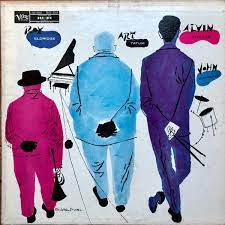
Alvin Stoller was born October 7, 1925 in New York City, New York and studied with drum teacher Henry Adler. He launched his career touring and recording with swing era big bands led by Benny Goodman, Tommy Dorsey, Harry James, and Charlie Barnet. He backed singers including Billie Holiday, Mel Tormé, and Frank Sinatra on some of their major recordings.
His drums may be heard on many of Ella Fitzgerald’s Songbook recordings; on Ella Fitzgerald Sings the Duke Ellington Songbook, having performed with the Duke Ellington orchestra itself, alongside Ellington’s own Sam Woodyard. From the moment Frank Sinatra started to record with Capitol Records in 1953, Stoller was the singer’s preferred percussionist and performed on nearly all Sinatra recordings until 1958.
He recorded with Art Tatum, Roy Eldridge, Oscar Peterson, Coleman Hawkins, Ben Webster, Benny Carter, Herb Ellis, and Erroll Garner among many other jazz musicians. The 1950s saw Stoller settlling in Los Angeles, California where he became respected for his work in the Hollywood studios which lasted for several decades.
Leonard Feather considered him a first-rate, swinging drummer. Buddy Rich, whom some consider to have been the greatest of all jazz drummers, chose Alvin to play drums on an album in which Rich sang suggests the esteem Stoller earned from his fellow musicians. He was the drummer on both Mitch Miller’s recording of The Yellow Rose of Texas and Stan Freberg’s parody of Miller’s recording.
Drummer Alvin Stoller, though an in-demand drummer during the Forties and Fifties and recorded more than five dozen albums, and eventually appeared to have been largely forgotten, transitioned on October 19, 1992.
More Posts: drums,history,instrumental,jazz,music
Daily Dose Of Jazz…
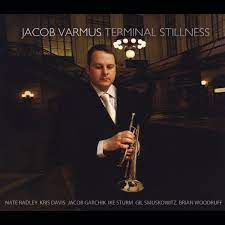
Jacob Varmus was born on October 6, 1973 in San Francisco, California. He first heard the trumpet’s call when he was two years old and ten years later had a trumpet of his own. He began winning top marks at all the California Music Educators’ Association festivals for his work as soloist and chamber musician.
Evolving parallel to his love of music was a talent for using language artistically thru poetry, critical essays, and autobiographical stories. In high school he won awards for poetry and sports journalism as well as music. His first year of college at the University of Iowa, Jacob studied poetry closely with MacArthur grant recipient Jorie Graham and classical trumpet virtuoso David Greenhoe.
An initiation to the music of John Coltrane sent Varmus to focus on jazz. In 1994 he moved to New York City to finish his BFA at the New School Jazz program. There he received timeless lessons from a long list of artists including Arnie Lawrence and Billy Harper. Here he became known to his peers and elders as a composer of harmonically intricate yet compellingly simple and striking tunes.
By his senior year he was being commissioned by the Jazz Composers’ Collective to write a suite combining jazz quintet with string quartet. It featured Ted Nash and Frank Kimbrough. He went on to enroll in composer workshops, receiving a further commission for jazz quartet.
As an educator he is on the faculty of the New York Jazz Academy. Trumpeter and composer Jacob Varmus continues to pursue his highly melodic yet rigorous music.
More Posts: bandleader,cornet,history,instrumental,jazz,music,trumpet