

Daily Dose Of Jazz…
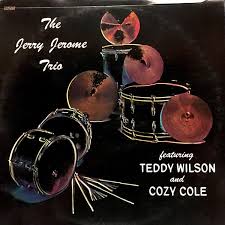
Jerry “Buck” Jerome was born on June 19, 1912 in Brooklyn, New York and he didn’t begin playing the saxophone until he was in high school in Plainfield, New Jersey.
Jerome became part of a national tour in 1936 with bandleader Harry Reser and his Clicquot Club Eskimos. He joined Glenn Miller’s original orchestra in 1937 and was a member until it broke up in 1938. He played and soloed on the Glenn Miller recording Doin’ the Jive. He then joined the Red Norvo band which was followed by his joining the Benny Goodman orchestra in 1938.
When Goodman broke up his band in 1940, he joined the Artie Shaw Orchestra. While with Shaw he appeared the same year he joind the band in the film Second Chorus, starring Fred Astaire and Burgess Meredith. By the end of the 1940s, Jerry became involved in broadcasting, working various positions as a conductor, composer, arranger and musical director.
Tenor saxophonist Jerry Jerome, who composed the Winston tastes good like a cigarette should jingle for the tobacco company, transitioned on November 17, 2001 at the age of 89.

More Posts: history,instrumental,jazz,music,saxophone
Daily Dose Of Jazz…
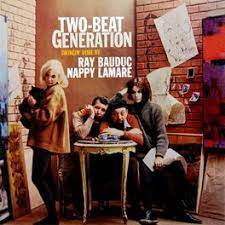
Ray Bauduc was born June 18, 1906 in New Orleans, Louisiana and was the son of cornetist Jules Bauduc, his older brother was a banjoist and bandleader, and his sister was a pianist. His youthful work in New Orleans included performing in the band of Johnny Bayersdorffer, and on radio broadcasts. His New Orleans origin instilled in him a love for two-beat drumming, which he retained when he played with Bob Crosby’s swing-era big band.
Moving to New York City in 1926 he joined Joe Venuti’s band. During the 1920s he recorded with the Original Memphis Five and the Scranton Sirens, which included Tommy and Jimmy Dorsey. His time with the Bob Crosby Orchestra brought him national fame and Bauduc and bassist Bob Haggart composed two hits for the orchestra, South Rampart Street Parade and Big Noise from Winnetka, which has become a jazz standard.
After his discharge from the Army in 1944, he and former Crosby group leader Gil Rodin formed a short-lived big band. He toured with a septet in 1946 and also worked in Tommy Dorsey’s orchestra for a couple of months that year. By 1947, he joined Bob Crosby’s new group, then left to play with Jimmy Dorsey where he stayed for the next two years. He freelanced on the West Coast for a couple of years before joining Jack Teagarden in 1952. In 1955, he formed a band with Nappy Lamare which found considerable success, touring nationally and recording several albums.
From 1960 Ray went into semi-retirement and relocatred to Bellaire, Texas but visited New Orleans in 1983. He appeared occasionally at Crosby Orchestra reunions, worked with Pud Brown on several recordings, and played with the Market Square Jazz Band headed by James Weiler in the early 1980s in Houston.
A trend setter in traditional jazz circles, his precise, disciplined, yet fiery patterns and syncopated fills, helped New Orleans drummers make the transition into swing from the rigid, clipped progressions that had defined the previous era. His use of woodblocks, cowbells, China cymbals, and tom-toms distinguished him from most drummers of the swing era, and made him one of the few white drummers to be influenced by Warren ‘Baby’ Dodds. Drummer Ray Bauduc, who authored two books on drumming, transitioned in Houston, Texas, on January 8, 1988.
More Posts: bandleader,drums,history,instrumental,jazz,music
Daily Dose Of Jazz…
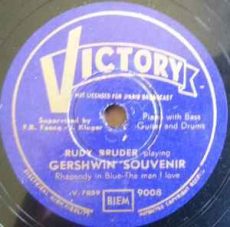
René “Rudy” Bruder was born on June 15, 1914 in Brussels, Belgium. His father was a bandleader and Rudy played in his father’s group in the mid-1930s. He then joined Jean Omer’s group, accompanying visiting American musicians such as Benny Carter, Bill Coleman, Coleman Hawkins, and Bobby Martin.
He worked with Omer through the early 1940s. He also recorded several times with Jean Robert and Gus Deloof. He led his own band, which recorded in the early 1940s and again in 1946.
Pianist Rudy Bruder retired from music and according to sources is 108 yers old.
More Posts: bandleader,history,instrumental,jazz,music,piano
Daily Dose Of Jazz…
Don Barrigo was born on June 12, 1906 in London, England. A competent tenor saxophonist, he was active in his hometown and New York City, New York in the 1920s and 30s.
Among the artists with whom Don played and sometimes recorded were Joe Venuti and Eddie Lang. In the UK he played with Nat Gonella, Harry and Sid Roy, Billy Mayerl, Al Bowlly, Percival Mackey, Bert Bowen, Howard Jacobs and the Freddy Schweitzer Band. In the States he played with Don Parker and Louis Armstrong, and in France with Serge Glykson.
By 1940 he was a member of Maurice Winnick’s dance band alongside fellow sideman Ted Heath. Tenor saxophonist Don Barrigo transitioned on May 4, 1977.
More Posts: history,instrumental,jazz,music,saxophone
Daily Dose Of Jazz…
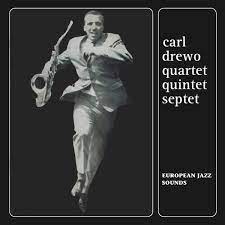
Karl Drewo was born May 17, 1929 in Vienna, Austria and as a child studied piano and accordion, but switched to tenor saxophone in his teens. In the late 1940s he worked with Charlie Gaudriot and Paul Reischman, followed by performing with Gert Steffens and Horst Winter in the early Fifties. He was a member of the Austrian All Stars in the mid-1950s and from 1956 to 1958 he worked with Fatty George.
He continued on by becoming a member of Kurt Edelhagen’s orchestra, where he played into the early 1970s. In the 1960s he recorded with Francy Boland, Kenny Clarke, Zoot Sims, and Jimmy Woode, among others.
After leaving Edelhagen’s group, he played with the Österreichischer Rundfunk band, and in the 1980s was a member of Peter Herbolzheimer’s ensemble. Later that decade he took a position as a lecturer at an arts school in Graz, Austria. In the Nineties he played with the Lungau Big Band, Rudolf Josel, and Rudi Wilfer.
Saxophonist Karl Drewo, often spelled Carl Drewo or Drevo, transitioned on May 10, 1995 in Wels, Austria.

More Posts: bandleader,history,instrumental,jazz,music,saxophone