

Daily Dose Of Jazz…
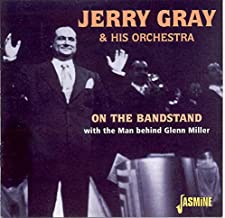
Jerry Gray was born Generoso Graziano on July 3, 1915 in East Boston, Massachusetts. His father was a music teacher who began teaching his son violin at age seven. As a teenager he studied with Emanuel Ondříček and was a soloist with the Boston Junior Symphony. By age eighteen he had formed a jazz band and was performing in Boston clubs.
1936 saw Gray joining the Artie Shaw orchestra as lead violinist and studied musical arrangement under Shaw. A year later he became a staff arranger. Over the next two years he penned some of the band’s most popular arrangements, including Carioca, Softly, As In A Morning Sunrise, Any Old Time, and Begin the Beguine. After the band broke up in 1939, Glenn Miller offered him a job arranging
In November 1939, Shaw suddenly broke up the band and moved to Mexico. On the next day, Glenn Miller called Gray and offered him a job arranging for his band. During his time with the Glenn Miller Orchestra, Jerry produced many of the most recognizable recordings of the era, arranging Elmer’s Tune, Moonlight Cocktail, Perfidia, and Chattanooga Choo-Choo among others, while his compositions among numerous others included Sun Valley Jump, The Man In The Moon, Caribbean Clipper, Pennsylvania 6-5000, and his most famous song, A String of Pearls. Many of his compositions became best-sellers.
The war years saw Jerry in Miller’s unit and became chief arranger for Miller’s “Band of the Training Command”, better known today as the Glenn Miller Army Air Forces Orchestra. He was the full orchestra’s assistant conductor, and conducted the orchestra’s first concert in Paris after Miller’s airplane disappeared over the English Channel.
After the war for a while he did radio and studio work around Los Angeles, California, including leading the band on a radio show called Club 15 that featured Dick Haymes. In 1949 he accepted a request from Decca Records to lead his own Miller-esque orchestra that was called Jerry Gray and the Band of Today.
Violinist, arranger, composer, and leader of swing big bands Jerry Gray, who continued to lead the Fairmont Hotel band into the 1970s, passed away of a heart attack on August 10, 1976 in Dallas, Texas. He was 61.

More Posts: arranger,composer,history,instrumental,jazz,music,violin

Daily Dose Of Jazz…
Clarence Profit was born on June 26, 1912 in New York City. Coming from a musical family, he began studying piano at the age of three and led a ten-piece band in New York City in his teens.
A visit to his grandparents in Antigua resulted in his staying in the Caribbean for five years. He also led a group in Bermuda. Returning to the States, Clarence led a trio. He co-composed Lullaby In Rhythm with Edgar Sampson. He was respected in his era, but after his early death he fell into obscurity. He was born, and died, in New York City.
Pianist and composer Clarence Profit, closely associated with the swing era, passed away in New York City on October 22, 1944.

More Posts: bandleader,composer,history,instrumental,jazz,music,piano
Daily Dose Of Jazz…
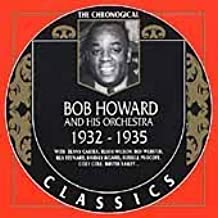
Bob Howard was born Howard Joyner on June 20, 1906 in Newton, Massachusetts, He began singing in New York City night clubs in the mid-1920s and began recording in 1931 under his real name for Columbia Records.
Under the name Bob Howard, he played New York’s Park Central Hotel, Famous Door, Hickory House and other clubs as well as theaters. Signed to Decca Records in 1934 he recorded a series of hot small group swing records between 1935 and 1938. His studio groups included Benny Carter, Buster Bailey, Rex Stewart, Ben Webster, Teddy Wilson, Russell Procope, Cecil Scott, Cozy Cole, Bunny Berigan, Artie Shaw, and Babe Russin among others. Unfortunately on these Decca recording sessions he did not play piano, only sang.
Embarking on several European tours as a solo performer in the middle and late 1930s, Bob also had his own radio series in New York. From 1936 to 1947 he performed in a handful of short films, and 1959 saw him acting in an episode of Perry Mason.
In 1948, Howard hosted The Bob Howard Show on CBS, making him the first Black man to host a regularly broadcast network TV show. The program was cancelled after 13 episodes. He also was a regular performer on Sing It Again on CBS-TV in 1950 – 1951.
Relocating to Las Vegas, Nevada and Los Angeles, California for a time, he returned East. Pianist and vocalist Bob Howard passed away on December 3, 1986 in the Bronx, New York.
More Posts: bandleader,history,instrumental,jazz,music,vocal

Daily Dose Of Jazz…
John W. Russell was born on June 4, 1909 in Charlotte, North Carolina but was raised in New York City. He began on violin at age nine, later picking up saxophone and clarinet. He played in both capacities with Jimmy Campbell in 1926, then worked at the Strand Danceland under Earle Howard.
While continuing to play violin in live settings, there are no known recordings of him as a violinist. In the early 1930s after working with Harry White, he replaced Chu Berry in Benny Carter’s ensemble in 1933-34, then joined up with Willie Bryant in 1935-36. Johnny toured with Bobby Martin’s orchestra in Europe in 1938, and played with this group on the soundtrack to the 1938 Erich von Stroheim film, L’alibi; it is for his solos in this recording that he is best known.
Following this Russell remained in Europe to play with Willie Lewis from 1939 to 1941. Upon his return to the U.S. he played with Garvin Bushell briefly before being drafted. He played in military bands, including Russell Wooding’s, during World War II, then played following the war with Cecil Scott in 1945 and Eddie Cornelius.
Tenor saxophonist, clarinetist, and violinist Johnny Russell, who stopped playing full-time later in the 1940s, but occasionally did club dates later in his life, passed away on July 26, 1991 in New York City.
More Posts: clarinet,history,instrumental,jazz,music,saxophone,violin
Daily Dose Of Jazz…
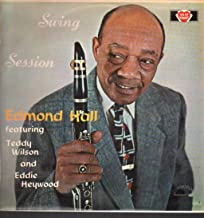
Arthur “Traps” Trappier was born on May 28, 1910 in Georgetown, South Carolina and played with Charlie Skeets and Blanche Calloway in the late 1920s. After working steadily through the 1930s, he joined Fats Waller in 1941-42 before serving in the military during World War II.
He led his own trio in various hotels in New York City in the 1950s, and played as a sideman into the 1970s. Among those he played with are Josh White, Wilbur De Paris, Edmond Hall, Sy Oliver, Hot Lips Page, Buddy Johnson, Wingy Manone, Sidney Bechet, Benny Goodman, and Red Allen.
He recorded with Waller, Hall, Conrad Janis, Punch Miller, Mutt Carey, Tony Prenti, Willie “The Lion” Smith, and Rex Stewart. Drummer Arthur Trappier passed away on May 17, 1975 in New York City.

More Posts: drums,history,instrumental,jazz,music