

Requisites
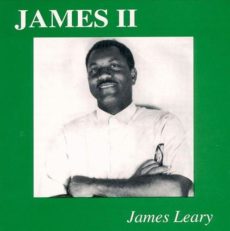
JAMES II ~ JAMES LEARY | BY EDDIE CARTER
This morning’s column begins with the second album by James Leary on David Manley’s audiophile record label VTL. James II (VTL-The Vital Sound 005) is a stellar 1992 quartet session released a year after his first album for Vital Records, James. The personnel for this two-record set is Eddie Harris on tenor sax (tracks: A2, C1, D1, D2), and vocals (track: B1); Billy Childs on acoustic piano; Leary on acoustic bass and Ralph Penland on drums. My copy used in this report is the original Stereo release.
The album gets underway with the opening number, Joshua. This is a Victor Feldman composition originally made famous by Miles Davis on Seven Steps To Heaven (1963) and two live albums, Miles Davis In Europe (1964) and ‘Four’ & More (1966). Billy kicks off the album with a breathtaking melody, then rips into the opening solo with searing intensity. James follows with a fascinating study of vivacity and sprightliness, then Ralph executes a brief finale of impeccable brushwork before the coda.
Have You Met Miss Jones? The popular standard by Richard Rodgers & Lorenz Hart first appeared in the 1937 musical comedy, I’d Rather Be Right. Eddie Harris makes his debut here and the quartet takes the melody at a relaxed beat. Billy picks up the pace on the opening solo with a compelling improvisation. Eddie’s first reading finds full rein of expression with a full-bodied tone you can’t help but enjoy. James puts together a very effective closing statement ahead of the ending theme.
A Flower Is a Lovesome Thing by Billy Strayhorn was composed in 1944. It opens Side Two with a hauntingly delicate introduction to the melody by the quartet utilizing Harris’ voice scatting along with the trio. Leary tells a deeply poignant story on the lead solo that’s a reminder of the passing of time. Childs delivers the second statement with the sweetness of a scented summer breeze after a light rain. Harris makes the final reading his own with a sublimed moody feeling that floats gently into the climax.
Seven Steps To Heaven by Miles Davis and Victor Feldman brings Record One to a close with a brief unaccompanied introduction by the bassist segueing into an invigorating theme. Leary swings from the outset on the first statement, then Childs gives an energetic workout next. Penland speaks last with a fierce intensity leading to an exuberant closing chorus. John Coltrane’s Spiral creates an infectious midtempo melody from the opening notes of the introduction into a swinging first interpretation by Eddie. Billy brings his own brand of excitement to the second reading and James provides some good cooking on the finale.
Leary’s Laugh, Laugh Again is a trio performance beginning with a bowed introduction by the bassist preceding the lovely opening chorus. Childs starts the first reading tenderly, revealing the essence of the song with a delicate interpretation that’s rich and atmospheric. Leary wraps up the solos with a tender, sweet performance.
Oleo by Sonny Rollins begins the final side with Leary providing a repeating bass figure reoccurring underneath each reading. Billy starts with a muscular groove that really cooks, then Eddie swings with an exciting restlessness on the second statement. James follows with a scintillating solo and Ralph ends in fine form on a dynamically propulsive presentation. Leary’s Hold My Hand is a simple ballad that opens elegantly with Harris in front of the foursome on the lyrically beautiful theme. The first solo is affectionately handled by Harris who gives a presentation of intimate lyricism. Childs wraps up the album with a thoughtfully delicate reading.
David Manley, VTL’s (Vacuum Tube Logic of America) founder produced and engineered this album in a state-of-the-art studio utilizing the company’s tube technology. The soundstage is extraordinary throughout the highs, midrange, and bass. The result is James II by James Leary is not just an excellent album, but a treat for any jazz fan to enjoy!
~ ‘Four’ & More (Columbia CL 2453/CS 9253); James (Vital Records ViTaL 003); Miles Davis In Europe (Columbia CL 2183/CS 8983); Seven Steps To Heaven (Columbia CL 2051/CS 8851) – Source: Discogs.com ~ Oleo, Have You Met Miss Jones? – Source: JazzStandards.com ~ Seven Steps To Heaven – Wikipedia.org © 2020 by Edward Thomas Carter
More Posts: bass,choice,classic,collectible,collector,history,instrumental,jazz,music
DAily Dose Of Jazz…
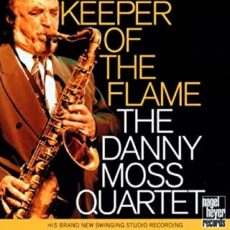
Dennis Moss MBE, known as Danny in the professional world, was born on August 16, 1927 in Redhill, Surrey, England. The son of a toolmaker, his childhood was spent on the south coast, in the Brighton-Worthing area, where he attended Steyning Grammar School. At the age of thirteen, he saw a jazz band appear briefly in a Bowery Boys film, and was so inspired by the clarinet playing that he swapped his most valued possession, his ice skates, for a second-hand instrument of his own. He was self-taught on both this and the tenor saxophone, which he took up at school,
A spell of National Service at the age of eighteen saw Moss performing for three years in a Royal Air Force regional band. After leaving the forces he joined the Vic Lewis Orchestra, then moved around various bands, especially ones with the potential for a soloist. In 1952, he joined Ted Heath’s band, soon discovering novelty numbers and musical reproductions were limiting his skills as an improviser, and he left after three years.
In 1957 Moss joined John Dankworth’s orchestra. Here, with the band’s encouragement, he began to develop his characteristic saxophone sound. He left Dankworth’s band in 1962, and from here, he joined Humphrey Lyttelton’s group, continuing to hone his style for another two years. He formed his own quartet, playing a mix of club gigs, festival appearances and radio broadcasts for the BBC and continued to tour with this quartet throughout the 1970s and 1980s. He also playing and recording with high-profile singers like Tony Bennett, Ella Fitzgerald, Bing Crosby, Sarah Vaughan, and Rosemary Clooney, and appearing with Buck Clayton in the mid-’60s and Louis Armstrong on his last British tour.
Diagnosed in 2005 with pleural mesothelioma, a rare form of lung cancer caused by exposure to asbestos. Saxophonist Danny Moss passed away on May 28, 2008, aged 80.

More Posts: bandleader,clarinet,history,instrumental,jazz,music,saxophone
Daily Dose Of Jazz…
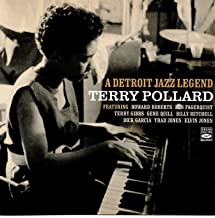
Terry Pollard (August 15, 1931 in Detroit, Michigan and began her career by collaborating with other Detroit musicians, such as Billy Mitchell and Elvin Jones, in the house band at the Blue Bird Inn. Johnny Hill, and the Emmitt Slay Trio.
Discovered by Terry Gibbs, she toured with him in the early 1950s, playing piano and vibraphone. They recorded several albums, including Terry Gibbs Quartet – Featuring Terry Pollard. Pollard appeared with Gibbs on an episode of The Tonight Show hosted by Steve Allen. Her collaborations with Gibbs from 1953 to 1957 marked the height of her career.
Pollard also performed with John Coltrane, Charlie Parker, Miles Davis, Chet Baker, Nat King Cole, Dinah Washington, Duke Ellington and Ella Fitzgerald
Recording a self-titled solo album for Bethlehem Records in 1955, Terry won Down Beat magazine’s New Artist award in 1956. She retired from her full-time music career shortly thereafter in order to raise a family, but she continued to play locally in Detroit and performed with Yusef Lateef, Dorothy Ashby, Don Fagerquist, and Diana Ross and the Supremes among others.
Her contributions to the mid-century Detroit jazz scene were recognized in the book Before Motown: A History of Jazz in Detroit 1920-1960, by Lars Bjorn and Jim Gallert. Pianist, vibraphonist Terry Pollard, who was inducted into the Michigan Jazz Hall of Fame, passed away on December 16, 2009 in Detroit.
More Posts: bandleader,history,instrumental,jazz,music,piano,vibraphone
Daily Dose Of Jazz…
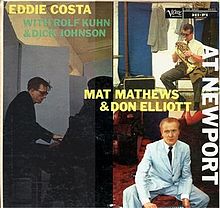
Edwin James Costa was born on August 14, 1930 in Atlas, Pennsylvania, near Mount Carmel, in Northumberland County. He was taught and influenced on piano by his older, musically trained brother, Bill, and a local piano teacher. He took paid jobs as a pianist from the age of 15, and in contrast to his piano training, he was self-taught on vibes.
In 1949 he played and toured for a few months with violinist Joe Venuti. He then worked for his brother in New York until 1951, when Eddie was drafted into the army. During this time in the armed forces, he performed in Japan and Korea. After his discharge, he returned home and worked around the New York area, including for bands led by Kai Winding, Johnny Smith, and Don Elliott.
n 1957 he was chosen as Down Beat jazz critics’ new star on piano and vibes – the first time that one artist won two categories in the same year. He became known for his percussive, driving piano style that concentrated on the lower octaves of the keyboard.
Costa had an eight-year recording career, during which he appeared on more than 100 albums, with five of them were under his own leadership. As a sideman, he appeared in orchestras led by Manny Albam, Gil Evans, Woody Herman, and others; played in smaller groups led by musicians including Tal Farlow, Coleman Hawkins, Gunther Schuller, and Phil Woods; and accompanied vocalists including Tony Bennett and Chris Connor. Costa died, aged 31, in a car accident in New York City.
His first recording as a leader was in 1956, with his trio featuring bassist Vinnie Burke and drummer Nick Stabulas. Around this time, he was nicknamed The Bear by Burke for his powerful playing. He and Burke joined Tal Farlow and became the resident trio at the Composer Club. In 1957 Costa was again leader, recording Eddie Costa Quintet with Woods, Art Farmer, Teddy Kotick, and Paul Motian. He would go on to record 1958’s Guys and Dolls Like Vibes with Bill Evans, Wendell Marshall, and Motian.
Late at night on July 28, 1962, pianist, vibraphonist, composer, and arranger Eddie Costa passed away in a car crash, involving no other vehicles, on New York’s Westside Highway at 72nd Street in New York City.
More Posts: arranger,composer,history,instrumental,jazz,music,piano,vibraphone
The Quarantined Jazz Voyager
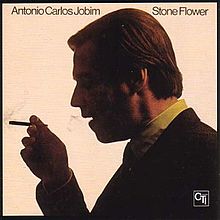
Stone Flower is the sixth studio album by Antônio Carlos Jobim. Recorded over a period of seven sessions in 1970 on March 16, April 23, 24, 29, and May 8, 20, and 22nd by Rudy Van Gelder at Van Gelder Studio in Englewood Cliffs, New Jersey. The album was produced by Creed Taylor, the album was released on July 7, 1970 on CTI Records. The album peaked at #18 on the Jazz Albums chart in 1971 and #196 on the Billboard 200.
Track Listing | 33:47 All tracks composed by Antônio Carlos Jobim, except where noted- Tereza My Love ~ 4:24
- Children’s Games ~ 3:30
- Choro ~ 2:10
- Brazil (Ary Barroso) ~ 7:25
- Stone Flower ~ 3:21
- Amparo ~ 3:41
- Andorinha ~ 3:32
- God and the Devil in the Land of the Sun ~ 2:23
- Sabiá ~ 3:58
- Antônio Carlos Jobim – piano, electric piano, guitar, vocals
- Harry Lookofsky – violin
- Joe Farrell – soprano saxophone
- Urbie Green – trombone
- Hubert Laws – flute
- Ron Carter – double bass
- João Palma – drums
- Airto Moreira – percussion
- Everaldo Ferreira – percussion
- Eumir Deodato – guitar, arranger

More Posts: adventure,club,genius,guitar,jazz,museum,music,piano,preserving,restaurant,travel,vocal,voyager