

Daily Dose Of Jazz…
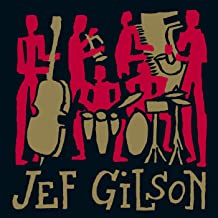
Jef Gilson was born on July 25, 1926 as Jean~François Quiévreux in Guebwiller, France. As a clarinetist he began playing with Claude Luter in the Boris Vian band. After that stint he switched to the piano. The experience of the Dizzy Gillespie Big Band led him to become an arranger and big band leader. In his band played, among others Bill Coleman, Bernard Vitet, Jean-Louis Chautemps, François Jeanneau, Michel Portal, Jean-Luc Ponty, Bernard Lubat, Lloyd Miller and Henri Texier.
For a time he was musical director of the vocal sextet Les Double Six. Gilson’s free jazz recordings did not materialize into success, and in 1968 he temporarily went to Madagascar. His 1971 return saw him concentrating first on ethno jazz, then total improvisation. In 1973 he founded his label Palm, and released recordings with his orchestra Europamerica, and with Butch Morris. For this more arranged record, which started reflecting his achievements of free jazz, he was awarded the 1978 Prix Boris Vian.
Up to his final days he lived withdrawn in Ardèche, France. Pianist, arranger, composer and big band leader Jef Gilson passed away on February 5, 2012.

More Posts: arranger,bandleader,composer,history,instrumental,jazz,music,piano
Three Wishes
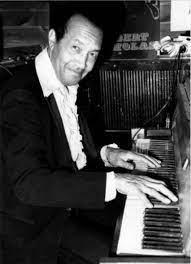
Sir Charles Thompson had but one thing to say in response NIca’s inquiry:
1. “To have you and be able to command you as a king! And be happy together, doing everything we want to do, forever.”
*Excerpt from Three Wishes: An Intimate Look at Jazz Greats ~ Compiled and Photographed by Pannonica de Koenigswarter

More Posts: baroness,history,instrumental,jazz,music,pannonica,piano,three,wishes
Daily Dose Of Jazz…
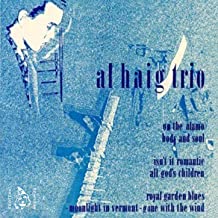
Alan Warren Haig was born on July 19, 1922 in Newark, New Jersey and raised in nearby Nutley. At eighteen he majored in piano at Oberlin College and started playing with Dizzy Gillespie and Charlie Parker in 1945. He performed and recorded from 1945 to 1951 with Gillespie, Parker, Eddie Davis and His Beboppers with Fats Navarro, the Eddie Davis Quintet, and Stan Getz. The Gillespie quintet, which included Haig, recorded four 78 r.p.m. sides for Guild Records in May 1945 which are regarded as the first recordings to demonstrate all elements of the mature bebop style. He was part of the nonet on the first session of Miles Davis’ Birth of the Cool.
For much of the 1950s and 1960s, Haig got by with semi-cocktail piano in New York bars. In 1969 he had a brush with the law having been accused and acquitted of the strangling murder charge of his thrid wife.
In 1974, Haig was invited to tour Europe by Tony Williams, owner of Spotlite Records in the United Kingdom. At the end of a very successful tour he recorded the Invitation album for Spotlite with Bibi Rovère on bass and Kenny Clarke on drums. This kick-started his re-emergence and, over the next eight years, he built a strong following in Europe and toured several times, recording in the UK and France, and appearing elsewhere. He also recorded for several Japanese labels.
Pianist Al Haig, best known as one of the pioneers of bebop, and who recorded twenty~three albums as a leader, passed away from a heart attack on November 16, 1982 in New York City.
More Posts: bandleader,history,instrumental,jazz,music,piano

Three Wishes
The Baroness asked Oscar Peterson what his three wishes would be and he said:
1. “I wish I could play the piano the way I want to.”
2. “I wish everyone was born with innate understanding of all art forms.”
3. “Love throughout the world, individual to individual.”
*Excerpt from Three Wishes: An Intimate Look at Jazz Greats ~ Compiled and Photographed by Pannonica de Koenigswarter
More Posts: baroness,history,instrumental,jazz,music,pannonica,piano,three,wishes
Requisites
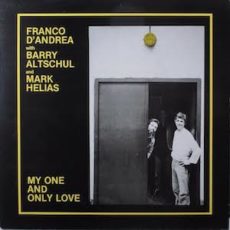
My One And Only Love ~ Franco D’Andrea | By Eddie Carter
This morning’s choice from the library is My One and Only Love (Red Record NS 201), a recent acquisition introducing me to the Italian pianist, Franco D’Andrea. His career began in 1963 with bandleader Nunzio Rotondo. He’s also played with Franco Ambrosetti, Gato Barbieri, Conte Candoli, Dave Douglas, Johnny Griffin, Lee Konitz, Steve Lacy, Max Roach, Frank Rosolino, Phil Woods, and other Italian musicians. D’Andrea is one of Italy’s most famous pianists and has an extensive discography of two hundred albums as a leader and sideman. Franco also taught at Conservatorio “F.A. Bonporti” from 1994 to 2006 and currently teaches at Mitteleuorpean Jazz Academy and Siena Jazz. On this date, he’s joined by Mark Helias on bass and Barry Altschul on drums. My copy used in this report is the 1983 Italian Stereo pressing.
Side One begins with the first of three tunes from the pianist’s pen, Nord E Sud is a pretty composition that starts slowly but grows to a medium tempo with Franco displaying fine finger work on the opening chorus. He continues holding our attention on an enchanting performance with consummate pacing ascending to a gorgeous climax. Mark takes over for a brief display of creative imagination on the closing solo before the threesome concludes exhibiting a simple lyrical beauty. The pace picks up for the medium-fast blues, Slalom Speciale beginning with a quick introduction by Altschul segueing into a brisk theme and superbly crafted, adventurous first reading by D’Andrea. The pianist and Altschul share a spirited interchange of ideas next, then the drummer breaks loose with a majestic interpretation ahead of the trio’s return to the theme.
Quiet Children, a delicately gentle ballad describing boys and girls at their most peaceful, when they’re sleeping starts Side Two. The ensemble embarks upon a lovely melody transmitting their joy collectively. The leader delves deeply into each child’s dreams with elegant warmth on the first solo. Mark follows with a thoughtful interpretation culminating with the threesome’s serene ending. My One and Only Love by Guy Wood and Robert Mellin is a 1953 jazz standard allowing each member ample solo space. The opening statement by D’Andrea provides an ideal setting to display his talents with delightful humor as it unfolds. Helias follows with a neatly paced reading expressing fervent admiration for the beautiful woman the lyrics describe. Altschul adds some marvelous energy to the final statement before the group’s reprise ends with a bit of collective free jazz improvisation.
The man behind the dials on My One and Only Love is Italian engineer, composer, and multi-instrumentalist, Giancarlo Barigozzi. His work has created a beautiful pressing with stunning stereo separation where the instruments come alive in your listening room crystal clear. Now that I’ve been introduced to this superb pianist, I’ll be looking for some of his other releases for my library. If you’re in the mood for some contemporary jazz, I submit for your consideration, My One and Only Love by Franco D’Andrea. The trio is strong in all three positions with bass and drums participating equally with the piano and their interplay working seamlessly. This album scores on all counts, and in my opinion, should not be overlooked on your next vinyl hunt!
~ My One and Only Love – Source: JazzStandards.com © 2020 by Edward Thomas Carter
More Posts: choice,classic,collectible,collector,history,instrumental,jazz,music,piano