

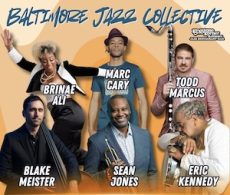
BALTIMORE JAZZ COLLECTIVE
Founded in 2019 at Keystone Korner Baltimore, the Baltimore Jazz Collective is making its Homecoming Return! Music and spirituality have always been fully intertwined in the artistic vision of trumpeter, bandleader, composer, educator and activist Sean Jones. With boundless passion, energy, and soul, Baltimore Jazz Collective explores the inner and outer frontiers of melody, harmony and time itself.
Sean Jones | Trumpet/Bandleader
Brinae Ali | Keys
Todd Marcus | Saxophone/Clarinet
Marc Cary | Piano
Blake Meister | Bass
Eric Kennedy | Drums
Cover: $35.00 ~ $45.00 + fee
Streaming: $15.00 + fee
More Posts: adventure,bandleader,bass,clarinet,drums,genius,instrumental,jazz,music,piano,preserving,saxophone,travel,trumpet,vocal
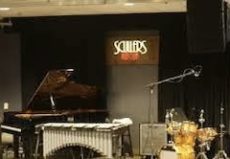
The Jazz Voyager
The coast to coast flight has the Jazz Voyager sleeping on the red eye heading east for a taste of jazz in the town where the tea party took place, Beantown as some call it or Boston, Massachusetts. The venue is Scullers Jazz Club and it has a small stage where jazz and soul legends as well as new talent perform in this intimate supper club with a background of river views.
This week I’ll be in the company of pianist, composer and arranger Jon Cowherd who is best known as the co-founder and co-director of Brian Blade and the Fellowship Band. He has worked extensively as an arranger, producer, songwriter and accompanist with a vast range of artists, such as Cassandra Wilson, John Scofield and Lizz Wright to Joni Mitchell, Brandi Carlile, Rosanne Cash, Norah Jones, Glen Hansard and more.
Scullers Jazz Club is located at 400 Soldiers Field Road 02134. For more information visit https://scullersjazz.com.
More Posts: adventure,bass,club,genius,guitar,jazz,music,piano,preserving,saxophone,travel
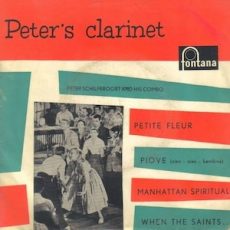
Daily Dose Of Jazz…
Anne Peter Schilperoort was born on November 4, 1919 in The Hague, Netherlands. Famous for his work with the Dutch Swing College Band, and projects with other well-known musicians.
He is most recognized as a saxophone and clarinet player, but also played the guitar and the banjo. Leading the Dutch Swing College Band from 1946 to 1955, then from 1960 to 1990, his style was Dixieland, a style popular at the start of the twentieth century. His band became widely popular across Europe, Australia, Asia and South America in 1960, known as a Dixieland revival band.
Peter Schilperoort, also known as Pat Bronx, died in Leiderdorp, Netherlands on November 17, 1990 at the age of 71.

More Posts: banjo,clarinet,guitar,history,instrumental,jazz,music,saxophone
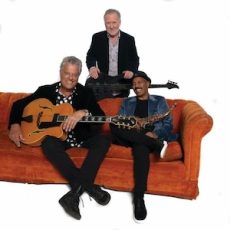
BRIAN BROMBERG, PAUL BROWN & MICHAEL PAULO
The Supergroup, formed by the first letters of their first names, as well as the term BPM stands for beats per minute, the definition of the tempo in music.
Collectively they are responsible for over 80 Billboard Smooth Jazz Number 1 Hits and many hundreds of thousands of record sales. Now together as BPM, they share their success with Grammy wins, nominations, and bring over 100 years of experience to the stage and to the music. BPM is the new fresh voice of Contemporary and Smooth Jazz!
Tickets: $40.00~$150.00
More Posts: adventure,bandleader,bass,club,genius,guitar,instrumental,jazz,music,preserving,saxophone,travel

Requisites
Swiss Movement ~ Les McCann and Eddie Harris | By Eddie Carter
This morning’s record from the library is an exceptional live album by Les McCann and Eddie Harris. They performed a spontaneous concert at the 1969 Montreux Jazz Festival. Their set, which became the highlight of the three-day event, was a testament to the quintet’s exceptional musicianship. Swiss Movement (Atlantic SD 1537) immortalizes this incredible performance. The ensemble consists of Benny Bailey on trumpet, Eddie Harris on tenor sax, Les McCann on piano, Leroy Vinnegar on bass and Donald Dean on drums. My copy is the original 1969 U.S. Stereo release.
The opener, Compared To What by Gene McDaniels, is a poignant reflection of the sentiments of many Americans towards the Vietnam War and the President of the United States. McCann’s vocals, which delve into the pressing issues of the time, add a layer of historical significance to the song. Les starts things with a spirited introduction, setting the stage for a lively dialogue when Donald joins in. Leroy and Eddie add to the jubilant theme with McCann’s vibrant vocal choruses. Benny follows with a zestful solo, and Les returns for another round of swinging. He then lets his fingers do the talking with exhilarating energy. Eddie takes the performance to a whole new level next, leading to an electrifying climax, the audience’s thunderous applause, and McCann’s quintet introduction.
Cold Duck Time by Eddie Harris slows the pace to medium speed, opening with Les McCann’s introduction to the crowd. Leroy and Donald build the song softly to the quintet’s relaxing theme. Eddie starts the soloing with a nice, easygoing groove. Benny delivers the following solo with thoughtful construction and captivating lines. Les ends with a contagious swing on the closer, which cooks to the finale. Kathleen’s Theme by Les McCann ends the first side with Harris leading a quartet performance. Eddie delivers a feisty reading with a spirited momentum fueled by the rhythm section’s groundwork, which receives a well-deserved ovation from the Montreux audience at its conclusion.
Les McCann’s You Got It In Your Soulness opens Side Two with the trio’s festive introduction to Les scatting along in the background of the melody. He continues taking care of business on the first solo. Eddie launches a funky, firm-toned attack next. Benny responds with energetic verses in the following reading, and Les puts the exclamation point on the solos with intense heat, which glows brightly into the close. The Generation Gap by Les McCann starts with the trio’s introduction and melody. Eddie begins with a velvety, smooth opening statement. Les delivers a stimulating workout before the trio’s gentle ending.
Nesuhi Ertegün and Joel Dorn produced Swiss Movement, and French recording engineer Pierre Grandjean crafted the album with meticulous diligence to detail. The album boasts an excellent soundstage with a “you are there” feeling, immersing the listener in the Montreux Jazz Festival audience as the group performs. The record is also quiet until the music begins. As for the music itself, Swiss Movement by Les McCann and Eddie Harris is a testament to the highest standards of jazz, a live performance that rocked the house that night and continues to captivate audiences today. If you’re a soul jazz or post-bop fan, it’s a must-have for your library!
~ Compared To What – Source: Wikipedia.org
© 2024 by Edward Thomas Carter
More Posts: choice,classic,collectible,collector,history,instrumental,jazz,music,piano,saxophone