


Daily Dose Of Jazz…
Russell Procope was born on August 11, 1908 in New York City and grew up in San Juan Hill, attending school with Benny Carter. His first instrument was the violin, but he switched to clarinet and alto saxophone. He began his professional career in 1926 as a member of Billy Freeman’s orchestra. At the age of twenty he recorded with Jelly Roll Morton and went on to play with bands led by Benny Carter, Chick Webb, Fletcher Henderson, Tiny Bradshaw, Teddy Hill, King Oliver and Willie Bryant by the mid-Thirties.
Procope would play with Roy Eldridge, Bill Coleman, Frank Newton, Dizzy Gillespie, Dickie Wells and Chu Berry. He made his first trip to Europe in 1937 as part of Teddy Hill’s band with “The Cotton Club Revue,” an all-Black show, which during its European tour appeared at the London Palladium.
In 1938 Russell replaced Pete Brown in John Kirby’s sextet and made a name for himself until 1945 with a three-year interruption in the Armed Services during World War II. He joined the reed section of the Ellington orchestra in ’46 as an alto saxophonist but made his name and reputation as a clarinetist. During the summer of 1950 the band returned to Europe bringing him back once again as a member and he stayed until the bandleader’s death in 1974,
Playing alto saxophone he recorded the 1956 album “The Persuasive Sax of Russ Procope” under the London Records label. Although his early playing reflected the influence of Benny Carter, alto saxophonist and clarinetist Russell Procope, most highly regarded for his woody, understated clarinet solos, lyrical approach and forceful swinging attack, passed away on January 21, 1981.
More Posts: saxophone
Requisites
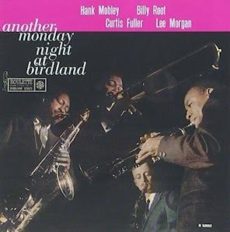
Another Monday Night at Birdland ~ Hank Mobley, Billy Root, Curtis Fuller, Lee Morgan | By Eddie Carter
This morning’s choice from the library brings us back to The Jazz Corner of The World for another live set by Lee Morgan on trumpet, Curtis Fuller (tracks: A2, B1, B2) on trombone, Hank Mobley, Billy Root on tenor sax. Another Monday Night at Birdland (Roulette R 52022/SR 52022) is the companion album to Monday Night at Birdland. Rounding out the septet is Ray Bryant on piano, Tommy Bryant on bass, and “Specs” Wright on drums. “Symphony Syd” Torin is the Master of Ceremonies, and my copy used in this report is the 1988 Spanish Mono reissue (Fresh Sound Records FSR-632).
Side One starts with an exhilarating rendition of It’s You Or No One, written in 1948 by Jule Styne and Sammy Cahn. Lee leads the ensemble on the melody before Hank opens the solos energetically. Lee lays down some spirited energy on the second statement, then Billy states his case with a vigorous finale leading to the climax and Syd’s introduction of the next tune. Jamph was written by Curtis Fuller, and I first heard it on the album, Big Six (1958). The septet begins the theme at mid~tempo collectively, then Mobley soars into the lead solo with some energetic blowing. Fuller greets the next statement enthusiastically, followed by Morgan who wails mightily on a vigorous reading. Root keeps the beat on the fourth interpretation with a scene-stealing performance. Bryant takes care of business on the closer with an aggressive solo into the out chorus.
Side Two starts with Syd’s announcement of the next tune, Nutville by Lee Morgan with inspired playing by the septet on the infectious melody. Hank launches into a swinging improvisation that’s a delight. Lee exhibits his skills on a joyful excursion next. Billy comes after him with a stellar statement that made me sit up and take notice. Curtis wraps up the solos with a delightful interpretation that brings so much pleasure ahead of the ensemble’s exit and group introductions. Wee by Denzil Best is an uptempo cooker that flies out of the gate with a high-voltage melody in unison. Mobley steps into the spotlight first with a heated solo. Morgan uses a mute for the second statement and attacks with the speed of a whirlwind. Root displays some lightning-fast chops on the third presentation, and Bryant covers plenty of ground motoring in rapid-fire fashion on the next reading. Wright gets a concise comment during the theme’s reprise into the septet’s lively finale.
Another Monday Night at Birdland was produced by Rudy Taylor and like the first album, the soundstage is excellent for a live recording. This is a four-star blowing session that I’m sure any fan of Hank Mobley, Billy Root, Lee Morgan, and Curtis Fuller would dig. If you’re a fan of Hard-Bop, this album is a terrific addition to any jazz library and one of the best in the Birdland Series!
~ Big Six (Riverside Records RLP12-273), Monday Night at Birdland (Roulette R-52015/SR-52015) – Source: Discogs.com © 2021 by Edward Thomas Carter

More Posts: choice,classic,collectible,collector,history,instrumental,jazz,music,saxophone,trombone
Daily Dose Of Jazz…
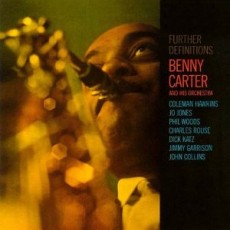
Benny Carter was born Bennett Lester Carter on August 8, 1907 in New York City. He received his first piano lessons from his mother but was largely self-taught. Growing up in Harlem under the influence of trumpeter Bubber Miley and was inspired to buy his own. Unable to play like Miley, he switched to saxophone.
By age fifteen he was sitting in at Harlem night spots and from 1924 to 1928, Carter gained valuable professional experience as a sideman in some of New York’s top bands. For the next two years he played with such jazz greats as cornetist Rex Stewart, Sidney Bechet, Earl Hines, Willie “The Lion” Smith, Fats Waller, James P. Johnson, Duke Ellington and others.
His first recordings of a prolific catalogue were made in 1928 with the Charlie Johnson’s Orchestra and he formed his first big band the following year. In the early 30s he played with Fletcher Henderson, led the McKinney’s Cotton Pickers in Detroit, then returned to New York to once again lead his own band. He would work with Sid Catlett, Chu Berry, Teddy Wilson and Dicky Wells.
Benny’s name first appeared on records with a 1932 Crown label, then on Columbia, Okeh and Vocalion. In 1935 he moved to Europe to play trumpet with Willie Lewis’s orchestra, became staff arranger for the BBC dance orchestra, made several records, returned home in 1938, formed another orchestra and spent much of 1939 and 1940 at Harlem’s Savoy Ballroom. He relocated to Los Angeles in 1943, moved increasingly into studio work and arrange for dozens of feature films and television productions, influencing and mentoring Quincy Jones, as well as arranging for Billie Holiday, Sarah Vaughan, Billy Eckstine, Pearl Bailey, Ray Charles, Peggy Lee, Lou Rawls, Louis Armstrong and Mel Torme among others over the course of his career.
Carter has been honored as a jazz master by the National Endowment for the Arts, received the National Medal of Arts from President Clinton, was a Kennedy Center honoree, was awarded the Grammy Lifetime Achievement Award, won six Grammy Awards, has a star on the Hollywood Walk of Fame and was inducted into the Downbeat Jazz Hall of Fame.
Alto saxophonist, clarinetist, trumpeter, composer, arranger and bandleader Benny Carter, who was a major figure known as “King” in the jazz community and the only musician to record in eight different decades, passed away on July 12, 2003 in Los Angeles, California at age 95.
More Posts: saxophone
Daily Dose Of Jazz…
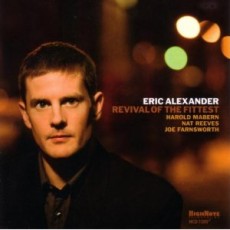
Eric Alexander was born August 4, 1968 in Galesburg, Illinois and began as a classical musician studying piano at six, clarinet at nine, switching to alto saxophone three years later. While at Indiana University he switched to the tenor saxophone and jazz before transferring to William Paterson University where he studied with Harold Mabern, Rufus Reid, Joe Lovano, Gary Smulyan, Ralph LaLama, Norman Simmons, Steve Turre and many others.
Alexander first achieved fame by finishing second behind Joshua Redman and ahead of Chris Potter at the 1991 Thelonious Monk International Jazz Saxophone Competition. He was quickly signed and began recording his more than three-dozen albums as a leader and collaborator.
Influenced primarily by Sonny Stitt, Dexter Gordon and George Coleman, playing in the hard bop and post-bop styles, he has worked with such notables as Ron Carter, Joe Farnsworth, Pat Martino, Peter Bernstein, Vincent Herring, Grant Stewart and Mike LeDonne among others. Alto saxophonist Eric Alexander continues to record and tour as a leader, extensively with the sextet One For All.
More Posts: saxophone
Daily Dose Of Jazz…
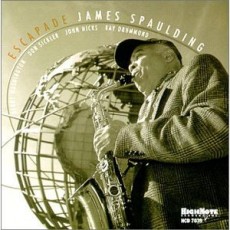
James Spaulding was born July 30, 1937 in Indianapolis, Indiana and started playing bugle while in grade school. He later learned to play trumpet and saxophone and flute. While in high school he studied clarinet and made his professional debut around his hometown in a rhythm and blues band.
After a three-year enlistment in the Army he settled to Chicago in 1957 leading his own groups. It was during this period he joined the Sun Ra Arkestra, making several recordings and remaining through 1959, while furthering his studies of flute at the Chicago Cosmopolitan School of Music. Spaulding subsequently freelanced as a studio musician and occasionally led his own groups before returning to Indianapolis in 1961.
Relocating to New York City in 1963, he recorded extensively for Blue Note Records as a sideman, and led several sessions as a leader for Storyville, Muse, 32 and High Note. He was also a member of the World Saxophone Quartet and recorded with Grant Green, Freddie Hubbard, Bobby Hutcherson, Lee Morgan, David Murray, Duke Pearson, Sam Rivers, Pharoah Sanders, Wayne Shorter, Stanley Turrentine, Larry Young and others.
As an educator he taught flute as an adjunct professor at Livingston College in New Jersey. Alto saxophonist James Spaulding continues to perform and record.