

Daily Dose Of Jazz…
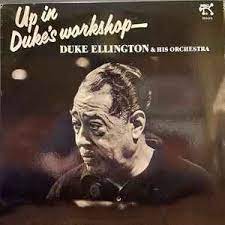
Fred Stone was born on September 9, 1935 in Toronto, Ontario, Canada and was the son of saxophonist Archie Stone. His initial musical studies were with his father. At the age of 14 he began studying the trumpet with Donald Reinhardt in Philadelphia, Pennsylvania and spent every summer in that city from 1950–1955. At home he studied music theory and music composition with Gordon Delamont and John Weinzweig.
Commencing his performance career in 1951 at the age of 16 he played in Benny Louis’s big band. From 1955 to 1967 he was a trumpeter in various orchestras related to the Canadian Broadcasting Corporation, including the CBC Symphony Orchestra. During the late 1950s and 1960s he performed widely as a concert soloist with orchestras throughout North America. He was an active performer as a jazz musician, playing regularly with Ron Collier , Phil Nimmons , the Boss Brass, and Lighthouse and he toured North America and Europe with the Duke Ellington Orchestra.
Returning to Toronto in 1971, Stone became highly involved with his work as a teacher, and operated his own private studio where he taught improvisational theory and music composition. His performance career virtually ceased for the remainder of the decade, although he remained active as a composer. Between 1971 and 1983 he mainly focused on his work as a composer and teacher, making only periodic public performances, and often with ensembles composed largely of his students.
In 1984 he formed Freddie’s Band, a jazz ensemble in residence at The Music Gallery in Toronto. Flugelhornist, trumpeter, pianist, composer, writer, and music educator Fred Stone recorded eleven albums as a sideman before he transitioned on December 10, 1986.

More Posts: educator,flugelhorn,history,instrumental,jazz,music,trumpet,writer
The Jazz Voyager
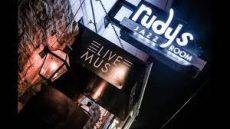
The Jazz Voyager is grabbing a plane for a quick hop to Music City for some jazz. It’s my first club outing since the pandemic lockdown so I’ll be wearing my mask at all times indoors. This week’s destination is Rudy’s Jazz Room located at 809 Gleaves Street, Nashville, Tennessee.
This Saturday I will be catching a triple threat of jazz from the Joel Frahm Trio, Jody Nardone Trio and Don Aliquo with a late afternoon start at 5:30 pm and heading well into midnight and beyond. Rudy’s Jazz Room embodies the history and spirit of traditional jazz clubs, where musicians played their hearts out while people gathered to listen, dance, eat, drink and socialize in a swingin’ atmosphere.
The evening’s performances have a cover charge of $15.00, $20.00 and $10.00 at the door and I plan on giving up my $45.00 when I arrive for the first show. I like going in my pocket one time for things. Doors at 5:00pm, dinner and late night bites are available, however, for additional information, the number is 615.988.2458 and web address is rudysjazzroom.com.
More Posts: adventure,album,bass,club,festival,genius,jazz,museum,music,piano,preserving,restaurant,saxophone,travel

Daily Dose Of Jazz…
Elmer Schoebel was born in East St. Louis, Illinois on September 8, 1896. Early in his career he played along to silent films in Champaign, Illinois. After moving on to vaudeville late in the 1910s, he played with the 20th Century Jazz Band in Chicago, Illinois in 1920.
1922-23 saw him as a member of the New Orleans Rhythm Kings, then led his own band, known variously as the Midway Gardens Orchestra, the Original Memphis Melody Boys and the Chicago Blues Dance Orchestra, before joining Isham Jones in 1925. After returning to Chicago, Elmer played with Louis Panico and Art Kassel, and arranged for the Melrose Publishing House.
By the 1930s, Schoebel was writing and arranging, working as the chief arranger for the Warner Brothers publishing division. From the 1940s onward he did some performing with Conrad Janis, Blue Steele’s Rhythm Rebels (1958), and with his own ensembles in St. Petersburg, Florida. He continued to play up until his death.
Schoebel wrote a number of standards, including Bugle Call Rag, Stomp Off- Let’s Go, Nobody’s Sweetheart Now, Farewell Blues, and Prince of Wails. While a member of the New Orleans Rhythm Kings he wrote I Never Knew What A Girl Could Do, Oriental, and Discontented Blues.
Pianist, composer and arranger Elmer Schoebel, who as a leader only recorded one of his own compositions in 1929 titled Prince of Wails, transitioned on December 14, 1970.
More Posts: arranger,bandleader,composer,history,instrumental,jazz,music,piano
Daily Dose Of Jazz…
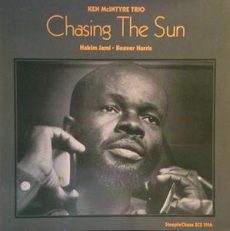
Makanda Ken McIntyre was born Kenneth Arthur McIntyreon on September 7, 1931 in Boston, Massachusetts to a father whoplayed mandolin. He started his musical life on the bugle when he was eight years old, followed by piano. In his teens he discovered the music of Charlie Parker and began playing saxophone at nineteen, then clarinet and flute two years later. Serving in the Army in 1953, for two years he played saxophone and piano in Japan.
Following his discharge Ken attended the Boston Conservatory where he studied with Gigi Gryce, Charlie Mariano, and Andy McGhee. In 1958 he received a degree in flute and composition with a master’s degree the next year in composition. He also received a doctorate (Ed.D.) in curriculum design from the University of Massachusetts Amherst in 1975.
1960 saw McIntyre recording as a leader with Eric Dolphy. The following year and for the next six he taught music in public schools. He took oboe lessons in New York before playing with Bill Dixon, Jaki Byard, and the Jazz Composer’s Orchestra. He went on to spend three years with pianist Cecil Taylor. During the 1970s he recorded with Nat Adderley and Beaver Harris and in the 1980s with Craig Harris and Charlie Haden.
In 1971, he founded the first African American Music program in the United States at the State University of New York College at Old Westbury, teaching for 24 years. He also taught at Wesleyan University, Smith College, Central State University, Fordham University, and The New School for Jazz and Contemporary Music.
In the early 1990s, while performing in Zimbabwe, a stranger handed him a piece of paper with the word “Makanda” written on it, which translates to many skins in the Ndebele language and many heads in Shona. He changed his name to Makanda Ken McIntyre. At the age of 69 on June 13, 2001 he transitioned from a heart attack in New York City.
More Posts: bass clarinet,bassoon,double bass,drums,flute,history,instrumental,jazz,music,oboe,piano,saxophone
Three Wishes
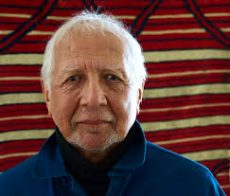
The question that came to Charles Lloyd from the Baroness when she asked if he had three wishes what would his answers be and he told her:
- “That’s awful difficult! Well, no – I wish I could play the music that I feel, and play with the musicians I’d like to.”
- “I would like to be a … to derive some kind of financial success from my music, and to know that it’s aesthetically pleasing.”
- “I’d like to make a contribution to art.”
*Excerpt from Three Wishes: An Intimate Look at Jazz Greats ~ Compiled and Photographed by Pannonica de Koenigswarter

More Posts: baroness,history,instrumental,jazz,music,pannonica,saxophone,three,wishes