

Daily Dose Of Jazz…
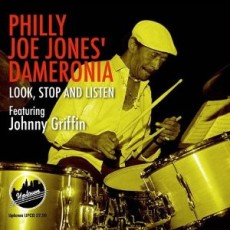
Joseph Rudolph Jones was born on July 15, 1923 in Philadelphia Pennsylvania. The name “Philly Joe” was used to avoid confusion with Jo Jones, the drummer from the Count Basie Orchestra, who became known as “Papa Jo Jones”. In 1947 he became the house drummer at New York’s Café Society, playing with the leading bebop players of the day. His most important influence among them was Tadd Dameron.
Jones toured and recorded with Miles Davis Quintet from 1955 to 1958 — a band that became known as “The Quintet”. Miles also acknowledged that Jones was his favorite drummer (in fact, in his autobiography, Davis admitted to asking other drummers to play that “Philly Joe lick”, with mixed results). He organized the Davis Quintet in 1955 so that he and Davis would not have difficulties finding competent local musicians to play with them.
From 1958 onwards he worked as a leader, but continued to work as a sideman with other musicians, including Bill Evans and Hank Mobley. Evans also openly admitted that Philly Joe was his all-time favorite drummer. For two years (1967-69) he taught at a specially organized school in Hampstead, London but was prevented from otherwise working in the UK by the Musicians’ Union. From 1981 he helped to found the group Dameronia, dedicated to the music of the composer Tadd Dameron, and led it until his death on August 30, 1985.
More Posts: drums
Daily Dose Of Jazz…
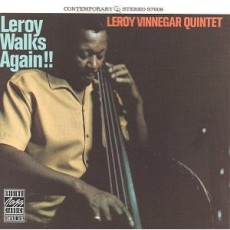
Leroy Vinnegar was born on July 13, 1928 in Indianapolis, Indiana and the self-taught bassist established his reputation in Los Angeles during the 50s and 60s. His trademark was the rhythmic “walking” bass line, a steady series of ascending or descending notes, and it brought him the nickname “The Walker”. Besides his jazz work, he also appeared on a number of soundtracks and pop albums, notably Van Morrison’s 1972 album, Saint Dominic’s Preview.
He recorded extensively as both a leader and sideman and came to public attention in the 1950s as a result of recording with Lee Konitz, Andre Previn, Stan Getz, Shorty Rogers, Chet Baker, Shelly Manne, Joe Castro and Serge Chaloff. He played bass on Previn and Manne’s My Fair Lady album, one of the most successful jazz records ever produced. He also performed on another of jazz’s biggest hit albums, Eddie Harris and Les McCann’s “Swiss Movement” released in 1969.
Moving to Portland, Oregon in 1986, the Oregon State Legislature honored him in 1995 by proclaiming May 1st as Leroy Vinnegar Day. The bassist died from a heart attack at the age of 71 in Portland on August 3, 1999.
More Posts: bass
Daily Dose Of Jazz…
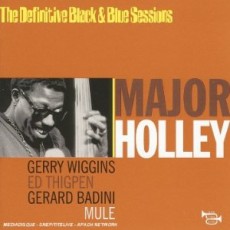
Major Holley was born on July 10, 1924 in Detroit, Michigan and started his music lessons playing violin and tuba at a young age. He started playing bass while serving in the Navy. In the latter half of the 1940s he played with Dexter Gordon, Charlie Parker, and Ella Fitzgerald. In 1950 he and Oscar Peterson recorded duets, and he also played with Peterson and Charlie Smith in a trio setting.
In the mid-1950s Major moved to England, working at the BBC. Upon returning to America he toured with Woody Herman in 1958 and with Al Cohn/Zoot Sims in 1959-60. A prolific studio musician, he played with Duke Ellington in 1964 and with the Kenny Burrell Trio, Coleman Hawkins, Lee Konitz, Roy Eldridge, Michel Legrand, Milt Buckner, Jay McShane and Quincy Jones during the Sixties and Seventies.
He was also noted for singing along with his arco (bowed) bass solos, a technique Slam Stewart also used. Holley and Stewart recorded together on two albums during the 1970s.
Never one far from the educational process, informal or formal, Holley was a professor and taught at the Berklee College of Music from 1967 to 1970. Upright jazz bassist Major Holley passed away on October 25, 1990 in Maplewood, New Jersey.
More Posts: bass
Daily Dose Of Jazz…
Colin James Bailey was born July 9, 1934 in Swindon, England and learned to play drums as a child, studying formally from age seven. Living in Australia from 1958 into the early 1960s, he played with Bryce Rohode and the Australian Jazz Quartet. While the AJQ toured the U.S., Bailey was hired by Vince Guaraldi to play alongside Jimmy Witherspoon and Ben Webster until 1963.
Settling in California, Bailey worked throughout the sixties with Claire Fischer, Victor Feldman, Joe Pass and Miles Davis; toured worldwide with Benny Goodman and George Shearing, played on a television program with Terry Gibbs and played with Chet Baker, Ray Brown, Joao Gilberto and Blossom Dearie in 1975.
In 1970, Bailey became an American citizen and spent six years as Ed Shaughnessy’s backup in the Tonight Show band, and starred in Fernwood Tonight in a drumming role in 1977-78. After a move to Texas in 1979, he became a faculty member at North Texas State University from 1981-84.
Drummer Colin Bailey’s later work includes time with Richie Cole, Jimmy Rowles, Red Mitchell, Stefan Scaggliari, Ron Affif, John Pisano, Weslia Whitfield, George H. Russell, Shelly Manne, Victor Feldman and re-teaming with Joe Pass.
More Posts: drums
Daily Dose Of Jazz…
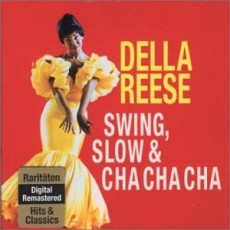
Della Reese was born Delloreese Patricia Early on July 6, 1931 in Detroit, Michigan to an African-American steelworker and Cherokee cook. At age 6 she began singing in church becoming an avid Gospel singer. Her mother would take her to the movies on weekends to see the portrayals of glamorous life by Joan Crawford, Bette Davis and Lena Horne, whereupon afterwards she would act out scenes from each movie. By 1944 she was directing the young people’s choir, nurturing her acting and her obvious musical talent.
She was often chosen on radio, as a regular singer and by age thirteen she was hired to sing with Mahalia Jackson’s Gospel group. Upon entering Cass Technical High School in Detroit, attending with Edna Rae Gillooly, later known as movie star Ellen Burstyn, Reese was a brilliant, no-nonsense student. She continued touring with Mahalia and with higher grades she was the first in her family to graduate from high school in 1947, at only 15.
After graduation Della formed her own gospel group called the Meditation Singers but her mother’s death and father’s illness interrupted her singing and education at Wayne State University. Taking odd jobs as a truck driver, dental receptionist and even elevator operator she continued to perform in clubs but realizing her name was too long for the marquee, shortened it to Della Reese.
Della’s career has spanned more than half a century and during that time she has taken her gospel roots and added jazz, pop and R&B. Her string of singles topped or landed in the top 10 of all the music charts at one time or another. She was voted Most Promising Singer in 1957 by Billboard, Cashbox and other magazines, following with her biggest hit at the time “Don’t You Know?” that would become her early career signature song.
She has received four Grammy nominations, recorded numerous albums, played Vegas for nine years, toured worldwide, ventured into acting on stage, film and television successfully with “Touched By An Angel”, has been a game show panelist, talk show host, spokeswoman for the American Diabetes Association, has a star on the Hollywood Walk of Fame and is an ordained minister.
More Posts: vocal