

Daily Dose Of Jazz…
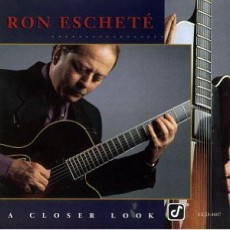
Ron Escheté was born on August 19, 1948 in Houma, Louisiana and after receiving his first guitar at the age of 14, joined a quartet and was working clubs in Louisiana before he had even graduated from high school. His early influences were jazz masters Jim Hall, Howard Roberts and Wes Montgomery. He attended Loyola University where he majored in classical guitar and minored in flute, and studied with classical guitarist Paul Guma.
Shortly after Escheté left Loyola he was tapped to tour with Buddy Greco and while touring with Greco, he set his sites on the Los Angeles music scene. In 1970 Ron relocated to California, worked and recorded with vibraphonist Dave Pike. In 1975 he joined forces with pianist Gene Harris and quickly establish his reputation as a premier accompanist.
Over the decades, Escheté, who plays a seven-string guitar, has worked with jazz musicians and vocalists such as Ella Fitzgerald, Sarah Vaughn, Diana Krall, Dizzy Gillespie, Milt Jackson, Ray Brown, Bill Cunliffe, Sam Most, Ernestine Anderson, Mort Weiss and many more.
No stranger to television, Escheté has appeared on the Tonight Show, the Merv Griffin Show and the Mike Douglas Show as well as playing nearly every notable jazz venue in Southern California including the Catalina Bar and Grill, The Jazz Bakery, Steamers, Donte’s, Carmelo’s, The Parisian Room and The Lighthouse to name a few.
Guitarist Ron Escheté, a quintessential sideman and innovative leader with some 36 albums to his credit, continues to tour, perform and record heading his own trio with Todd Johnson on bass and Kendall Kay on drums. He died suddenly on May 20, 2026, at the age of 77.
More Posts: guitar
Daily Dose Of Jazz…
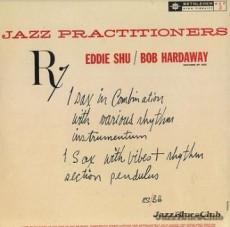
Eddie Shu was born on August 18, 1918 in New York City. He learned violin and guitar as a child before picking up saxophone as a teenager. His first professional gigs were as a harmonica-playing ventriloquist. He played in military bands while serving in the Army from 1942 to 1945.
Following his discharge he played with Tadd Dameron in 1947, George Shearing, Johnny Bothwell, Buddy Rich, Les Elgart and Lionel Hampton from 1949–1950. He would play with Charlie Barnet, Chubby Jackson and Gene Krupa through the end of the decade.
In the 1960s Shu moved to Florida, playing locally as well as clarinet with Louis Armstrong’s All-Stars, as well as Hampton and Krupa again. He would freelance around New York City, the Virgin Islands and Florida. Though he only did a few sessions as a leader in 1949, 1954 and 1955, he also recorded frequently with Gene Krupa.
Though he never gained much fame, Eddie Shu, a multi-talented swing and jazz saxophonist, a valued sideman skilled on reeds and brass instruments, passed away on July 4, 1986 in Tampa, Florida.
Daily Dose Of Jazz…
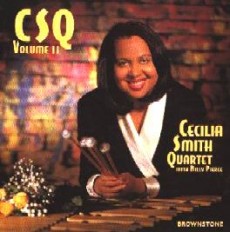
Cecilia Smith was born on August 17th, in Cincinnati, Ohio and raised in Cleveland Heights. She began her musical odyssey at age eight with piano lessons and by age twelve, she had added drums to her repertoire. At fourteen, she was on to mallet percussion, studying in her early teens music theory with graduate students at the Cleveland Music Institute. This led to her discovery that music would be her life’s quest.
Upon graduating from high school, Cecilia attended the Berklee College of Music in Boston, Massachusetts and while there she pursued composing, arranging, film scoring and her instrument of choice, the vibraphone. Earning a Bachelor of Music degree in Professional Music from Berklee, Smith continued in a teaching capacity for four years before moving to New York City.
As a professional composer and recording artist, Cecilia Smith has received numerous commissions and grants. She is an avid midi programmer, is currently one of the leading vibraphonist of the Four-Mallet Technique, the first woman to release material on vibraphone on a national and international level and has performed in concert halls, nightclubs and festivals throughout North and South America, Europe and Asia. Vibraphonist Cecilia Smith has frequently been highlighted on national radio and television broadcasts and she continues to compose, arrange and perform.
More Posts: vibraphone
Requisites
Central Avenue Reunion ~ Art Farmer, Frank Morgan, Lou Levy, Eric Von Essen, Albert “Tootie” Heath | By Eddie Carter
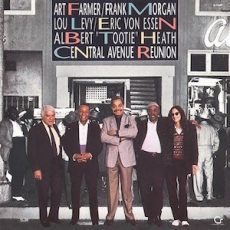
It’s wonderful to be back with you all after some time away to recuperate from two surgeries earlier this month. This morning’s album from the library, Central Avenue Reunion (Contemporary Records C-14057) spotlights two of my favorite artists, Art Farmer and Frank Morgan. Recorded live in 1989 over two memorable nights at Kimball’s East, it reunites Art Farmer on both flugelhorn (tracks: A2, A3, A4, B1) and trumpet (A1, B3), and Frank Morgan on alto saxophone (A1, A2, A4, B1 to B3). An outstanding rhythm section joins them: Lou Levy on piano, Eric Von Essen on bass, and Albert “Tootie” Heath on drums. I own the 1990 U.S. stereo release.
The set opens with Star Eyes by Gene De Paul and Don Raye. Art sets the solos in motion on muted trumpet, leading the group through the relaxing melody. Frank takes flight first with a spirited solo that’s crisp and precise. Art takes the second statement with smooth efficiency. Lou takes a cheerfully appealing turn, and Eric follows with a short walk towards the restatement of the theme. Farmer’s Market by Art Farmer takes off at a fast gallop for the quintet’s opening ensemble. Frank gets right down to business first, then Art sustains the momentum with passionate fire next. Lou follows with a vigorous statement, then all the soloists share a brisk exchange before the closing ensemble comes to a dead stop.
Art and the trio pay homage to George and Ira Gershwin with Embraceable You, opening with a gorgeous melody. Art begins with the first of two exceptionally gentle interpretations, showing off his sentimental side. Lou follows with a short solo filled with warmth and sensitivity. Art returns with a thoughtfully graceful reading, leading back to the soothing theme. Blue Minor by Sonny Clark brings the ensemble back for a medium-tempo melody. Frank sets the pace with a wailing opening statement. Art takes the wheel next and continues with a jubilant reading. Lou has the last word and neatly wraps up the solos before the theme returns.
I Remember You by Victor Schertzinger and Johnny Mercer begins with Lou’s lovely introduction, which segues into the quintet’s lively melody. Art is in top form first, with a good-hearted swing. Frank works out a few intriguing ideas next, then Lou’s piano flows like cool water in a relaxing river stream. Art and Frank share a brief conversation into the closing chorus. Don’t Blame Me by Jimmy McHugh and Dorothy Fields is a beautiful ballad from the thirties that begins elegantly, with Frank and the rhythm section’s melody moving like a couple’s Sunday evening stroll. He continues approaching the song’s only solo from the heart, anchored by the trio’s subtle support, into a gorgeous reprise and ending.
Sonny Clark’s Cool Struttin’ brings the set to a close with the ensemble’s collective midtempo theme, setting a good tone. Lou comes in first and skillfully navigates the rhythm section. Art takes the next spot on muted trumpet with carefree enthusiasm. Frank sparkles next with steady sureness, and Eric delivers a delightful finale before the group’s theme restatement earns the audience’s approval. Helen Keane produced Central Avenue Reunion. Danny Kopelson managed the recording console, and George Horn mastered the album. The sound quality is exceptional, placing the listener in the audience as the musicians perform.
If you’re searching for an exhilarating hard-bop live session to listen to after a long day, evening, or week, I invite you to join Art Farmer, Frank Morgan, Lou Levy, Eric Von Essen, and Albert “Tootie” Heath for a Central Avenue Reunion the next time you’re out record shopping. It’s a lively, spirited performance of standards and originals, with thoughtful arrangements and inspired solos that offers many hours of listening enjoyment and shouldn't be missed for a spot in your library!
~Donna Lee, Don’t Blame Me, Embraceable You, I Remember You, Star Eyes – Source: JazzStandards.com © 2026 by Edward Thomas Carter
More Posts: bass,choice,classic,collectible,collector,drums,fluegelhorn,history,instrumental,jazz,music,piano,saxophone,trumpet
Daily Dose Of Jazz…
Carl Perkins was born August 16, 1928 in Indianapolis, Indiana and as a child suffered with polio. Overcoming a slightly crippled left hand he learned to play piano, holding his arm sideways over the keyboard. His early professional playing came touring with the big bands of Tiny Bradshaw and Big Jay McNeely but then he settled and worked mainly in Los Angeles, becoming a West Coast fixture from 1949 on.
Best known for his performances with the Curtis Counce Quintet, he performed alongside tenor saxophonist Harold Land, trumpeter Jack Sheldon and drummer Frank Butler. In 1954 Carl performed with the Clifford Brown-Max Roach group, and recorded with Frank Morgan in 1955.
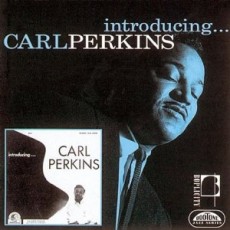
Perkins recorded on as a leader for Savoy, Duotone, and Pacific Jazz labels between 1949 and 1957 and for the Boplicity label between 1955-56 titled “Introducing Carl Perkins”. He composed the jazz standard “Grooveyard” that was recorded in a 1958 session led by Harold Land.
Over the course of his short career absent of fame and beleaguered with drug addiction, Perkins recorded with Chet Baker, Art Pepper, Dizzy Gillespie, Jim Hall and Dexter Gordon to name a few.
Carl Perkins, known to be one of the best hard bop pianist of his day, died due to an untimely drug overdose at age 29 on March 17, 1958 in Los Angeles, California.
More Posts: piano