

Daily Dose Of Jazz…
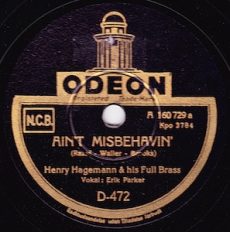
Erik Parker was born July 13, 1918 in Århus, Denmark. By 1938 he became a member of the Svend Asmussen Orchestra and from 1939 to 1945 was involved in Leo Mathisen’s Orchestra, where he performed both as an instrumentalist and a vocalist.
He worked as a club manager, and from 1945-1951 he was an actor. In 1953 he emigrated to the United States, where he settled in Los Angeles, California where he became a restaurateur and trumpet teacher.
Throughout his career he was a member of the All Danish Starband, Henry Hagemann & His Full Brass, Henry Hagemann’s Sextet, Kai Ewans And His Swinging 16, Leo Mathisens Band, Leo Mathisens Orkester, Leo Mathisens Ønskeorkester, and Roger Henrichsen Trio.
Trumpeter and vocalist Erik Parker, who is considered one of the most significant Danish jazz musicians and a distinguished representative of golden age jazz, died in 2003.

Daily Dose Of Jazz…
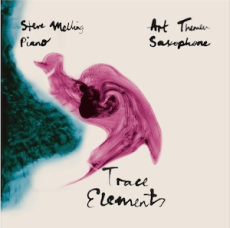
Steve Melling was born on July 12, 1959 and brought up in Preston, Lancashire, UK and began classical piano lessons at age 9. Two years later he began teaching himself jazz at around 11 years old. His first introduction to professional jazz musicians was when he asked the members of the Stan Tracey Quartet to autograph one of their vinyl albums at a Preston gig when he was 17. This fortuitous encounter would eventually lead him back to playing with them, Stan, Art Themen, Bryan Spring and Dave Green later in his career and always learn from the experiences.
Steve went on to study at Goldsmiths’ College in London, joined the National Youth Jazz Orchestra around that time and began playing professionally in the late Seventies, touring with Harry Beckett and Elton Dean. In 1986 received the first Pat Smythe Memorial Trust Award.
The Nineties had him playing regularly at Ronnie Scott’s with his trio and recording with Alan Skidmore, Claire Martin and Peter King. Melling recorded his own album Trio Duo Solo for Ronnie Scott’s Jazz House label. He was commissioned by the Appleby Jazz Festival and wrote and directed a set for an 11-piece group. He joined The New Couriers, worked with Georgie Fame and played with the European Jazz Ensemble.
Steve was commissioned by the National Youth Jazz Orchestra to arrange a piece by Stan Tracey for an album to mark their 50th Anniversary and the album was launched at Ronnie Scott’s in early 2016. The same year he moved to Derbyshire and has spent much time composing, working on his own original compositions. He is also teaching and working with local and national jazz musicians.
Pianist and composer Steve Melling remains in demand in Britain and Europe.
More Posts: bandleader,composer,history,instrumental,jazz,music,piano
Daily Dose Of Jazz…
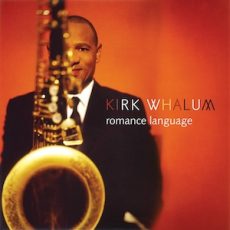
Kirk Whalum was born July 11, 1958 in Memphis, Tennessee into a musical family, singing in his father’s church choir. He got his love of music from his piano teacher grandmother and two uncles who performed with jazz bands around the country. After graduating from Melrose High School he attended Texas Southern University where he was a member of the renowned Ocean of Soul Marching Band.
By 1986 he performed at Jean-Michel Jarre’s giant concerts Rendez-Vous Houston and Rendez-Vous Lyon. Whalum would go on to record with Jevetta Steele, Luther Vandross and tour with Whitney Houston, soloing on her single I Will Always Love You.
Kirk has worked on a number of film scores, including for The Prince of Tides, Boyz n the Hood, The Bodyguard, Grand Canyon, Cousins and contributed to the 2008 documentary film Miss HIV. As a leader he has recorded a series of well received albums and has twelve Grammy nominations and his first Grammy award in 2011 for Best Gospel Song.
He is the inaugural Jazz Legend honoree of the National Museum of African American Music in Nashville, Tennessee, joined the faculty of Visible Music College and received a Brass Note on Historic Beale Street, both in Memphis.
More Posts: bandleader,flute,history,instrumental,jazz,music,saxophone,songwriter

Daily Dose Of Jazz…
Alain Samba was born on July 10th in Pointe Noire, Congo Brazzaville. His early music experiences began with him playing different kinds of percussion native to the region such as sanza (kalimba), kikongui, marimba and drums. He was influenced by listening to both African and European music. At the age of 8 he moved to France where he studied saxophone and harmony at the American School of Modern Music in Paris.
His music is inspired mostly by the jazz of Duke Ellington, John Coltrane, Charles Parker, Wes Montgomery, Nat King Cole, Ella Fitzgerald and Wayne Shorter, and the music of his native region of Congo such as bantous’ music, lari , téké , mbochi and of course the pygmies polyrhythms and polyphonies.
Since the 90’s he has performed in Paris, France clubs, and all around Europe. He created the Art Ensemble of Africa to illuminate the struggle of world citizenship with the same love of music and sharing. In Stockholm, Sweden he teaches saxophone, harmony and polyrhythms and has played with musicians from around the world based in Sweden. such as Rene Martinez, Celso Paco, Pepe Espinosa, Tropicana se, Marianne Fuglevaag, Derrick Walker, Emilio Estrada, and Jorge Arruda to name a few.
Saxophonist, composer, pianist and percussionist Alain Samba, whose main instruments are tenor and soprano saxophones, continues to mix modern jazz with traditional African music.
More Posts: bandleader,composer,history,instrumental,jazz,music,percussion,piano,saxophone

Daily Dose Of Jazz…
Sara Jacovino was born on July 9, 1983 and earned both a Bahelors and Masters degree in music from the University of North Texas. While there she studied composition with Neil Slater and Paris Rutherford and trombone with Steve Wiest and Tony Baker.
Since leaving Texas for New York City, she has entrenched herself in the jazz scene as a trombonist, composer, and arranger. who has drawn the recognition of many of her peers nationwide. She has received awards from the BMI Foundation, Downbeat Magazine, the Airmen of Note, The International Trombone Association and among others.
Sara leads her own quartet and is a member of The Birdland Big Band, The Diva Jazz Orchestra, David Berger and the Sultans of Swing, Band of Bones, The Manhattan Bridges Orchestra, and The Afro-Bop Alliance. She is an active musician in the Broadway scene performing in numerous musical productions and currently holds the tenor/bass trombone chair in “Tina, The Tina Turner Musical” at the Lunt-Fontanne Theatre.
A sought after session musician as both a lead/section trombonist and soloist. Her writing and playing is often featured by the Birdland Big Band, The Diva Jazz Orchestra, and can be heard on numerous albums by the University of North Texas One O’Clock Lab Band including: “Lab 2008,” “Lab 2007,” “Lab 2006” and “Live at Blues Alley, and by the award winning UTubes Jazz ensemble.
She enjoys working as a guest artist and clinician for University and High school jazz programs. Sara will be a guest performer and clinician at both the International Trombone Festival in 2021 and IWBC Festival in 2022.
Trombonist Sara Jacovino continues to perform, compose, arrange and continues to accept commissioned works.
More Posts: arranger,bandleader,composer,history,instrumental,jazz,music,trombone