Daily Dose Of Jazz…
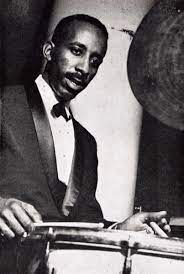
Joseph A. Venuto, Jr. was born on June 20, 1929 in Bronx, New York into an Italian immigrant family where he received his first drum kit from his grandfather. Having had lessons with Henry Adler, he moved on to Phil Kraus to learn mallet percussion. After earning a master’s degree from the Manhattan School of Music, he became a member of the Sauter-Finegan Orchestra, with whom he made his first recordings Doodletown Races on the RCA label in 1953. He was a featured soloist with the orchestra on Solo for Joe and Swingcussion. The DownBeat Reader’s Poll voted him the best vibraphonist that year.
From the mid-1950s, Venuto worked with Billy Byers in the Westchester Workshop, the Kent Harian Orchestra, Bobby Dukoff, and the Johnny Richards Orchestra before joining Radio City Music Hall as a session musician in the recording and television studios. By 1959 he recorded his debut album for Everest Records under his own name.
Between 1953 and 1975 Joe was involved in 104 recording sessions with Jack Teagarden, Kenyon Hopkins, Rex Stewart, The Creed Taylor Orchestra, Irene Kral/Al Cohn Orchestra, Mary Ann McCall, Don Costa, Hal Mooney, Ruth Brown, Gene Krupa and His Orchestra, LaVern Baker, Budd Johnson, Marion Montgomery, Benny Goodman, Shirley Scott, Solomon Burke, Gary McFarland, Johnny Hodges, Hank Jones/Oliver Nelson, and numerous more.
the early 1970s when he was in his Forties, he left New York City and moved to Reno, Nevada. He met, married, performed and recorded with his wife, harpist Bev Colgan, in a harp/vibes duo. Percussionist Joe Venuto, who also played the vibraphone, marimba, bongos and drums, transitioned on Feb. 14, 2019 at age 89.
More Posts: bongos,drums,history,instrumental,jazz,marimba,music,percussion,vibraphone

Daily Dose Of Jazz…
Pierre Favre was born June 2, 1937 in Le Locle, Switzerland. Not much is known about his childhood or his early music career.
He recorded the album Singing Drums in 1984 on the ECM label with Paul Motian and Nana Vasconcelos. He also appears on John Surman’s album, Such Winters of Memory released the year beore.
He has recorded with several well-known musicians, including Tamia, Michel Godard, Mal Waldron, Paul Giger, Jiří Stivín, Michel Portal, Irene Schweizer, Samuel Blaser, the ARTE Quartett, Barre Phillips and the London Jazz Composers Orchestra.
He has recorded six albums as a leader and drummer and percussionist Pierre Favre continues to explore his craft, perform and record.
More Posts: bandleader,drums,history,instrumental,jazz,music,percussion

Daily Dose Of Jazz…
Herbie Lovelle was born June 1, 1924 in Brooklyn, New York. His uncle was drummer Arthur Herbert. He began his career in the late 1940s with the trumpeter, singer and bandleader Hot Lips Page. By the 1950s he was playing with the saxophonist Hal Singer, Johnny Moore’s Three Blazers and the pianist Earl Hines.
Through working for both Lucky Thompson and Jimmy Rushing of Count Basie’s Orchestra, he became house drummer at the Savoy Ballroom in New York City for much of the 1950s. He toured with the tenor saxophonist Arnett Cobb and the pianist Teddy Wilson in 1954.
He contributed to the pianist Paul Curry’s album Paul Curry Presents the Friends of Fats in 1959. Then in the early years of television, Herbie performed with the King Guion Orchestra on the Jerry Lester Show and the Ed Sullivan Show. In 1966, he was the lead drummer for the Sammy Davis, Jr. TV show.
During the 1950s Lovelle began playing more R&B and worked as a studio musician recording behind Sam Taylor, Bob Dylan, Pearls Before Swine, Eric Andersen, David Blue, John Denver, Tom Rush, B. B. King, John Martyn, the Strangeloves, the McCoys, and the Monkees. He continued working as a studio musician well into the 1980s.
In 1976, he produced the first album by Stuff, which went platinum in Japan. He also played drums in the 1976 revival of Guys and Dolls. From the 1980s on he acted in film and television, on such shows as Law & Order and Third Watch. His film credits ~ A Man Called Adam, Bella, Mitchellville, The Rhythm of the Saints, Don’t Explain, The Curse of the Jade Scorpion, and Down to Earth among others.
His list of recordings as a studio musician extended across genres to some six dozen albums with jazz notables Candido Camero, Buck Clayton , Art Farmer, Herbie Mann, Sonny Stitt, Budd Johnson, Buddy Tate, Chico O’Farrill, Evie Sands, Johnny Hodges, Nat Adderley, Tony Bennett, Illinois Jacquet and numerous others. Drummer, producer and actor Herbie Lovelle transitioned on April 8, 2009 in New York City.

Requisites
The Great Jazz Trio At The Village Vanguard | By Eddie Carter
This morning’s subject submitted for your consideration is a recent addition to the library by one of the quintessential small groups in jazz. The Great Jazz Trio At The Village Vanguard (East Wind EW-8053) is the first of three live albums by Hank Jones on piano, Ron Carter on bass, and Tony Williams on drums recorded over two nights at the venue in 1977. My copy used in this report is the 1978 US Stereo release (Inner City Records IC 6013).
Side One starts the set with a speedy rendition of Moose The Mooche by Charlie Parker. The trio takes off on a lively opening chorus, succeeded by Hank who accelerates quickly on the first solo. Tony takes over for the closing statement with a fierce attack of intense heat preceding the trio’s swift climax.
Up next is Naima, John Coltrane’s beautiful ballad named for his first wife. The trio’s rendition begins with a delicately graceful piano introduction segueing into a breathtaking collective theme. Jones opens the first solo luxuriously, gaining momentum into an enticing ending. Carter displays his abundant skills on a delightful finale complemented by Williams’ gentle brushwork leading to a warm, expressive exit.
Side Two gets underway with a pretty tune by Claus Ogerman, Favors. The ensemble begins with an easygoing midtempo opening chorus. Hank is up first and lets his ideas unfold at a leisurely pace. Ron follows with a relaxing message on the second solo, then Hank and Tony share a carefree conversation leading to the ensemble’s theme reprise and soft close.
The set closes with a blues by Ron Carter, 12 + 12. After the ensemble’s happy melody, Jones kicks off the solos with an utterly joyful performance. Carter also says plenty on an impressively buoyant statement, followed by Williams who speaks last in an exchange with Jones into the theme’s reprise and Tony’s introductions of the group. The album was produced by Kiyoshi Itoh and Yasohachi Itoh. Co-Producer David Baker also was the recording engineer. He’s done a phenomenal job because the sound quality is splendid with an exquisite soundstage placing the listener’s sweet spot in the crowd as the trio’s performing. The only issue is a small typo appearing on the back cover and the Side Two record label of both the Japanese and US releases, Claus Ogerman’s name is mispronounced.
Hank Jones was regarded by critics and fans alike as one of the most gifted musicians in jazz with an extensive discography and a career lasting sixty-six years including thirty-six as a member of The Great Jazz Trio. He passed away on May 16, 2010, at age ninety-one. Ron Carter is a living legend and the most recorded jazz bassist in history. He also plays the cello, is still performing and recording, and just celebrated his eighty-fifth birthday. Tony Williams was one of the best drummers in jazz and for five years provided the power behind The Miles Davis Quintet. He passed away at age fifty-one on February 23, 1997; but leaves a lasting legacy of music as a leader and sideman. If you enjoy live jazz and are a fan of these great musicians, I invite you to check out The Great Jazz Trio At The Village Vanguard. It’s a terrific jazz album with superb performances that is sure to please novice and seasoned jazz fans alike!
~ The Great Jazz Trio At The Village Vanguard, Volume 2 (East Wind EW-8055), ~ The Great Jazz Trio At The Village Vanguard Again (East Wind UCCJ-4001) – Source: Discogs.com ~ Naima – Source: JazzStandards.com ~ Moose The Mooche – Source: Wikipedia.org © 2022 by Edward Thomas Carter
More Posts: bass,choice,classic,collectible,collector,drums,history,instrumental,jazz,music,piano

The Quarantined Jazz Voyager
Contrary to the announcement that the pandemic is over and the unmasking the country has clearly exhibited, a variant is still present and this Jazz Voyager is getting out remains distant from crowds and enclosed spaces. So we will continue to listen to great music.
My selection this week is the Complete Studio Recordings, a two compact disc set whose songs were recorded between 1956 and 1958 by the Curtis Counce Quintet composed of Counce, Jack Sheldon, Harold Land, Carl Perkins and Frank Butler went into the studio of Contemporary Records and recorded twenty-four songs. Though the group was short~lived, their impact produced a powerhouse two-disc set of music comprising the main recordings on the Contemporary label.
The group’s expressed purpose was to develop a West Coast answer to the soulful, hard-bop East Coast sound. Each of the musicians was among the most gifted on his instrument, yet the focus was always on a collaborative result that would reflect undiscovered possibilities within a familiar post-bop idiom. Seldom does a group of musicians come together and play so seamlessly that they sound like one voice speaking. The contribution of each of the five principals, therefore, invites close scrutiny.
The beauty of the recorded disc is that it is a lasting tribute to the musicians who performed on this recording. Lester Koenig at Contemporary Records was known for extremely high audio standards and turned out some of the best-sounding records of the day thanks to the expertise of engineer Roy DuNann. The audio on these Contemporary dates is rich in depth and detailing, allowing the listener to pick out each of the subordinate motifs and subtle moving harmonies. The engineering created a naturally ambient soundscape inviting the listener to partake of the worthy.
The caveat is that this music appeared on previously released albums by Curtis Counce and this is an opportunity to pick up the excellence of 24 tracks of music in a one~stop shop. This represents African-American indigenous art of the highest order. Released by Gambit Records in 2007 and definitely one for the collector.
Track Listing | 150:00+
Disc 1- Landslide (Harold Land) ~ 8:37
- Time After Time (Sammy Cahn/Jule Styne) ~ 6:32
- Mia (Carl Perkins) ~ 4:55
- Sarah (Jack Sheldon) ~ 11:38
- Fifth For Frank (Gerald Wiggins/Cal Tjader) ~ 7:14
- Big Foot (Charlie Parker) ~ 9:07
- Sonar (Kenny Clarke/Gerald Wiggins) ~ 7:28
- Stranger In Paradise (Robert Wright/George Forrest) ~ 7:04
- Woody’n You (Dizzy Gillespie) ~ 6:18
- Pink Lady (Jack Sheldon) ~ 4:41
- Councelation (Curtis Counce) ~ 6:05
- Love Walked In (George Gershwin/Ira Gershwin) ~ 4:56
- Too Close For Comfort (Larry Holofcener) ~ 5:38
- How Deep Is The Ocean (Irving Berlin) ~ 6:37
- Complete (Curtis Counce) ~ 5:52
- Nica’s Dream (Horace Silver) ~ 8:00
- How Long Has This Been Going On (George Gershwin/Ira Gerswin) ~ 3:18
- Mean To Me (Fred E. Ahlert/Roy Turk) ~ 4:31
- I Can’t Get Started (Vernon Duke/Ira Gershwin) ~ 8:01
- Larue (Clifford Brown) ~ 5:04
- Carl’s Blues (Carl Perkins) ~ 5:54
- Night In Tunisia (Dizzy Gillespie/Frank Paparelli) ~ 8:17
- Love Walked In (George Gershwin/Ira Gershwin) ~ 2:55
- Sophisticated Lady (Duke Ellington) ~ 4:10
- Fifth For Frank (Gerald Wiggins/Cal Tjader) ~ 1:56
- The Butler Did It (Frank Butler) ~ 4:39
Personnel
- Jack Sheldon ~ trumpet
- Harold Land ~ tenor saxophone
- Carl Perkins ~ piano
- Curtis Counce ~ bass
- Frank Butler ~ drums
- Gerald Wilson ~ trumpet (replaces Sheldon on three tracks of disc 2)
More Posts: adventure,album,bass,club,drums,genius,jazz,museum,music,piano,preserving,restaurant,saxophone,travel,trumpet