

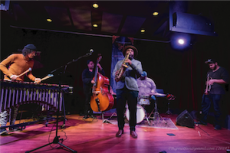
ROY HARGROVE BIRTHDAY TRIBUTE
CELEBRATING THE CO-FOUNDER OF THE JAZZ GALLERY
Jaleel Shaw ~ saxophones
Giveton Gelin – trumpet
Orrin Evans -piano
Mimi Jones -bass
Johnathan Blake –drums
With Special Guests
Renee Neufville -vocals
Tadataka Unno -piano
Justin Robinson –saxophone
Guest MC: Lezlie Harrison
Sets at 7.30pm + 9.30pm ET
$30/$10 members; cabaret seating: $40/$20 members; LIVESTREAM: $20/$5 members
More Posts: adventure,album,bass,club,drums,festival,genius,jazz,museum,music,piano,preserving,restaurant,saxophone,travel,trumpet,vocal

KENDRICK SCOTT | UNEARTHED
Kendrick Scott, composer/drums
Deborah D.E.E.P. Mouton, poet, Poet Laureate Emeritus of Houston
Robert Hodge, visual artist
Harlem String Quartet ((Ilmar Gavilán, violin; Melissa White, violin; Jaime Amador, viola; Felix Umansky, cello)
Gerald Clayton, piano; Walter Smith III, saxophone; Joe Sanders, bass
A new DACAMERA production memorializing the Sugar Land 95, bringing together original music, poetry and visuals
Unearthed pays tribute to the tragic history behind the recent discovery of the remains of 95 Black people (94 men, 1 woman) in unmarked graves in Sugar Land, Texas. They were convict laborers, swept back into “slavery by another name” in the post-Civil War era, arrested for petty crimes like vagrancy and forced into back-breaking and often fatal labor in the sugar fields of Texas.
Now, Houston native jazz artist Kendrick Scott explores this untold story in a new production, teaming up with outstanding Houston-based creative team including the former Houston poet laureate Deborah D.E.E.P. Mouton and performed by the acclaimed Harlem String Quartet and a trio of first-call jazz musicians.
More Posts: adventure,album,club,drums,festival,genius,jazz,museum,music,preserving,restaurant,travel
Daily Dose Of Jazz…
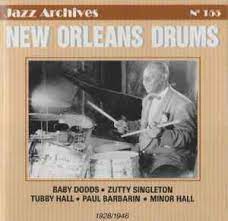
Alfred “Tubby” Hall was born October 12, 1895 in Sellers, Louisiana and his family moved to New Orleans, Louisiana in his childhood. His younger brother Minor “Ram” Hall also became a professional drummer. He played in many marching bands in New Orleans, including with Buddie Petit. His drumming style was forceful and sober, generally maintaining constant tempo on the snare.
By 1917 Hall had moved to Chicago, Illinois where he played with Sugar Johnny Smith. After two years in the United States Army, he returned to playing in Chicago mostly with New Orleans bands, joining Carroll Dickerson’s Orchestra and recording in 1927. He later played with the groups of King Oliver, Jimmie Noone, Tiny Parham, and Johnny Dodds.
He is seen in Armstrong’s Paramount movies of the early 1930s, including the live action and Betty Boop cartoon I’ll Be Glad When You’re Dead, You Rascal You and A Rhapsody in Black and Blue in 1932. Only Armstrong and Hall got closeups in the two films, and both get their faces transposed with those of racially stereotyped jungle natives in the cartoon. Hall morphs from a jazz drummer to a cannibal stirring a cooking pot with two wooden sticks.
Drummer Tubby Hall, considered one of the three greatest jazz drummers of his generation by jazz critic Hugues Panassié, along with Zutty Singleton and Baby Dodds, transitioned in Chicago, Illinois on May 13, 1945.

More Posts: drums,history,instrumental,jazz,music

Three Wishes
While having a conversation with Denis Charles the Baroness brought up the subject of three wishes and asked him if they could be granted what would he wish for and he said:
- “To be able to be playing my instrument regularly, so as to truly express myself.”
- “To be in a better position financially, so as to satisfy some of my personal wants, which I’m sure would make me much more calm inside.”
- “Lastly, to stay healthy and enjoy living.”
More Posts: baroness,drums,history,instrumental,jazz,music,pannonica,three,wishes
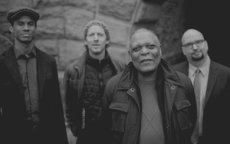
BILLY HART QUARTET
One of the leading drummers of his generation, Billy Hart continues to make jazz history with his quartet. Working with the phenomenally creative and talented pianist Ethan Iverson, saxophonist Mark Turner, and bassist Ben Street, Hart constantly seeks new territory, pushing the boundaries of post-bop and straight-ahead, of free jazz and composition, all the while embracing beauty and soulful communication. Turner’s rich, gorgeous tenor and Iverson’s exquisite technique combine to create a nearly infinite variety of textures and colors. Street and Hart have an uncanny connection that enables them to move effortlessly between swinging, tight grooves and sonic landscapes. Hart made an indelible mark on the jazz world in the ’60s and ’70s with his work with such jazz legends as Jimmy Smith, Wes Montgomery, McCoy Tyner, Wayne Shorter, Joe Zawinul, Eddie Harris, Marian McPartland, Stan Getz, Herbie Hancock, and Miles Davis. Less known is his earlier work with soul artists Otis Redding and Sam and Dave.
Mark Turner – Saxophone
Ethan Iverson – Piano
Ben Street – Bass
Billy Hart – Drums
More Posts: adventure,album,club,drums,festival,genius,jazz,museum,music,preserving,restaurant,travel