


Daily Dose Of Jazz..
Benny de Weille was born on March 6, 1915 in Lübeck, Germany. He studied clarinet under Hans Helmke and was heavily influenced by Benny Goodman, whom he often emulated in his own ensembles.
Benny made recordings with Teddy Stauffer, Hans Rehmstedt, and Willy Berking in the 1930s and 1940s. In 1940 he led his own Bar Trio. Following World War II he worked at Radio Frankfurt and conducted the Nordwestdeutscher Rundfunk Orchestra.
Clarinetist and bandleader Benny de Weille, whose last recordings were in a Dixieland style in 1951, died on December 17, 1977 in Westerland, Germany.

More Posts: bandleader,clarinet,history,instrumental,jazz,music
Jazz Poems
LISTENING TO SONNY ROLLINS AT THE FIVE SPOT There will many other nights like this be standing here with someone, some one someone some-one some some some some some some one there will be other songs a-nother fall, another–spring, but there will never be a-noth, noth anoth noth anoth-er noth-er noth-er Other lips that I may kiss but they won’t thrill me like thrill me like like yours used to dream a million dreams but how can they come when there never be a-noth– Paul BlackburnFrom Jazz Poems | Selected and edited by Kevin Young

More Posts: book,classic,collectible,history,jazz,library,poet
Daily Dose Of Jazz…
Harry Charles Prime was born on March 5, 1920 in Philadelphia, Pennsylvania. He graduated from St. Bridget’s Elementary and Roman Catholic High School. In the fall of 1944, he entered and won a singing contest at the 400 Club in Washington, D.C. and was offered a week’s engagement at the Club.
From there he proceeded to perform with big bands such as Randy Brooks, Tommy Dorsey, Jack Fina and Ralph Flanagan throughout the 1940’s and 50’s. Prime’s recording of the song Until with Tommy Dorsey sold a million records, but recording most of his hit songs with the Flanagan band.recording most of his hit songs with the latter.
In 1945, the Nations Disc Jockeys voted the Ralph Flanagan Band as the #1 band in the country and Prime was voted 20th best singer ahead of Dennis Day, Eddie Fisher and Dean Martin.
In the years following his tenure with the big bands, Prime never strayed far from the music business and worked as a disc jockey and radio host in various cities including WCAU in Philadelphia and WNPV in Lansdale.
His impeccable phrasing and vocal prowess led him to record Dear Hearts and Gentle People, Oh, What a Beautiful Morning, Nevertheless and Just One More Chance. He sits among the likes of Bob Eberle, Billy Eckstine, Dick Haymes, Frank Sinatra and Perry Como.
Prime recorded nearly 100 songs in the 1940s and 1950s, including Until, a million-seller with the Tommy Dorsey Orchestra. The song peaked at number four in the US chart.
Big band vocalist Harry Prime died on June 15, 2017 in Chalfont, Pennsylvania at age 97.
More Posts: history,instrumental,jazz,music,vocal

Daily Dose Of jazz…
David Darling was born March 4, 1941 in Elkhart, Indiana. Interested in music from an early age, he began piano when he was four, cello at ten, and string bass in high school. He studied classical cello at Indiana State University and after graduating remained there another four years as a teacher.
Working as a studio musician in Nashville, Tennessee he was a member of the Paul Winter Consort until 1978. During the following year Gus was part of the chamber jazz group Gallery with Ralph Towner and released his first solo album, Journal October. His performance and composition draw on a wide range of styles, including classical, jazz, Brazilian, African, and Indian music.
He has written and performed music for more than a dozen major motion pictures from 1988 to 2004 and recorded a collaboration with the Wulu Bunun, a group of Taiwanese aborigines. In 2007 he recorded The Darling Conversations, with Julie Weber discussing his music philosophy. He followed this in 2009 with the release of the Grammy-winning Prayer for Compassion.
In the Eighties he began his life as an educator of young children by joining Young Audiences, founded Music for People, which seeks to encourage self-expression through musical improvisation. He became part of a collaboration of music teachers and performers offering a training program in holistic and intercultural approaches to healing with sound and music at the New York Open Center Sound and Music School.
Cellist and composer David Darling died in his sleep on January 8, 2021.
More Posts: bandleader,cello,composer,history,instrumental,jazz,music
Requisites
Bass on Top ~ Paul Chambers Quartet | By Eddie Carter
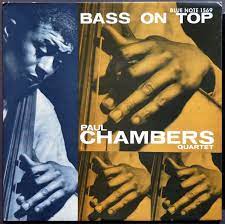
I was in the mood to hear something soothing before going to bed a few nights ago. The record I chose to play inspired my first March discussion by one of the great jazz bassists, Paul Chambers. Bass on Top (Blue Note BLP 1569/BST 81569) by The Paul Chambers Quartet is a 1957 release and his second record for the label. It was one of my mom’s favorite albums to listen to when she was cooking dinner. She always loved his big and warm sound, and his playing always knocked me out whenever I heard him. He is joined on this date by a marvelous rhythm section: Kenny Burrell on guitar, Hank Jones on piano, and Art Taylor on drums. My copy is the 2021 Blue Note Tone Poet Series Stereo Audiophile reissue, sharing the original catalog number.
Side One gets underway with Paul and Kenny’s two-instrument introduction to Yesterdays by Walter Gross and Jack Lawrence. Hank and Art come in to pick up the pace to deliver the alluring melody. The standard’s only solo is a thoughtful, reflective showcase by Paul, complemented by Hank, Kenny, and Art’s delicate accompaniment leading to the gentle ending. You’d Be So Nice To Come Home To by Cole Porter brings the beat up a few notches for the bassist’s introduction, segueing into his stating the melody supported by his colleagues. Chambers starts it off with an easy swinging interpretation, then gives way to Burrell’s unhurried statement. Jones brings on the pleasant finale before the leader’s return for the reprise and conclusion.
Chasin’ The Bird by Charlie Parker affords everyone a solo opportunity and begins with Kenny’s introduction to the group’s medium melody. Paul takes the lead with a lightly swinging solo, then Hank follows with a splendid statement. Kenny comes in next for a thoroughly satisfying reading, and Art cooks comfortably in the closer, preceding the theme’s return. Dear Old Stockholm is a Swedish folk song and jazz standard that receives a medium groove by the quartet. Kenny makes the introduction, and the ensemble joins in for the opening chorus. Chambers is up first and gives a soothing interpretation. Burrell follows with a sensitive and delicate performance; then, Jones wraps up the readings with a delightfully pleasant statement until the quartet regroups for the close.
The Theme ended many of Miles Davis’ live sets. The group opens with Kenny and Paul’s introduction to their lively melody. Paul swings right out of the gate in the opening solo. Kenny follows, maintaining the infectious beat in a vibrant statement. Hank comes in and builds the next reading exquisitely; then, Art shares the finale with Paul ahead of the climax. Confessin’, aka I’m Confessin’ That I Love You by Doc Daugherty, Ellis Reynolds and Al Neiburg begins with Paul’s introduction ahead of the foursome’s lovely opening chorus. Chambers handles the first of two interpretations flawlessly with excellent taste. Jones follows with a short solo as pleasant as a Sunday evening stroll. Chambers returns to give a brief statement that brings the set to a fitting climax.
Alfred Lion produced the original session, and Rudy Van Gelder was the man behind the dials of the recording. Joe Harley supervised this reissue’s release, and Kevin Gray mastered it. The sound quality is superb, with a breathtaking soundstage. A lot of thought and care went into the remastering of this audiophile reissue. The record is pressed on 180 grams of audiophile vinyl and is incredibly quiet until the music starts. The covers could be displayed at home on any wall, and the inside gatefold photos are wonderful. Every once in a while, something magical happens in a recording session where all the musicians come together in such a way that perfection is the result. Bass on Top by Paul Chambers is one of those albums.
Paul Chambers and his bandmates compel you to listen as they’re playing and, as the album unfolds, they provide the perfect backdrop to help you unwind after a long day, night, or week. If you’re new to jazz or only know of his work as a sideman with The Miles Davis Quintet and others. In that case, I happily recommend and invite you to check out Bass on Top by The Paul Chambers Quartet the next time you’re out record shopping. It’s a stellar album of soulful, swinging jazz at its best and a title you won’t have to listen to twice to know you love it!
~ I’m Confessin’ That I Love You, Yesterdays, You’d Be So Nice To Come Home To – Source: JazzStandards.com
~ Chasin’ The Bird, Dear Old Stockholm – Source: Wikipedia.org
© 2024 by Edward Thomas Carter

More Posts: bass,choice,classic,collectible,collector,history,instrumental,jazz,music