

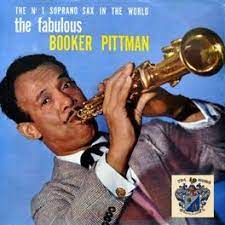
Daily Dose Of Jazz…
Booker Pittman was born on March 3, 1909 in Fairmount Heights, Maryland, was the son of Portia Pittman and a grandson of Booker T. Washington. He became an accomplished jazz clarinetist and played with greats like Louis Armstrong and Count Basie in the US and Europe in the 1920s and 1930s.
Leaving the States for the first time in 1933, he went with Lucky Millinder’s orchestra to France and stayed there for four years. During that period, he met a Brazilian musician named Romeo Silva, who took him on a tour of Brazil along with other musicians. They sailed to Bahia aboard the Siqueira Campos.
In 1937, Booker moved to Brazil, where he was known by the nickname “Buca“, and continued his musical career there, playing at the Urca Casino. He lived in Copacabana and befriended Jorge Guinle and Pixinguinha. He also played in Argentina and other countries.
He performed and recorded with his singer/actress stepdaughter Eliana Pittman. On October 19, 1969 clarinetist and saxophonist Booker Pittman, sometimes spelled Pitman, transitioned in his home in the São Paulo quarter of Vila Nova Conceição of laryngeal cancer at the age of 60. On behest of his wife Ofélia he was transferred to Rio de Janeiro and there laid to rest at the Cemitério São João Batista in the quarter of Botafogo.

More Posts: clarinet,history,instrumental,jazz,music,saxophone

Daily Dose Of Jazz…
Minor Hall was born in Sellers, Louisiana on March 2, 1897 and was the younger brother of Tubby Hall. He studied at New Orleans University until 1914, then began playing with Kid Ory in the middle of the decade. He played in various New Orleans ensembles, including the Superior Band, then moved to Chicago, Illinois in 1918. He briefly took his brother’s spot in Lawrence Duhe’s band before serving in the U.S. Army during World War I. By the time he returned, King Oliver was leading Duhe’s band, which Hall rejoined in 1921.
In 1926 he played with Jimmie Noone, then moved to California for an extended run with Mutt Carey’s Jeffersonians from 1927 to 1932. He played in the Winslow Allen Band during the Thirties, but took a hiatus from music for part of the decade. He served briefly in the Army again in 1942.
In 1945 he rejoined Ory in his Creole Jazz Band, becoming one of his most long standing members. He remained with Ory’s ensemble until 1956, when he retired on account of poor health, having never led his own recording date, though he recorded extensively with Ory and with Louis Armstrong in the 1940s.
Drummer Minor Hall, better known as Ram Hall, died in Sawtelle, California at the age of 61 on October 16, 1959.
More Posts: drums,history,instrumental,jazz,music
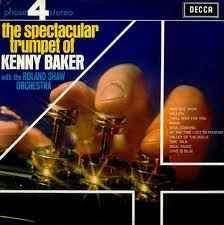
Daily Dose Of Jazz…
Kenny Baker was born on March 1, 1921 in Withernsea, East Riding of Yorkshire, England. Joining a brass band, by the age of 17 he had already become a professional musician. After leaving his home town for London, he met and began performing with George Chisholm. He was first heard on record in a British public jam session in 1941 and quickly established a strong reputation in London clubs.
After serving in the Royal Air Force during WWII, the young Baker was lead trumpeter with Ted Heath’s post war orchestra, with Bakerloo Non-Stop recorded for the Decca record label in 1946. He played a tenor saxophone solo on Johnny Gray, the piece recorded by both Baker and the drummer Jack Parnell. During the 1950s, he led his own group called Baker’s Dozen and performed on the first regular jazz show, the BBC Light Programme series Let’s Settle For Music.
During this period he regularly recorded as a quartet for Parlophone, and in the Sixties and Seventies, he was on call for film and studio work. He shared top billing with comedy variety acts, continued to appear on BBC shows, and formed the Best of British Jazz show with Don Lusher and Betty Smith. He went on to play with Frank Sinatra, Petula Clark, Sammy Davis, Jr. and Tony Bennett, as well as performing on James Bond soundtracks, with The Beatles and The Muppet Show among numerous other television shows.
Trumpeter, cornetist, flugelhornist and composer Kenny Baker, who was titled three times as best trumpet player and awarded the MBE title, died in Felpham, West Sussex on December 7, 1999 after suffering from a viral infection. He was 78.
More Posts: bandleader,composer,cornet,flugelhorn,history,instrumental,jazz,music,trumpet
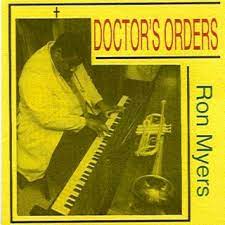
Daily Dose Of Jazz…
Ronald V. Myers, Sr. was born February 29, 1956 in Chicago, Illinois but moved with the family to Milwaukee, Wisconsin when his parents became employed as teachers in the Milwaukee Public Schools. He attended Rufus King High School in Milwaukee and was a soloist in the high school jazz ensemble on trumpet and piano.
Attending the University of Wisconsin–Madison he majored in Black Studies and was a member of the Experimental Improvisational Black Music Ensemble, under the mentorship of trombonist and professor Jimmy Cheatham. He graduated from the University of Wisconsin Medical School in 1985 and completed his residency in Family Medicine at LSU Medical Center’s Washington St. Tammany Parish Charity Hospital in Bogalusa, Louisiana in 1988.
He took part-time courses at Reformed Theological Seminary at Mississippi Valley State University in 1989 and 1990 and was ordained by Pilgrim Rest Missionary Baptist Church in Milwaukee, and commissioned by the Wisconsin Baptist Pastors Conference as a medical missionary to the Mississippi Delta.
Pianist and trumpeter Ron Myers, who was instrumental in solidifying Juneteenth as a national holiday and chairman of the National Association of Juneteenth Jazz Presenters, died on September 7, 2018.

More Posts: bandleader,history,instrumental,jazz,music,piano,trumpet
Daily Dose Of Jazz…
William Douglass was born on February 28, 1923 in Sherman, Texas. His extended family relocated to Los Angeles, California when he was six months old in an effort to escape Jim Crow laws. As a member of a musical family he took an early interest in music and when he heard drummer Gene Krupa performing Sing, Sing, Sing on the radio his path was set. He met and befriended Dexter Gordon while attending McKinley Junior High School in Los Angeles, at which point he first began playing drums.
At Jefferson High School, both he and Gordon began taking band under teacher Lloyd Reese, and took private keyboard instructions. Never taking private drum lessons, Bill eventually made the acquaintance of drummer Cozy Cole, who allowed him to watch him practice. What he learned by watching him and other drummers helped him evolve a style of his own.
While still in schoo he, Dexter and Lammar Wright, Jr. he began playing in Central Avenue night clubs. Eventually he began drumming for pianist Gerald Wiggins, along with double bass and tuba player Red Callender, until he and Callender left to form a trio with blind pianist Art Tatum.
In 1941 upon graduating from high school he enlisted in the United States Army and was assigned to the Black 10th Cavalry Regiment at Camp Lockett. This led to his start to seeing the world being stationed in Casablanca, Oran, Algiers, Naples and Rome. During these travels, Bill became drum major of his 28-piece ensemble, a position he attributed to his great height.
Leaving the service he went on to a stint with Benny Goodman, where he was at the time the only black member of the band. Bill eventually became part of the union struggle for integration and equality. Even as a working musician, Douglass expanded into teaching drums at Drum City. Among his students, were Ray Brown, Jr., Karen Carpenter, and Ella Fitzgerald.
Drummer and educator Bill Douglass, who was an active proponent of desegregation in the American Federation of Musicians, died on December 19, 1994.
More Posts: bandleader,drums,history,instrumental,jazz,music