

Daily Dose Of Jazz…
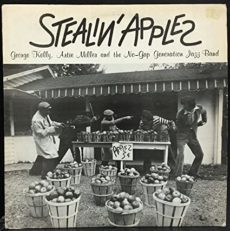
George Kelly was born on July 31, 1915 in Miami, Florida. In the 1930s Panama Francis was a sideman in Kelly’s band. During the Forties, he played in Al Cooper’s band.
Kelly played in Francis’s Savoy Sultans band in the 1970s, and had played of the same name in the 1940s. Leading his own bands he was also a sideman who worked with Tiny Grimes, Rex Stewart, and Cozy Cole.
Tenor saxophonist, vocalist, bandleader, and arranger George Kelly, who recorded seven albums as a leader, passed away at the age of 82 on May 24, 1998.

More Posts: arranger,bandleader,history,instrumental,jazz,music,saxophone,vocal
Daily Dose Of Jazz…
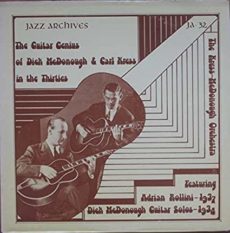
Richard Tobin McDonough was born on July 30, 1904 in New York City and began playing banjo and mandolin in high school. While matriculating through Georgetown University, he performed professionally at weekend dances and two years later started a band. Attending Columbia Law School he played with bands in New York City.
McDonough played with Red Nichols in 1927 as a banjoist, and soon after played with Paul Whiteman. He began studying the guitar and eventually was in demand for session work, recording with The Dorsey Brothers, Red Nichols, and Miff Mole. In the 1930s, he performed in a duo with jazz guitarist Carl Kress and cut several sessions with an orchestra under his own name, in addition to backing numerous other recording artists.
His session work with Mildred Bailey, Smith Ballew, The Boswell Sisters, Rube Bloom, Chick Bullock, The Charleston Chasers, Cliff Edwards, Gene Gifford, Benny Goodman, Adelaide Hall, Annette Hanshaw, Billie Holiday, Baby Rose Marie, Glenn Miller, Irving Mills, Red McKenzie, Johnny Mercer, Red Norvo, Fred Rich, Adrian Rollini, Pee Wee Russell, Ben Selvin, Artie Shaw, Frank Signorelli, Jack Teagarden, Claude Thornhill, Frankie Trumbauer, Joe Venuti, Don Voorhees, and Ethel Waters. He played in the Jam Session at Victor with Fats Waller, Bunny Berigan, and George Wettling.
Struggling with alcohol abuse during his adult life and guitarist Dick McDonough passed away of pneumonia on May 25, 1938 in New York City.
More Posts: bandleader,guitar,history,instrumental,jazz,music,tenor banjo

Daily Dose Of Jazz…
Patricia Dean was born in Tampa, Florida on July 29th and went through her banging on pots and pans stage listening to drummer/singer Karen Carpenter’s records until she got a drum set and began studying privately and really playing, at the age of 11. Growing up she was literally and figuratively surrounded by music while growing up, her father a recorded clarinetist and alto saxophonist and musicians were always around. She played her first professional job with her father and brother when she was fourteen.
One of the few artists in the history of jazz who play drums and sing, Dean does both at an exceptional level. As a drummer, she’s an inspiring and supremely tasteful time-keeper, accompanist, and soloist and as a vocalist, she swings with sensitivity and is a heartfelt ballad singer and evocative interpreter of Brazilian melodies.
Patricia cites Sarah Vaughan, Shirley Horn, Nancy Wilson, and Julie London as among her singing influences. Careful listeners may hear some overtones of Dinah Washington who, of course, greatly influenced Nancy Wilson and Betty Roche. Her drumming influences in addition to Carpenter are Ed Thigpen, Jack DeJohnette, Tony Williams, and Sonny Payne.
Through the years, she has worked with a number of jazz legends, including Nat Adderley, Ira Sullivan, Whitey Mitchell, Bobby Militello, and the late John LaPorta. Drummer Patricia Dean continues to perform and record.
More Posts: bandleader,drums,history,instrumental,jazz,music
Daily Dose Of Jazz…
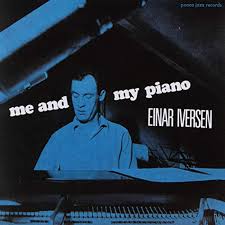
Einar Iversen was born on July 27, 1930 in Mandal Municipality, Norway and was raised in Oslo, Norway where he studied classical piano under Inge Rolf Ringnes, Artur Schnabel, and Finn Mortensen. He quickly established himself on the Oslo jazz scene in 1949 and released his first album with Rowland Greenberg’s orchestra in 1953.
In the 1950s he played with Dizzy Gillespie, Anthony Ortega, and the Modern_Jazz_Quartet”>Modern Jazz Quartet. He was a regular pianist at Metropol Jazz Club in the Sixties, where he played with Dexter Gordon, Coleman Hawkins, Johnny Griffin, Svend Asmussen, and Stuff Smith in Sweden. As a leader, Einar recorded an album in 1967 leading his own E. I. Trio, Me and My Piano, plus five more. His sideman duties had him performing with Swedish Putte Wickman, Monica Zetterlund, and Povel Ramel on tour in 1978. In Norway, he participated in a number of releases with Bjarne Nerem, Egil Johansen, Totti Bergh, Nora Brockstedt, and Ditlef Eckhoff.
Pianist and composer Einar Iverson, who became one of the most respected Norwegian jazz musicians, awarded Buddyprisen and the Knight of First Class of the Order of the St. Olavs, passed away on April 3, 2019 in Oslo, Norway at the age of 88.
More Posts: bandleader,composer,history,instrumental,jazz,music,piano
Daily Dose Of Jazz…
Rudy Collins was born on July 24, 1934 in New York City, New York. He played trombone in high school and started on drums at that time as well. From 1953 to 1057 he studied with drummer Sam Ulano.
He began gigging in New York City, playing with Hot Lips Page, Cootie Williams, Eddie Bonnemere, Dizzy Gillespie, Johnny Smith, Carmen McRae, Cab Calloway, and Roy Eldridge. At the Newport Jazz Festival, Rudy performed with J.J. Johnson and Kai Winding.
Later in the 1950s, Collins became increasingly interested in the budding free jazz scene, in addition to playing with more traditional ensembles. He worked with Herbie Mann from 1959 and later with Cecil Taylor, Quincy Jones, Dave Pike, and Lalo Schifrin.
He recorded with Ahmed Abdul-Malik, Gene Ammons, Ray Bryant, Billy Butler, Junior Mance, James Moody, the Jimmy Owens-Kenny Barron Quintet, Randy Weston, and Leo Wright. Drummer Rudy Collins, whose last recordings were in 1981, passed away on August 15, 1988.
More Posts: drums,history,instrumental,jazz,music