

Requisites
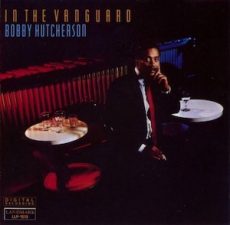
In The Vanguard ~ Bobby Hutcherson | By Eddie Carter
This morning’s discussion arose because I’ve been listening intensely to several great vibraphonists in my library recently, leading me to an underrated live album by Bobby Hutcherson. In The Vanguard (Landmark Records LLP-1513) hit the stores in 1987 and documents excerpts of his performance over two December nights the year before at the Village Vanguard. Bobby was the first artist Orrin Keepnews signed for his new record label; this was his third release. The quartet consists of Bobby Hutcherson on the vibraphone and marimba, Kenny Barron on piano, Buster Williams on bass, and Al Foster on drums. My copy is the original U.S. Stereo album.
The opener, Little Niles by Randy Weston, is a jazz waltz. The quartet gets things off to a spirited start with their melody. Bobby opens the soloing with an infectiously swinging groove. Kenny keeps the lyricism intact with a compelling case ahead of the theme’s restatement and close. Estaté by Bruno Martino and Bruno Brighetti is up next. Williams and Hutcherson set the song in motion with a pretty introduction. Barron and Foster enter next to add sensitive warmth to the gorgeous melody. Bobby’s opening solo is beautiful; then Kenny articulates his ideas tenderly while Buster and Al hold everything together into the quartet’s graceful climax.
Well, You Needn’t by Thelonious Monk and Mike Ferro opens with Bobby’s introduction before the ensemble’s theme takes off quickly. Bobby is out of the gate first with an exhilarating reading. Kenny steps up next to play with exciting urgency. Buster and Al share a moment in the closer, preceding the foursome’s return with a quick resolution. Side Two starts with Some Day My Prince Will Come by Frank Churchill and Larry Morey. The ensemble establishes the song with a quaint melody that moves upward for Hutcherson’s opening solo. Barron turns in an exquisite performance next, and Williams provides a superbly conceived finale, one of the album’s highlights before the reprise and ending.
Witchcraft by Cy Coleman and Carolyn Leigh begins with a two-instrument dialogue between Bobby and Buster, segueing into the quartet’s lovely melody. Bobby kicks off the solos with a stream of imaginative ideas. Kenny takes the reins, gliding to the rhythm section’s buoyant beat ahead of the song’s conclusion. I Wanna Stand Over There by Bobby Hutcherson is off to the races during the quartet’s upbeat theme. Barron comes right out of the gate, bristling with energy. Hutcherson follows with a hard-driving interpretation; then Foster provides the album’s final fireworks in a short solo ahead of the theme’s restatement and climax.
In The Vanguard is a digital recording produced by Orrin Keepnews and Tom Mark, the recording engineer. George Horn mastered the album, and Danny Kopelson provided the digital transfer, editing and sequencing at Fantasy Studios. The album’s sound quality is exceptional, capturing the live energy and ambiance of the Village Vanguard. The listener becomes a part of the audience as the musicians perform with crystal-clear fidelity. Despite its high-quality performance and recording, this album is often overlooked in Bobby Hutcherson’s discography. But please don’t let that discourage you from checking out In The Vanguard by Bobby Hutcherson the next time you’re out record shopping. It’s a jazzy treat for your ears and an absolute pleasure to listen to, especially if you enjoy live jazz albums!
Postscript: Estaté is listed on the Side One label and back album cover with two composers, Bruno Martino, and Bruno Brighetti. I have no idea why this happened, but they are the same man, Bruno Martini. He was an Italian composer, pianist, singer, and songwriter. Estaté was his best-known composition; many jazz musicians and vocalists have recorded it since its first appearance in 1960. Martino’s career lasted fifty-five years; he died on June 12, 2000, at age seventy-four.
~ Bruno Brighetti, Bruno Martino – Source: Discogs.com
~ Some Day My Prince Will Come – Source: JazzStandards.com
~ Little Niles, Witchcraft – Source: Wikipedia.org
© 2024 by Edward Thomas Carter

More Posts: choice,classic,collectible,collector,history,instrumental,jazz,music,vibraphone
Jazz Poems
ART PEPPER
It’s the broken phrases, the fury inside him.
Squiggling alto saxophone playing out rickets
And jaundice, a mother who tried to kill him
In her womb with a coat hanger, a faltering
God-like father. The past is a bruised cloud
Floating over the houses like a prophecy,
The terrible foghorns off the shore at San Pedro.
Lightning without thunder. Years without playing.
Years of blowing out smoke and inhaling fire,
Junk and cold turkey, smacking up, the habit
Of cooking powder in spoons, the eyedroppers,
The spikes. Tracks on both arms. Tattoos.
The hospital cells at Fort Worth, the wire cages
In the L.A. County, the hole at San Quentin.
And always the blunt instrument of sex, the pain
Bubbling up inside him like a wound, the small
Deaths. The wind piercing the sheer skin
Of a dark lake at dawn. The streets at 5 a.m.
After a cool rain. The smoky blue clubs.
The chords of Parker, of Young, of Coltrane.
Playing solo means going on alone, improvising,
Hitting the notes, ringing the changes,
It’s clipped phrasing and dry ice in summer,
Straining against the rhythms, speeding it up,
Loping forward and looping back, finding the curl
In the wave, the mood in the air. It’s
Splintered tones and furious double timing.
It’s leaving the other instruments on stage
And blowing freedom into the night, into the faces
Of emptiness that peer along the bar, ghosts
Shallow hulls of nothingness, Hatred of God.
Hatred of white skin that never turns black.
Hatred of Patti, of Dianne, of Christine.
A daughter who grew up without him, a stranger.
Years of being strung out, years without speaking.
Pauses and intervals, silence. A fog rolling
Across the ocean, foghorns in the distance.
A lighthouse rising from the underworld.
A moon swelling in the clouds, an informer,
A twisted white mouth of light. Scars carved
And criscrossed on his chest. The memory
Of nodding out, the dazed drop-off into sleep.
And then the curious joy of surviving, joy
Of waking up in a dusky room to a gush
Of fresh notes, a tremoring sheet of sound.
Jamming again. Careening through the scales
For the creatures who haunt the night.
Bopping through the streets in a half-light
With Laurie on his arm, a witness, a believer.
The night is going to burst inside him.
The wind is going to break loose forever
From his lungs. It’s the fury of improvising,
Of going on alone. It’s the fierce clarity
Of each note coming to an end, distinct,
Glistening. The alto’s full-bodied laughter
The white grief-stricken wail.
EDWARD HIRSCH
from Jazz Poems ~ Selected and Edited by Kevin Young

More Posts: book,classic,collectible,history,jazz,library,poet
Requisites
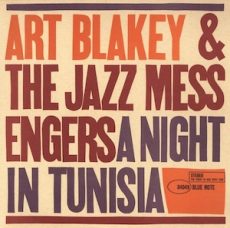
A Night In Tunisia ~ Art Blakey and The Jazz Messengers | By Eddie Carter
This morning’s record from the library is an exceptional jazz album where the musicians complement each other behind the iconic drummer Art Blakey. A Night In Tunisia (Blue Note BLP 4049/BST 84049) is a 1961 release that is not just one of the best LPs in The Jazz Messengers discography but a historical treasure that is better experienced than described. In the spotlight with Art on this date are Lee Morgan on trumpet, Wayne Shorter on tenor sax, Bobby Timmons on piano, and Jymie Merritt on bass. The 1978 King Record Company Japanese Stereo reissue is my copy (Blue Note BST 84049 – GXK 8041).
A Night In Tunisia by Dizzy Gillespie and Frank Paparelli starts swinging with Art’s lively introduction to the quintet’s brisk melody. Wayne launches into a hard-driving interpretation, showcasing his technical prowess and emotional depth. Lee continues cooking with energetic exuberance, his trumpet work adding a vibrant layer to the tune. Jymie demonstrates his skillful command of the bass, walking with authority in a short solo. Art fuels the finale with intense emotion ahead of the theme’s vigorous restatement.
The ensemble eases to a medium melody for Sincerely Diana by Wayne Shorter, stepping aside for the saxophonist’s bluesy opening statement. Morgan carries himself well in the following reading, his trumpet work adding a soulful touch. Then, Timmons delivers a delightfully relaxed performance, his piano playing adding a smooth, jazzy feel. Blakey provides a memorable exclamation point ahead of the closing chorus, his drumming adding a dynamic energy to the piece.
So Tired by Bobby Timmons starts Side Two at a medium tempo, with a boogaloo flavor for the ensemble’s theme. Wayne gives the opening solo an unmistakable melodic charm. Lee next illustrates a splendid study in soulful improvisation; then Bobby hits an ideal groove, leading to the theme’s restatement and graceful fadeout. Yama is the first of two originals by Lee Morgan, and the quintet’s melody is a model of uncomplicated beauty. Timmons is up first and shows his soloist capabilities to fine advantage here in a gentle performance. Morgan responds with a tender, tasteful presentation next. Shorter culminates the solos with an affectionately intimate reading over the trio’s lush foundation into the song’s soothing ending.
Art’s drums kick off the album closer, Kozo’s Waltz by Lee Morgan. The complete ensemble joins in for the medium-fast theme. Wayne gets things underway with a passionate opening statement. Lee responds with an exciting interpretation; Timmons follows with a few intriguing choruses. Art puts his stamp on the closing solo with a sizzling beat before the return to the theme. Alfred Lion produced the initial session, and Rudy Van Gelder was the recording engineer, both of whom were instrumental in capturing the quintet’s energy and chemistry. This King Record Company reissue has a spectacular soundstage that transports the musicians to the sweet spot in your listening room with stunning fidelity. If you’re a hard bop fan, I happily recommend A Night In Tunisia for a place in your jazz library. It’s a gem by Art Blakey and The Jazz Messengers that no jazz enthusiast should miss on their next shopping trip!
~ A Night In Tunisia – Source: JazzStandards.com
© 2024 By Edward Thomas Carter
More Posts: choice,classic,collectible,collector,drums,history,instrumental,jazz,music
Jazz Poems
LUSH LIFE
I used to visit all the very gay places,
Those come-what-may places,
Where one relaxes on the axis of the wheel of life
To get the feel of life
From jazz and cocktails.
The girls i knew had sad and sullen gray faces,
With distingué traces
That used to be there.
You could see where
They’d been washed away
By too many through the day
Twelve o’clock tails.
Then you came along
With your siren song
To tempt me to madness.
I thought for a while
That your poignant smile
Was tinged with the sadness
Of a great love for me.
Ah, yes, I was wrong,
Again, I was wrong!
Life is lonely again,
And only last year
Ev’rything seemed so sure.
Now life is awful again,
A troughful of hearts could only be a bore.
A week in Paris will ease the bite of it.
All I care is to smile in spite of it.
I’ll forget you, I will,
While yet you are still
Burning inside my brain.
Romance is mush, stifling those who strive.
I’ll live a lush life in some small dive,
>And there I’ll be, while I rot with the rest
Of those whose lives are lonely too.
BILLY STRAYHORN
from Jazz Poems ~ Selected and Edited by Kevin Young
More Posts: book,classic,collectible,history,jazz,library,poet
Requisites
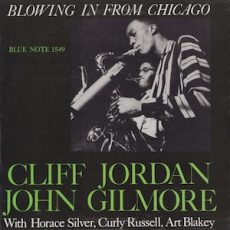
Blowing In From Chicago ~ Cliff Jordan & John Gilmore | By Eddie Carter
As a youngster discovering this music, I was always captivated by jazz’s unique and spontaneous nature, particularly the ‘blowing session’ or ‘jam session.’ These impromptu performances, where musicians control the flow of musical ideas from moment to moment, are a testament to the music’s excitement and unpredictability. Whether in a live setting at a club, concert, or jazz festival or captured in a studio session, jazz’s enthusiasm, vitality, and freedom are always present.
This morning’s choice from my library is an excellent LP from 1957 by two tenor saxophonists who made significant impressions in jazz, Clifford Jordan and John Gilmore. Their only album as co-leaders is titled Blowing In From Chicago (Blue Note BLP 1549), which signifies their roots in the vibrant jazz scene of Chicago. The quintet has an excellent rhythm section consisting of Horace Silver on piano, Curly Russell on bass, and Art Blakey on drums. My copy is the 1983 Pathé Marconi-EMI French Mono reissue, sharing the original catalog number. Before I proceed, let me state that this is not a DMM (Digital Metal Mastering) pressing.
The album opener, Status Quo, is a lively tune by John Neely, with both horns leading the charge through the uptempo melody. John rips into the opening solo, aggressively slicing through each verse like a sharp blade. Clifford joins him next in a short exchange, then takes off with a supercharged reading. Horace shifts into high gear on the third statement with a blazing swiftness that’s equally inspired and scintillating. Art engages in a brief conversation with both horns, then brings the solos to a close with an electric performance illustrating his incomparable artistry before the ensemble returns to the theme and quick stop. The first of two originals by Jordan follows.
Bo-Till slows the tempo to a laid-back pace with a Latin flavor. After a short introduction by the trio, the quintet states the theme collectively, stepping aside for Jordan, who makes a profound impression with a beautifully conceived statement displaying a great tone throughout. Silver gets into the groove next with an incredible, smooth reading, one of his best on the album. Gilmore delivers the closing choruses of the song proficiently with meticulous execution. Blakey constructs a concise comment during the ensemble’s end theme and close.
Blue Lights by Gigi Gryce is a catchy tune that opens with the quintet laying down a gorgeous medium beat on the theme and gives everyone a solo opportunity. John steps into the spotlight with a spirited performance. Horace follows with notes of undeniable pleasure in one of his most robust solos. Clifford weaves his way through the next musical improvisation with astounding skill. Curly puts together a condensed reading that walks for one chorus with solid bass lines. Art breezes into a straightforward interpretation that culminates into a splendid summation of the first side.
The second side gets underway with Charlie Parker’s Billie’s Bounce, which gives everyone except Russell a lengthy solo canvas on which to work. Blakey begins with a high-voltage introduction that sets the pace for the following fiery quintet theme. Clifford packs a mighty punch on the opening statement with a fire-breathing showcase, preceding John, who exhibits a robust attack on the subsequent interpretation with extremely hot choruses. Horace takes over next for a scintillating performance, taking his piano on a sizzling uptempo ride. Both horns exchange a few riffs with Art before the drummer gives an unaccompanied propulsive exhibition into the ending theme.
Clifford’s second original is a blues titled Evil Eye, which eases the throttle back from the previous burner to a medium pace with a collective melody by the quintet. Jordan opens the solos with a series of choruses that are smooth and well-structured. In the following presentation, Gilmore shows that he can also interpret blues with plenty of soul, which develops nicely. Silver delivers a lightly swinging performance that expresses pleasure as he moves masterfully through each chorus. Both horns return to share a few more thoughts. Blakey makes a short statement preceding the theme’s reprise and finish.
The album’s final track is Everywhere, a mid-tempo original by Horace Silver, which I believe made its debut on this album. It opens with a simple opening melody by the ensemble in unison, and the solo order is Gilmore, Jordan, Silver, and Blakey. John takes the stage first with a bewitchingly delightful opening statement. Clifford makes his case with a captivating contribution that moves sprightly alongside the rhythm section’s groundwork drive. Horace takes over next, communicating his points well with a pronounced beat. Art puts the joyous exclamation point on the song and album with a compelling statement that leads the group back to the ending theme and close.
Clifford Jordan recorded three albums for Blue Note; the other two LPs are Cliff Jordan and Cliff Craft. He played and recorded with many elite jazz musicians, including Charles Mingus and Max Roach. Clifford also enjoyed success recording as a leader and sideman, and in my opinion, his discography is well worth investigating. He remained in demand over the next three decades and toured worldwide. His final album was a 1992 live recording at Condon’s in New York City for Milestone, where he performed with his big band, Down Through The Years. He lost his battle against lung cancer on March 27, 1993, at age sixty-one.
Blowing In From Chicago was the first of three appearances on Blue Note by John Gilmore. The other two were as a sideman on two of Andrew Hill’s LPs, Andrew and Compulsion. He began playing the clarinet at fourteen, then pursued a musical career after a four-year stint in the United States Air Force, where he took up and played the tenor saxophone. He began a forty-year term with Sun Ra in 1953 and recorded for various labels with his group, Sun Ra Arkestra. During this time, Gilmore also toured with The Jazz Messengers and recorded with Paul Bley, Andrew Hill, Pete LaRoca, McCoy Tyner, and Dizzy Reece. After Sun Ra’s death on May 30, 1993, Gilmore led the Arkestra for two years before his death from emphysema on August 20, 1995, at age sixty-three.
As for the music on Blowing In From Chicago, it’s fantastic, as are the solos on each track, and the sound quality of this reissue is exemplary. The instruments deliver an excellent soundstage throughout the treble, midrange, and bass that places your sweet spot in the studio with the musicians. It’s a cut above the average debut album and a title I recommend as a terrific addition to any jazzophile’s library, particularly if you’re a hard-bop fan or love a good “blowing session” or “jam session.”
~ Andrew (Blue Note BLP 4203/BST 84203), Cliff Jordan (Blue Note BLP 1565), Cliff Craft (Blue Note BLP 1582/BST 81582), Compulsion (Blue Note BLP 4217/BST 84217), Down Through The Years (Milestone MCD-9197-2) – Source: Discogs.com
~ Billie’s Bounce – Source: JazzStandards.com
~ John Gilmore, Andrew Hill, Clifford Jordan – Source: Wikipedia.org
© 2024 by Edward Thomas Carter
More Posts: choice,classic,collectible,collector,history,instrumental,jazz,music,saxophone