


Daily Dose Of Jazz…
John “Bugs” Hamilton was born on March 8, 1911 in St. Louis, Missouri.
Leaving home for New York City in 1930 he was a member of trombonist Billy Kato band and played with Chick Webb around the same time for about a year.. Toward the middle of the decade he played with Kaiser Marshall, then joined Fats Waller’s ensemble in 1938. Bugs remained with Waller until 1942, touring, recording and often appearing in several films as a member of Waller’s group.
During World War II he played with Eddie South and Roy Eldridge. Shortly after the end of the war, trumpeter John Hamilton contracted tuberculosis, resulting in his death at age 36 on August 15, 1947 in St. Louis.

More Posts: history,instrumental,jazz,music,trumpet

JEAN CAZE
Jean Caze, a Haitian American trumpeter from Queens, N.Y., is one of today’s most captivating new musicians in jazz. He has performed with legends including Herbie Hancock, Aretha Franklin, Michael Bublé and Mariah Carey. Caze’s unique style blends his Haitian roots with his American jazz education, offering audiences an unparalleled musical experience.
Starting trumpet at age 9, Caze quickly developed a passion that led to numerous scholarships and awards, including at the National Trumpet Jazz Competition and the International Trumpet Guild Jazz Competition. He earned his bachelor’s degree from the Manhattan School of Music and a master’s from Florida International University (FIU).
Caze has toured globally with Bublé and released two self-produced albums, Miami Jazz Scene and Amédé. He is also a dedicated educator, teaching at institutions including the Litchfield Jazz Camp and FIU. Caze continues to inspire and elevate the jazz world with his sophisticated and rootsy style.
Admission: Free
More Posts: adventure,bandleader,genius,instrumental,jazz,music,preserving,travel,trumpet

WALLACE RONEY JR. QUARTET
Growing up surrounded by the sounds of jazz and melodies that filled every corner of his home, Roney Jr. found his passion for the trumpet at an early age. Inspired by legendary players like Kenny Dorham, Miles Davis, Freddie Hubbard, Woody Shaw, and Lee Morgan, he quickly developed an intense love for the craft. At just 10 years old, his dedication to learning harmony and his eagerness to play led his father to gift him his very first trumpet—a moment that would set the stage for his musical journey.
Since then, Wallace Roney Jr. has graced stages alongside jazz luminaries such as Chick Corea, Jimmy Heath, Lenny White, Buster Williams, and the late Ornette Coleman. A proud graduate of the prestigious Oberlin Conservatory of Music, he continues to captivate audiences at venues across the U.S. and around the globe. Today, Roney Jr. is one of the most sought-after trumpeters in the New York jazz scene, known for his dynamic performances and deep understanding of the genre.
Music runs deep in Roney Jr.’s veins. As the son of renowned trumpeter Wallace Roney Sr. and the universally celebrated pianist Geri Allen, his artistry is both a reflection of his family’s rich musical legacy and a testament to his own extraordinary talent.
More Posts: bandleader,club,genius,jazz,music,preserving,travel,trumpet

ARTEMIS
ARTEMIS is a powerful ensemble of modern jazz masters, founded in 2017 by pianist and musical director Renee Rosnes. In Real Time––the band’s second release on Blue Note Records––has been garnering universal acclaim. NPR wrote that “it further establishes their prowess both as individuals and as a collective…a femme fatale supergroup,” and from the Times of London, “robust voicings, free-jazz diversions and searching modal patterns all feature in the intricate style of ARTEMIS…so distinctive is each voice and so striking is their sense of unity.” DownBeat hailed the music as “deep swinging” and a “stellar follow up” to the band’s debut album in 2020. Each musician is a bandleader and composer and every performance encompasses inspired arrangements of classics and originals.
Renee Rosnes ~ piano & keyboard
Ingrid Jensen ~ trumpet
Nicole Glover ~ tenor saxophone
Noriko Ueda ~ bass
Allison Miller ~ drums
Tickets: $35.00 ~ $45.00 + fee | Streaming: $15.00 + fee
More Posts: adventure,bandleader,bass,club,drums,genius,instrumental,jazz,music,piano,preserving,saxophone,travel,trumpet
Requisites
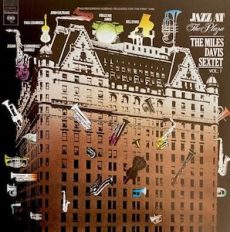
Jazz at The Plaza, Volume 1 ~ The Miles Davis Sextet | By Eddie Carter
Submitted for your approval this morning is the first of two unique 1973 albums, capturing an unforgettable event. Jazz at The Plaza, Volume 1 (Columbia C 32470) is a live recording of a jazz party hosted by Columbia Records in The Persian Room of New York City’s Plaza Hotel on September 9, 1958. This celebration represented a significant moment in Columbia’s history, acknowledging the impressive talent of jazz artists on the label’s roster. The guests enjoyed a performance by The Miles Davis Sextet during the first set: Miles Davis on trumpet, Julian “Cannonball” Adderley (tracks: A1, B2) on alto sax, John Coltrane (A1, B1, B2) on tenor sax, Bill Evans on piano, Paul Chambers on bass, and Jimmy Cobb on drums. My copy is the original U.S. Stereo release.
The album opener is misidentified as Jazz at The Plaza on the back cover and record label, but it is Thelonious Monk’s Straight, No Chaser. The song’s brisk pace sets the stage for the sextet’s lively introduction and theme. Miles delivers a vigorous opening statement, followed by John’s adventurous interpretation. Cannonball provides an energetic solo next. Bill makes a concise contribution before the ensemble returns for the finale and a brief presentation of the sextet’s theme. The pace slows for Bill’s introduction to the Rodgers and Hart classic My Funny Valentine. This highlight of the quartet sees Miles switching to the mute for the gentle melody and a beautiful solo. Bill follows with an enchanting statement, and Paul walks delicately toward the closing chorus and sensitive climax.
If I Were a Bell by Frank Loesser opens the second side with a short piano introduction that segues into the ensemble’s medium melody. Miles takes the lead with an agile, muted opening statement. John continues wailing in a spirited performance. Bill sinks his teeth into a captivating interpretation next, leading to the theme’s restatement and conclusion. Oleo by Sonny Rollins raises the tempo for Miles’s muted introduction, which leads to the sextet’s quick theme. Miles starts the opening statement with infectious heat, while John fuels the following performance with electrifying notes. Cannonball launches into a furiously hard-driving solo next, and then Bill keeps the fire burning with a concise comment. Paul has his turn in a short interlude before Miles guides the way to a speedy culmination.
Teo Macero and Irving Townsend produced Jazz at The Plaza, Volume 1, with recording engineer Russ Payne capturing the event for posterity. While the sound quality may not meet Columbia’s usual high standards, its unique charm conveys the exhilarating energy of the group’s performances. After listening to this album, I’ll be looking to find its companion, Jazz at The Plaza, Volume 2, featuring Duke Ellington and His Orchestra, Billie Holiday, and Jimmy Rushing. If you appreciate the trumpeter’s work from the fifties, I recommend exploring Jazz at The Plaza, Volume 1 by The Miles Davis Sextet, on your next record hunt. It offers a compelling snapshot of the ensemble’s fiery live performance and should make a worthy addition to any jazz enthusiast’s library!
Postscript: The owners of the long-out-of-print Mosaic Records box set, The Complete Columbia Recordings of Miles Davis With John Coltrane, also has a copy of Jazz at The Plaza, Volume 1.
~ Jazz at The Plaza, Volume 2 (Columbia C 32471), The Complete Columbia Recordings of Miles Davis With John Coltrane (Mosaic Records MQ9-191) – Source: Discogs.com
~ Straight, No Chaser – Source: JazzStandards.com
~ If I Were a Bell – Source: Wikipedia.org
© 2025 by Edward Thomas Carter

More Posts: choice,classic,collectible,collector,history,instrumental,jazz,music,trumpet